
How to Reconstitute Peptides in 9 Simple Steps — A Complete Laboratory Guide
How to reconstitute peptides correctly is one of the most important practical skills in research peptide laboratory work. This complete step-by-step guide covers solvent selection, reconstitution technique, storage, and the most common mistakes researchers make.
📁 Laboratory Best Practice |
⏱ 7 min read
Knowing how to reconstitute peptides correctly is one of the most critical — and most frequently overlooked — practical skills in research peptide laboratory work. The peptide in your vial is only as useful as the technique used to prepare it. Incorrect solvent selection, poor handling technique, or improper post-reconstitution storage can reduce peptide yield, alter bioactivity, introduce experimental confounds, and compromise the reproducibility of your research data — regardless of how pure the peptide itself is.
This guide covers everything researchers need to know about how to reconstitute peptides in a laboratory setting — from solvent selection and step-by-step technique to post-reconstitution storage and the most common mistakes. All reconstitution supplies referenced are available from PrimaLab Peptide’s Accessories & Reconstitution Supplies section.
Table of Contents
What Is Peptide Reconstitution?
Research peptides are supplied in lyophilized (freeze-dried) powder form — a stable, dry state produced by removing water from the peptide under vacuum at low temperature. Lyophilization dramatically extends shelf life compared to aqueous peptide solutions, improves stability during shipping and storage, and allows researchers to reconstitute peptides to their exact required working concentration.
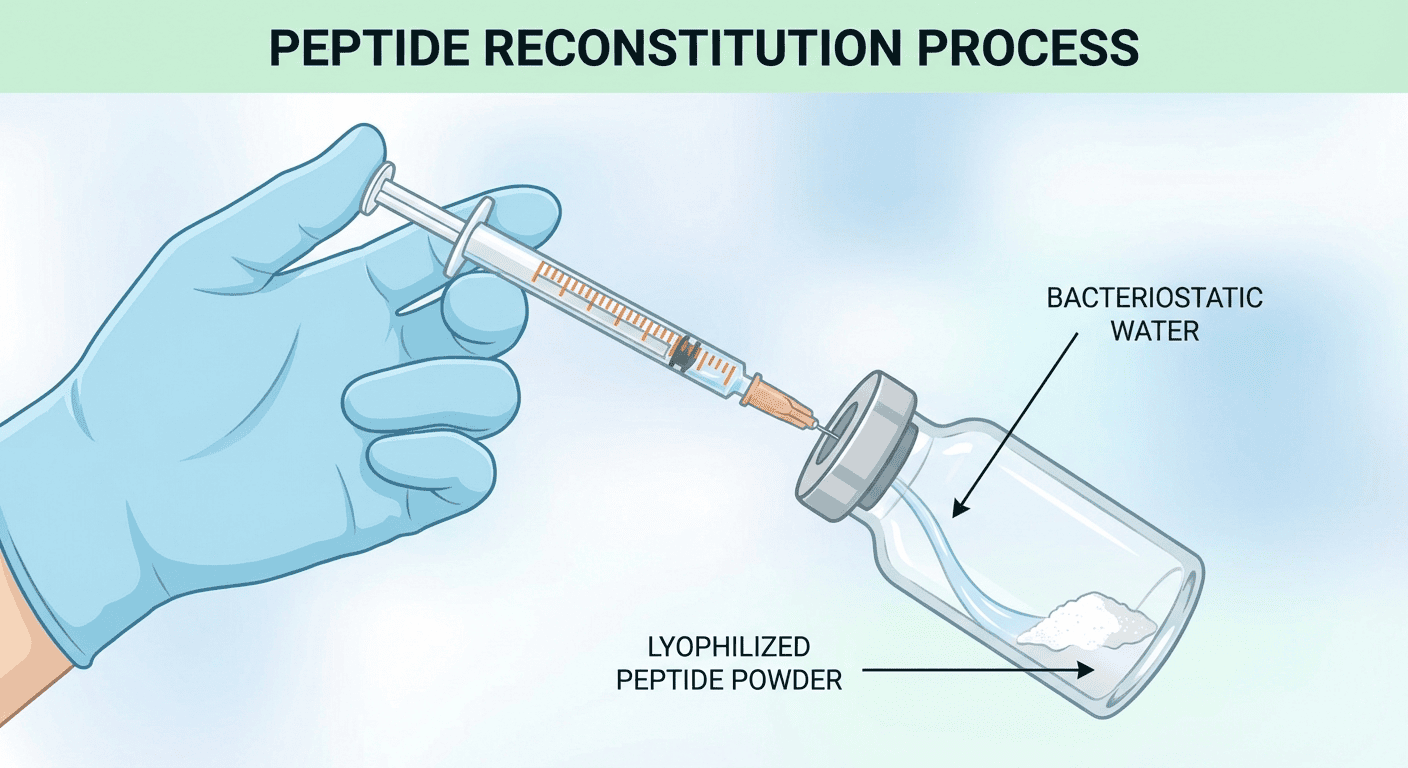
Reconstitution is the process of dissolving this lyophilized peptide powder into a sterile aqueous solvent to produce a working solution at the concentration required for your research protocol. Understanding how to reconstitute peptides correctly — including which solvent to use and how to handle the vial — is essential for maintaining peptide integrity and producing reliable research data.
🔬 Why Reconstitution Technique Matters
A research peptide at 99%+ purity reconstituted with the wrong solvent, shaken vigorously, or stored incorrectly after reconstitution will produce compromised, irreproducible research data — regardless of the peptide’s own purity. Correct reconstitution technique is as important as correct peptide quality.
Which Solvent Does Your Peptide Need?
Solvent selection is not a matter of preference — it is a research protocol requirement. The three reconstitution solvents used for research peptides are Bacteriostatic Water (BAC Water), Acetic Acid Water 0.6%, and Benzyl Alcohol 0.9%. Each serves a distinct purpose and is appropriate for different peptide types.
Bacteriostatic Water (BAC Water) — The Standard Choice
Bacteriostatic Water (BAC Water) is 0.9% benzyl alcohol in sterile Water for Injection (WFI). It is the standard reconstitution solvent for the vast majority of research peptides and the correct choice for most researchers learning how to reconstitute peptides for the first time.
The 0.9% benzyl alcohol provides bacteriostatic preservation — inhibiting bacterial growth in the reconstituted solution and allowing multiple draws from the same vial over 28 days without microbial contamination of the research sample.
Use BAC Water for: BPC-157, TB-500, Semaglutide, Tirzepatide, Retatrutide, CJC-1295, Ipamorelin, Sermorelin Acetate, HGH, GHK-Cu, Epitalon, Semax, Selank, and all Peptide Blends & Stacks.
Acetic Acid Water 0.6% — For Hydrophobic Peptides
Acetic Acid Water 0.6% is a mildly acidic sterile solution (pH ~3.0–4.0) used for research peptides that cannot achieve adequate solubility in neutral-pH solvents. The acidic environment protonates amine groups on hydrophobic amino acid residues, dramatically increasing aqueous solubility. It is the primary reconstitution solvent for IGF-1 LR3 — the most common hydrophobic peptide in the PrimaLab Peptide catalog. After initial reconstitution in Acetic Acid Water, the solution can be diluted to working concentration with BAC Water or sterile saline.
Step-by-Step Peptide Reconstitution Protocol
Follow this universal step-by-step protocol for how to reconstitute peptides correctly in the laboratory. This protocol applies to the vast majority of lyophilized research peptides reconstituted with BAC Water.
Gather Your Materials
You will need: lyophilized peptide vial, BAC Water vial, sterile insulin syringes, alcohol swabs, and a clean work surface. If available, work in a laminar flow cabinet for maximum sterility.
Equilibrate the Peptide Vial
Allow the sealed lyophilized peptide vial to reach room temperature before opening. Cold sealed vials can create internal pressure when punctured, risking material loss and contamination.
Calculate Your Target Concentration
Determine how much BAC Water to add based on your required working concentration. Example: Adding 1mL BAC Water to a 5mg peptide vial produces a concentration of 5mg/mL (5000µg/mL). Adding 2mL produces 2.5mg/mL. Always verify against your specific protocol requirements before proceeding.
Clean Both Vial Septa
Wipe the septum (rubber top) of both your peptide vial and BAC Water vial with a fresh alcohol swab. Allow to air dry for 10 seconds before puncturing. Repeat every time you puncture a vial.
Draw the Solvent
Using a sterile syringe, draw the calculated volume of BAC Water from the BAC Water vial. Use a fresh sterile syringe for this step — never reuse syringes between vials.
Inject Down the Vial Wall — Not Onto the Powder
Insert the needle into the peptide vial and angle it so the solvent runs slowly down the inside glass wall — never spray directly onto the lyophilized powder cake. Direct injection onto the powder causes aggregation, foaming, and incomplete dissolution that reduces yield and compromises bioactivity.
Swirl Gently — Never Shake
Gently swirl or slowly roll the vial between your palms to mix. Never shake, vortex, or vigorously agitate the vial — mechanical agitation introduces air bubbles, causes foaming, and can mechanically damage peptide structure, particularly for larger peptides like HGH and TB-500.
Allow Complete Dissolution
Allow 2–5 minutes for complete dissolution. Acylated peptides like Semaglutide, Tirzepatide and Cagrilitide may dissolve more slowly due to their fatty acid chains — allow additional time. The reconstituted solution should be clear and colourless. Cloudiness or particulates indicate a problem.
Label and Store Correctly
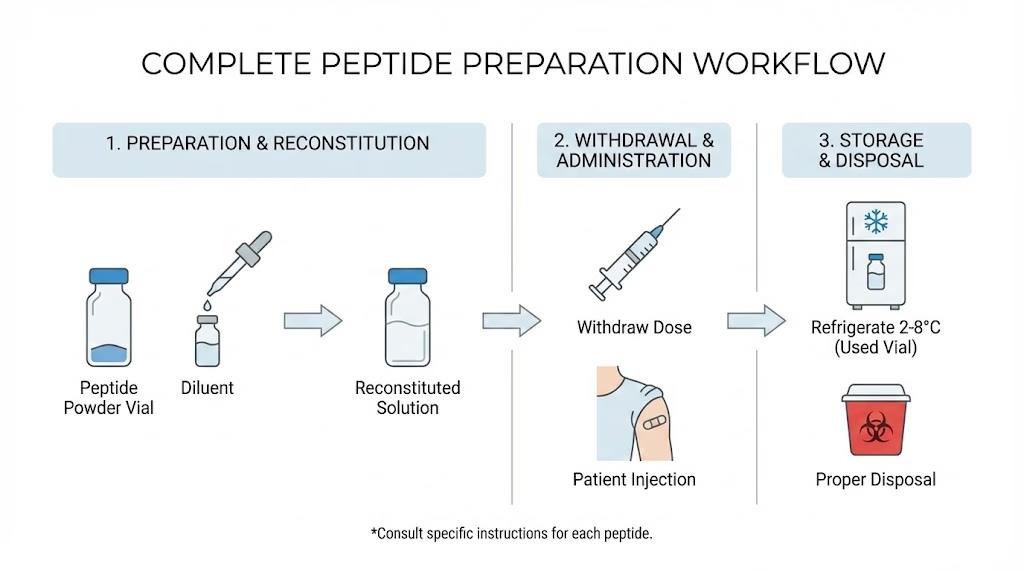
Label the reconstituted vial immediately with: compound name, batch number, concentration, reconstitution date, and solvent used. Store according to each compound’s specific post-reconstitution requirements — see the storage guide below.
Post-Reconstitution Storage Guide
Post-reconstitution storage is as important as correct reconstitution technique. The wrong storage conditions after reconstitution degrade peptide integrity rapidly — negating the benefit of a correctly performed reconstitution procedure. Here are the universal rules for storing reconstituted research peptides:
🌡️
Store at 2–8°C
Standard laboratory refrigerator temperature. Never store reconstituted peptides at room temperature — degradation accelerates rapidly above 8°C.
❌
Do Not Refreeze
Never freeze reconstituted peptide solutions. Each freeze-thaw cycle degrades peptide integrity and can cause aggregation.
📅
Use Within 28–30 Days
Most reconstituted peptides in BAC Water are stable for 28–30 days at 2–8°C. Always verify the compound-specific post-reconstitution window on the product page.
🔒
Protect From Light
UV exposure degrades certain peptide residues — particularly aromatic amino acids. Store vials in a dark location or wrap in foil, especially for light-sensitive compounds like Tesamorelin and SS-31.
Common Peptide Reconstitution Mistakes to Avoid
These are the most common mistakes researchers make when learning how to reconstitute peptides — each one avoidable with the correct protocol:
❌ Mistake 1: Shaking or Vortexing the Vial
Mechanical agitation damages peptide structure, introduces air bubbles, and causes foaming. Always swirl gently — never shake. This is especially critical for large peptides like HGH (22,124 Da) and TB-500 (4,963 Da) that are sensitive to shear forces.
❌ Mistake 2: Injecting Solvent Directly Onto the Powder
Spraying solvent directly onto the lyophilized powder cake causes aggregation, foaming, and incomplete dissolution. Always inject slowly down the inside glass wall of the vial — never aim the needle at the powder.
❌ Mistake 3: Using the Wrong Solvent
Using sterile water where BAC Water is required eliminates bacteriostatic protection and reduces stable shelf life to ~72 hours. Using BAC Water for IGF-1 LR3 produces inadequate solubility. Always verify the correct solvent for your specific peptide before reconstitution.
❌ Mistake 4: Freezing Reconstituted Solution
Freezing reconstituted peptide solutions causes ice crystal formation that mechanically disrupts peptide structure and promotes aggregation. Store reconstituted peptides at 2–8°C only — never refreeze. Aliquot the lyophilized powder before initial reconstitution if multiple sessions are planned.
❌ Mistake 5: Not Labelling the Vial
Unlabelled reconstituted vials are a research documentation failure. Always label with compound name, batch number, concentration, reconstitution date, and solvent. This is essential for research records, institutional audit trails, and research publication requirements.
❌ Mistake 6: Opening a Cold Vial Directly From the Freezer
Opening a cold sealed vial directly from −20°C creates condensation risk — moisture enters the vial and contacts the powder before reconstitution begins. Always allow sealed vials to reach room temperature before opening.
Peptide-Specific Reconstitution Notes
Some research peptides require additional considerations beyond the standard protocol when learning how to reconstitute peptides correctly:
HGH (Somatropin) — Shear Sensitivity
HGH is a 22,124 Da folded protein with a four-helix bundle tertiary structure that is highly sensitive to shear forces. Even vigorous pipetting can disrupt the structure and cause aggregation. Add BAC Water very slowly, allow passive dissolution without any agitation, and never vortex or shake.
IGF-1 LR3 — Acetic Acid Water Required
IGF-1 LR3 has a hydrophobic sequence profile that makes it poorly soluble in neutral-pH solvents. Reconstitute with Acetic Acid Water 0.6% first, then dilute to working concentration with sterile saline or BAC Water. Never attempt to reconstitute IGF-1 LR3 in BAC Water alone.
Tesamorelin — Light Protection Essential
Tesamorelin’s N-terminal trans-3-hexenoyl group is light-sensitive and susceptible to photo-oxidation. Perform reconstitution quickly, minimise bench-top light exposure, and wrap the reconstituted vial in foil before refrigerated storage.
Semaglutide, Tirzepatide & Cagrilitide — Slow Dissolution
Acylated peptides with C18/C20 fatty diacid chains may dissolve more slowly than unacylated peptides. Allow additional dissolution time — up to 10 minutes — swirling gently throughout. Do not interpret slow dissolution as a quality issue.
GHK-Cu — Blue Solution is Normal
GHK-Cu reconstitutes to a clear blue-tinted solution — this is the characteristic colour of the copper (II) complex and is expected. A colourless solution may indicate incomplete copper complexation. Use BAC Water or sterile water.
Reconstitution Supplies from PrimaLab Peptide
All reconstitution solvents are independently tested by Janoshik Analytical for confirmed concentration, sterility, and absence of contaminants. A batch-specific COA is available on request for every reconstitution solvent.
Bacteriostatic Water (BAC Water)
Standard multi-use reconstitution solvent for most research peptides. 0.9% benzyl alcohol in sterile WFI.
Acetic Acid Water 0.6%
For IGF-1 LR3 and hydrophobic peptides requiring acidic reconstitution conditions.
Benzyl Alcohol 0.9%
For custom buffer preparation and multi-dose research vial formulation.
Need Research Peptides or Reconstitution Supplies?
Browse PrimaLab Peptide’s complete catalog of independently verified research peptides — all with Janoshik COA included. Reconstitution supplies available with every order.
⚠️ Research Use Disclaimer: All products referenced in this article are intended exclusively for in-vitro laboratory research purposes only. They are not approved by any regulatory authority for human or veterinary use. Nothing in this article constitutes medical advice, diagnosis, or treatment recommendations. Researchers are solely responsible for compliance with all applicable local regulations governing the purchase, storage and use of research compounds.