
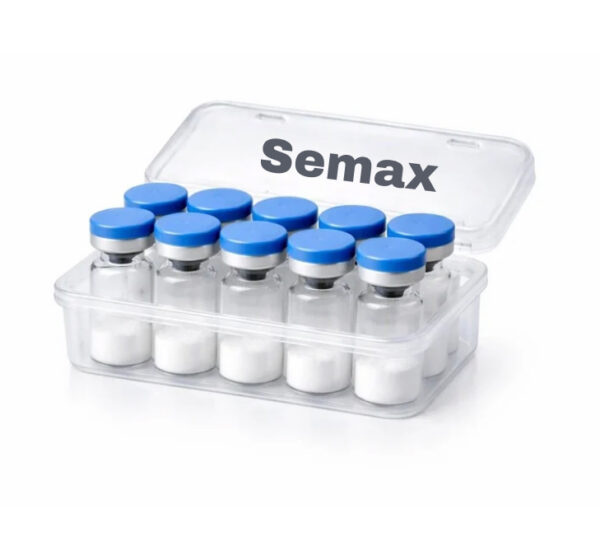
Buy Semax Peptide | Pure ACTH-Derived Nootropic Research Heptapeptide | PrimaLab Peptide
Semax (also designated ACTH(4-7)PGP) is a synthetic heptapeptide derived from the ACTH(4-7) fragment of adrenocorticotropic hormone, originally developed at the Institute of Molecular Genetics of the Russian Academy of Sciences. Researchers who buy Semax peptide use it to investigate BDNF (brain-derived neurotrophic factor) and NGF (nerve growth factor) modulation pathways, neuroprotective mechanisms in cell and animal research models, dopaminergic and serotonergic system interactions, cognitive function research, and broader CNS peptide research applications.
With a research history spanning several decades, built primarily from Russian and Eastern European research institutions, Semax has a solid and independently verifiable scientific foundation. PrimaLab Peptide supplies research-grade Semax at ≥99% purity, independently verified by Janoshik Analytical via HPLC and mass spectrometry, with a full batch-specific Certificate of Analysis included with every order.
What Is Semax?
Semax is a synthetic heptapeptide (seven amino acids) with the sequence Met-Glu-His-Phe-Pro-Gly-Pro (molecular formula C₃₅H₄₈N₈O₁₀S, MW 779.88 g/mol). It was designed as a structurally modified and metabolically stabilised analogue of the ACTH(4-7) fragment (Met-Glu-His-Phe) of adrenocorticotropic hormone. The addition of the Pro-Gly-Pro C-terminal tripeptide extension — creating the full Semax heptapeptide- confers improved metabolic stability, resistance to peptidase degradation, and an extended biological research profile compared to the parent ACTH(4-7) tetrapeptide fragment.
Although Semax shares structural heritage with ACTH through its N-terminal ACTH(4-7) core, it does not produce the steroidogenic effects (cortisol/ACTH axis activation) associated with full-length ACTH. The Pro-Gly-Pro extension and the truncated nature of the fragment produce a distinct pharmacological profile focused on neurotrophic and neuroprotective research pathways. A review of Semax’s research profile is available through published PubMed research on Semax.
Semax vs. Selank — Clearing Up the Confusion
Semax and Selank are two of the most frequently confused research neuropeptides. They are completely distinct compounds with different structural origins, receptor interactions, and research applications:
- Semax (this product): Derived from ACTH(4-7). Sequence Met-Glu-His-Phe-Pro-Gly-Pro. Primary research focus: BDNF and NGF pathway modulation, neuroprotection, dopaminergic/serotonergic system interactions, and cognitive function research models. Research profile centres on neurotrophic and neuroprotective mechanisms
- Selank: Derived from tuftsin (IgG fragment). Sequence Thr-Lys-Pro-Arg-Pro-Gly-Pro. Primary research focus: GABAergic system modulation, anxiolytic mechanisms, enkephalin enzyme inhibition, and immune modulation. Research profile centres on anxiolytic and immunomodulatory mechanisms
These compounds are not interchangeable in research protocols. Confirm which specific neurobiological pathway your research targets before ordering. Both are available from PrimaLab Peptides’ Nootropic & Neuro Peptides category.
Semax Research Applications
Semax has a well-established and growing published research foundation, spanning preclinical cell culture research, animal model studies, and clinical-adjacent investigations in Eastern European literature. Published research available on PubMed has examined Semax across the following research areas:
- BDNF pathway research: Semax’s most studied research mechanism involves upregulation of BDNF (brain-derived neurotrophic factor) expression in research models. BDNF is a key neurotrophin supporting neuronal survival, synaptic plasticity, and learning-associated mechanisms — making Semax a research tool for studying neurotrophic factor regulation. BDNF biology is reviewed in the NIH-published review of BDNF in neuroscience research
- NGF modulation research: Studies have examined Semax’s effects on nerve growth factor (NGF) expression alongside BDNF, exploring its broader neurotrophic factor modulation profile in cell culture and animal research models
- Neuroprotective mechanism research: Research has investigated Semax’s neuroprotective effects in ischaemic research models, examining its effects on neuronal survival, mitochondrial function in neural tissue, and anti-apoptotic pathway activation
- Dopamine and serotonin system research: Studies have examined Semax’s interactions with dopaminergic and serotonergic neurotransmitter systems — contributing to its cognitive research profile and providing a mechanistic context for its effects in cognitive function research models
- Cognitive function research models: Research has examined Semax’s effects on learning, memory, and attention performance metrics in rodent research models, reflecting its BDNF-modulating and neurotrophic properties
- Anti-inflammatory CNS research: Studies have examined Semax’s effects on neuroinflammatory markers in research models, including effects on pro-inflammatory cytokine expression in neural tissue contexts
- Intranasal delivery research: Due to its relatively short systemic half-life, Semax has been studied in intranasal delivery research models — a CNS peptide delivery approach that bypasses peripheral peptidase degradation and the blood-brain barrier challenge. This is also the case for Selank, reflecting shared delivery research considerations for this class of neuropeptides
Purity & Third-Party Testing
Every batch of Semax supplied by PrimaLab Peptide is independently tested by Janoshik Analytical:
- HPLC — quantitative purity confirmed at ≥99% with clean chromatography
- Mass Spectrometry — molecular identity confirmation (C₃₅H₄₈N₈O₁₀S, MW 779.88 g/mol)
Beyond purity percentage, the Janoshik COA provides HPLC chromatography data showing the clean profile, mass spectrometry identity confirmation, and absence of harmful residual solvents — the complete documentation picture a research-grade peptide should provide. The batch-specific COA is included with every order and cross-referenceable on the Janoshik database using the batch number from your vial.
Storage & Reconstitution
Semax is supplied as a lyophilized powder, stable for up to 24 months under correct sealed storage conditions.
- Sealed (lyophilized): Store at −20°C, sealed and away from moisture and light. Stable up to 24 months under these conditions
- After reconstitution: Store at 4°C and use within 28–30 days. Do not re-freeze the reconstituted solution
- Reconstitution: Reconstitute with sterile Bacteriostatic Water (BAC Water). Roll the vial gently to mix — never shake or vortex, which damages peptide structure. Allow full dissolution before use
- Freeze-thaw cycles: Avoid. Reconstitute only the volume needed for your current research window. Aliquot before freezing if multiple uses are required
- Vial labelling: Label all reconstituted vials with compound name, batch number, reconstitution date, and concentration for research documentation
Product Specifications
| Peptide Name | Semax |
| Also Known As | ACTH(4-7)PGP |
| Sequence | Met-Glu-His-Phe-Pro-Gly-Pro |
| Molecular Formula | C₃₅H₄₈N₈O₁₀S |
| Molecular Weight | 779.88 g/mol |
| Purity | ≥99% (Janoshik HPLC + Mass Spectrometry verified) |
| Form | Lyophilized powder |
| Available Sizes | 5mg, 10mg |
| Storage (sealed) | −20°C, away from moisture and light |
| Storage (reconstituted) | 4°C, use within 28–30 days |
| Stability (lyophilized) | 24 months sealed |
| Reconstitution | Bacteriostatic Water (BAC Water) |
| Testing Lab | Janoshik Analytical (independent third-party) |
| COA | Batch-specific — included with every order |
| Intended Use | In-vitro laboratory research only — not for human or veterinary use |
Frequently Asked Questions — Semax Peptide
What is Semax used for in research?
Researchers who buy Semax peptide use it to investigate BDNF and NGF pathway modulation in neural research models, neuroprotective mechanisms in ischaemic and stress research contexts, dopaminergic and serotonergic neurotransmitter system interactions, cognitive function and memory performance in animal research models, anti-inflammatory CNS mechanisms, and intranasal neuropeptide delivery systems. Its well-characterised BDNF-modulating research profile makes it one of the most distinctive nootropic research peptides available. Published literature is available on PubMed.
Is Semax the same as Selank?
No. These are entirely distinct research compounds. Semax derives from ACTH(4-7) and is primarily studied for BDNF/NGF modulation and neuroprotective mechanisms. Selank derives from tuftsin and is primarily studied for GABAergic, anxiolytic, and immunomodulatory mechanisms. They are not interchangeable in research protocols. Confirm your specific research target — neurotrophic/neuroprotective pathways (Semax) vs. anxiolytic/immune pathways (Selank) — before ordering. Both are available from PrimaLab Peptide.
Is Semax from PrimaLab Peptide independently tested?
Yes. Every batch is independently verified by Janoshik Analytical at ≥99% purity via HPLC and mass spectrometry identity confirmation (C₃₅H₄₈N₈O₁₀S, MW 779.88 g/mol). The batch-specific COA includes purity data, MS identity confirmation, and HPLC chromatography data, and is cross-referenceable on the Janoshik database using your vial’s batch number.
What reconstitution solvent should I use for Semax?
Reconstitute Semax with sterile Bacteriostatic Water (BAC Water). Add solvent slowly and roll the vial gently — never shake or vortex. Store the reconstituted solution at 4°C and use within 28–30 days. Label the vial with reconstitution date, concentration, batch number, and compound identity for research documentation.
Why does Semax have a short half-life and how does this affect research design?
Semax’s relatively short systemic half-life — attributable to peptidase degradation in plasma — is a key consideration for research protocol design. For CNS research applications, this is why intranasal delivery has been the most commonly studied administration route in published Semax research: intranasal delivery allows direct CNS access through the olfactory epithelium pathway, bypassing peripheral peptidase degradation and the blood-brain barrier challenge. Researchers designing in vitro cell culture studies are less affected by half-life considerations, as direct application to culture medium maintains defined concentrations.
What neuropeptides are commonly studied alongside Semax?
Researchers buying Semax peptide frequently explore complementary compounds from PrimaLab Peptide’s Nootropic & Neuro Peptides category including Selank (complementary anxiolytic/GABAergic research), Oxytocin Acetate (social behaviour and amygdala research), and Kisspeptin-10 (neuroendocrine axis research). For longevity and neuroprotection research, SS-31 (Elamipretide) and Epitalon are frequently used as complementary compounds.
Related Research Peptides
Researchers buying Semax peptide for nootropic and neuroprotective research frequently explore:
- Selank — tuftsin analogue for anxiolytic and GABAergic mechanism research
- Oxytocin Acetate — nonapeptide for social behaviour, amygdala, and neuroendocrine research
- Kisspeptin-10 — KISS1 gene peptide for HPG axis and neuroendocrine research
- SS-31 (Elamipretide) — cardiolipin-binding tetrapeptide for mitochondrial neuroprotection research
- Epitalon — AEDG tetrapeptide for telomerase, pineal, and longevity research
Browse our complete Nootropic & Neuro Peptides category. Bulk researchers can apply for discounted rates through our Wholesale Portal. Reconstitute with BAC Water, available in our Accessories & Reconstitution Supplies section.
⚠️ For in-vitro laboratory research use only. Not intended for human or veterinary consumption. Not a drug, supplement, or medical treatment. Researchers are solely responsible for compliance with all applicable local, national, and international regulations. All products are intended exclusively for laboratory research and are not approved by any regulatory authority for human or veterinary use.
Reviews
There are no reviews yet.