
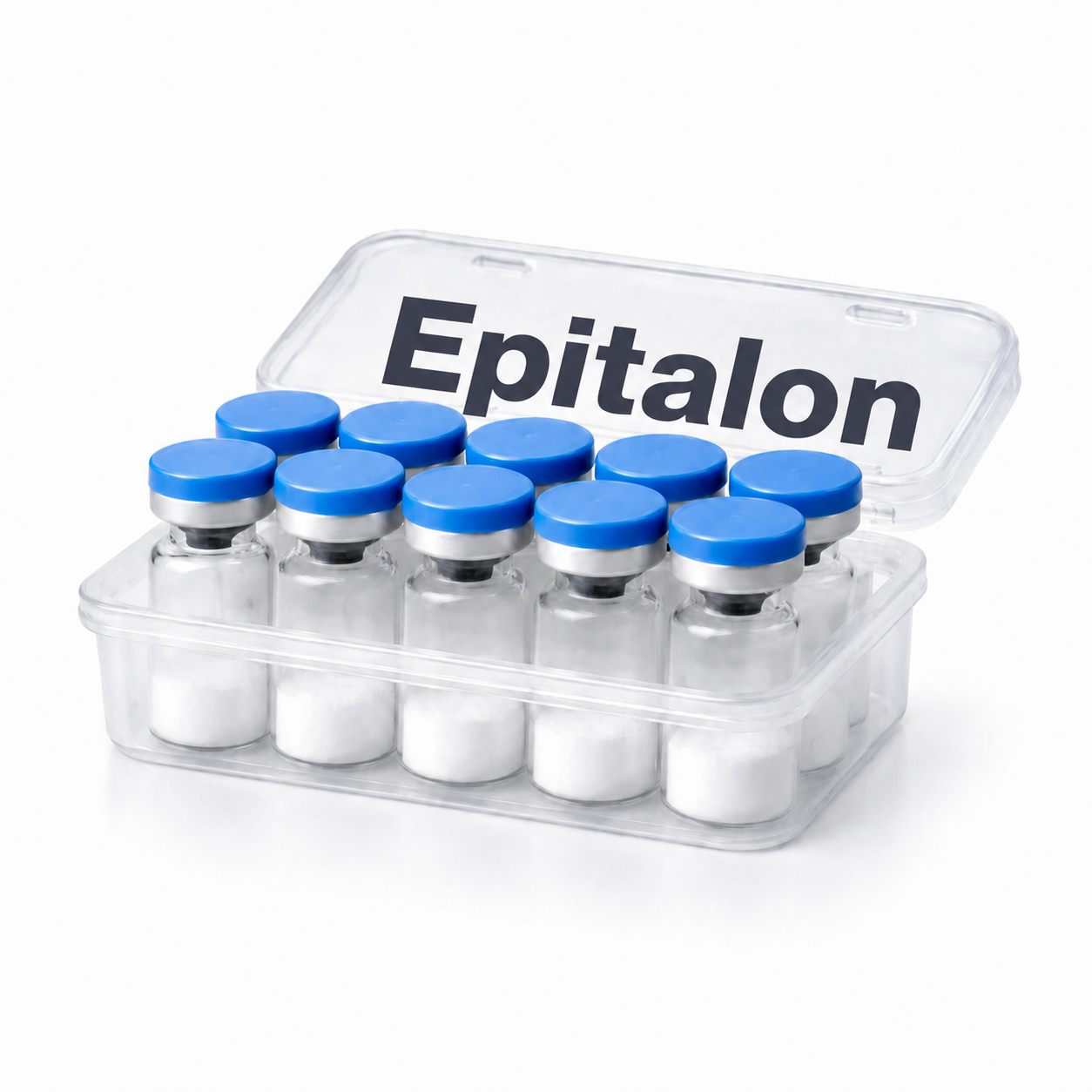
Buy Epitalon Peptide | Pure Telomere & Longevity Research Tetrapeptide | PrimaLab Peptide
Epitalon (also known as Epithalon or Epithalone) is a synthetic tetrapeptide with the sequence H-Ala-Glu-Asp-Gly-OH (AEDG), first developed and studied by Professor Vladimir Khavinson at the St. Petersburg Institute of Bioregulation and Gerontology. Researchers who buy Epitalon peptide use it to investigate telomerase activation and telomere biology, gene expression regulation, pineal gland and melatonin pathway research, antioxidant mechanisms, and longevity-related cellular signalling pathways. PrimaLab Peptide supplies research-grade Epitalon at 99.76% purity — independently verified by Janoshik Analytical — with a full batch-specific Certificate of Analysis included with every order.
Important regulatory context for researchers: The FDA’s orphan drug database lists Epitalon as not FDA-approved for any indication. The FDA has also flagged compounded Epitalon as raising safety concerns due to aggregation and peptide-related impurities in poorly manufactured batches — making independent third-party purity verification through Janoshik Analytical a critical quality requirement, not merely a commercial differentiator. PrimaLab Peptide supplies Epitalon strictly for in-vitro and preclinical laboratory research use only.
What Is Epitalon?
Epitalon is a tetrapeptide — a chain of four amino acids in the sequence Alanine-Glutamate-Aspartate-Glycine (AEDG). With a molecular formula of C₁₄H₂₂N₄O₉, a molecular weight of 390.35 g/mol, and CAS number 307297-39-8, it is a well-characterised small peptide first isolated as a synthetic analogue of Epithalamin — a polypeptide extract of the pineal gland. The names Epitalon, Epithalon, and Epithalone are used as synonyms across scientific databases and technical reference documents, including PubChem and NCATS.
The AEDG tetrapeptide sequence was identified through Khavinson’s systematic research into peptide bioregulators — short peptides derived from tissue-specific proteins that were hypothesised to regulate gene expression and cellular function in ageing-related research. Epitalon’s research profile has grown substantially since its development, with a published literature base spanning telomere biology, gene expression, pineal function, and longevity-associated signalling pathways.
Epitalon Research Applications
Epitalon has accumulated a substantial research literature base, particularly from Russian research institutions, with a growing body of international peer-reviewed work. Researchers studying Epitalon have examined it across the following areas:
- Telomerase activation research: Epitalon is primarily studied in the context of telomerase biology — the enzyme responsible for maintaining and extending telomere length at chromosome ends. Research has examined Epitalon’s effects on telomerase activity in somatic cell research models, with studies published in peer-reviewed journals investigating its role in telomere length regulation. This represents the most distinctive and researched aspect of Epitalon’s biology, distinguishing it from other longevity research compounds. Detailed telomere biology is reviewed by the NIH-published research on telomerase and ageing
- Gene expression regulation research: Khavinson’s bioregulator peptide research has examined Epitalon’s effects on gene expression patterns in ageing research models, with studies investigating its effects on the expression of genes associated with cellular senescence and ageing pathways
- Pineal gland and melatonin research: Derived from a pineal gland extract analogue, Epitalon has been studied for its effects on pineal function, melatonin secretion regulation, and circadian rhythm biology in aging research models
- Antioxidant pathway research: Studies have examined Epitalon’s antioxidant activity and free radical scavenging properties in research models, contributing to its broader cellular protection research profile
- Immune system modulation research: Research has explored Epitalon’s effects on immune function parameters in aging research models, examining its role as a peptide bioregulator in immune senescence research
- Longevity research programs: Epitalon is a cornerstone compound in longevity and cellular health research, frequently studied alongside NAD+ (cellular energy metabolism and sirtuin activation), SS-31 (Elamipretide) (mitochondrial protection), MOTS-c (mitochondrial metabolic peptide), and Glutathione (master antioxidant) in comprehensive cellular aging and longevity research programs. Browse the full Wellness & Longevity category
Why Purity Matters Especially for Epitalon Research
The FDA has specifically flagged compounded Epitalon as raising safety concerns related to aggregation and peptide-related impurities — a regulatory signal that underscores why independent third-party purity verification is non-negotiable for research-grade Epitalon. Aggregated or impurity-containing Epitalon samples will produce unreliable and non-reproducible research data, and cannot be used to draw valid conclusions about the peptide’s biological activity in research models.
PrimaLab Peptide’s Epitalon tests at 99.76% purity — among the highest purity figures in our catalog — independently verified by Janoshik Analytical. The purity figure is a documented lab result from an independent testing laboratory, not a supplier-generated marketing claim. The batch-specific COA is included with every order. Always review the specific batch COA and purity data before use in any research protocol.
Storage & Reconstitution
Epitalon is supplied as a lyophilized powder.
- Before reconstitution (sealed): Store at −20°C in a dry environment, protected from light. Lyophilized Epitalon is stable under these conditions
- After reconstitution: Store at 4°C. Avoid repeated freeze-thaw cycles of reconstituted solution — each cycle can affect peptide aggregation state, which is particularly relevant given the FDA’s noted concerns about Epitalon aggregation in poorly manufactured batches
- Reconstitution solvent: Reconstitute with sterile Bacteriostatic Water (BAC Water) or sterile water per your laboratory protocol. Add solvent gently down the inside vial wall — swirl gently, do not shake or vortex
- Aliquoting: Aliquot reconstituted solution into single-use volumes before freezing if your protocol requires extended storage, to minimise freeze-thaw exposure
Product Specifications
| Product Name | Epitalon |
| Aliases | Epithalon, Epithalone |
| Sequence | H-Ala-Glu-Asp-Gly-OH (AEDG) |
| Molecular Formula | C₁₄H₂₂N₄O₉ |
| Molecular Weight | 390.35 g/mol |
| CAS Number | 307297-39-8 |
| Purity | 99.76% (Janoshik Analytical verified) |
| Form | Lyophilized powder |
| Available Sizes | 10mg, 50mg |
| Storage (sealed) | −20°C, dry, protect from light |
| Storage (reconstituted) | 4°C, use promptly |
| Reconstitution | Bacteriostatic Water or sterile water |
| Testing Lab | Janoshik Analytical (independent) |
| COA | Batch-specific — included with every order |
| Regulatory Status | Not FDA-approved. For research use only |
| Intended Use | In-vitro / preclinical laboratory research only |
Frequently Asked Questions — Epitalon Peptide
What is Epitalon used for in research?
Researchers who buy Epitalon peptide use it to investigate telomerase activation and telomere length biology, gene expression regulation in aging research models, pineal gland function and melatonin pathway research, antioxidant mechanisms, immune senescence research, and longevity-associated cellular signalling pathways. Its telomere biology research profile is the most distinctive and internationally published aspect of Epitalon research. A growing published literature is available on PubMed.
Is Epitalon the same as Epithalon?
Yes — Epitalon, Epithalon, and Epithalone are synonyms used interchangeably across databases and technical sheets. All refer to the same tetrapeptide AEDG (H-Ala-Glu-Asp-Gly-OH, CAS 307297-39-8, MW 390.35 g/mol). PubChem and NCATS list these as alternative names for the same compound.
Is Epitalon FDA-approved?
No. The FDA’s orphan drug database lists Epitalon as not approved for any indication. The FDA has also noted that compounded Epitalon raises safety concerns related to aggregation and peptide-related impurities. PrimaLab Peptide supplies Epitalon strictly for in-vitro and preclinical laboratory research use only — not for human administration, clinical use, or therapeutic application.
Why is purity particularly important for Epitalon research?
The FDA’s specific flagging of aggregation and peptide impurity concerns in compounded Epitalon makes independent third-party purity verification especially critical for this compound. Aggregated or impure Epitalon produces unreliable, non-reproducible research data and cannot be used to draw valid scientific conclusions about the peptide’s biological activity. PrimaLab Peptide’s Epitalon tests at 99.76% purity by Janoshik Analytical — independently verified, not supplier-declared. Always request and review the batch-specific COA before use.
What compounds are commonly studied alongside Epitalon in longevity research?
Researchers buying Epitalon peptide for longevity and cellular aging research frequently explore complementary compounds from PrimaLab Peptide’s Wellness & Longevity category including NAD+ (sirtuin activation and cellular energy metabolism), SS-31 (Elamipretide) (mitochondrial cardiolipin stabilisation), MOTS-c (mitochondrial metabolic signalling peptide), and Glutathione (master antioxidant and redox balance research).
What is the correct storage temperature for lyophilized Epitalon?
Store sealed lyophilized Epitalon at −20°C in a dry environment protected from light. After reconstitution, store at 4°C. Avoid repeated freeze-thaw cycles of reconstituted solution — given the FDA’s noted concerns about Epitalon aggregation in poorly manufactured batches, minimising thermal cycling of the reconstituted peptide is particularly important for maintaining solution quality during research use.
Related Research Compounds
Researchers buying Epitalon peptide for longevity and cellular aging research frequently explore:
- NAD+ (Nicotinamide Adenine Dinucleotide) — cellular energy coenzyme for sirtuin, DNA repair, and metabolic research
- SS-31 (Elamipretide) — mitochondria-targeted tetrapeptide for cardiolipin stabilisation and ROS reduction research
- MOTS-c — mitochondria-derived peptide for AMPK activation and metabolic regulation research
- Glutathione (GSH) — master antioxidant tripeptide for redox balance and cellular protection research
- Thymosin Alpha-1 — immunomodulatory peptide studied for immune senescence and T-cell activation research
Browse our complete Wellness & Longevity category. Bulk researchers can apply for discounted rates through our Wholesale Portal. Reconstitute with BAC Water, available in our Accessories & Reconstitution Supplies section.
⚠️ For in-vitro and preclinical laboratory research use only. Not FDA-approved. Not intended for human or veterinary consumption. Not a drug, supplement, or medical treatment. Researchers are solely responsible for compliance with all applicable local, national, and international regulations governing the purchase, storage, and use of research compounds.
Reviews
There are no reviews yet.