
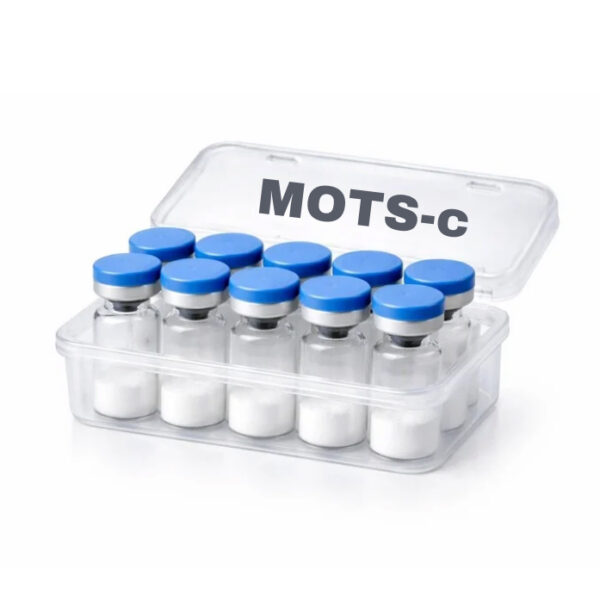
Buy MOTS-c Peptide | Pure Mitochondria-Derived AMPK-Activating Metabolic Research Peptide | PrimaLab Peptide
MOTS-c (Mitochondrial Open Reading Frame of the 12S rRNA-c) is a 16-amino acid mitochondria-derived peptide with a uniquely distinctive origin in the research peptide landscape: unlike the vast majority of bioactive peptides encoded in the nuclear genome, MOTS-c is encoded within the mitochondrial genome itself — specifically within the 12S ribosomal RNA gene (MT-RNR1). This mitochondrial origin places MOTS-c at the intersection of mitochondrial biology and systemic metabolic signalling in a way that distinguishes it from all other peptides in PrimaLab Peptide’s catalog.
Researchers who buy MOTS-c peptide use it to investigate AMPK pathway activation, glucose and fatty acid metabolism, insulin signalling, mitochondrial-nuclear communication, and longevity-associated metabolic pathways in cell culture and preclinical research models. PrimaLab Peptide supplies research-grade MOTS-c at 99.2% purity, independently verified by HPLC with a Certificate of Analysis included with every order.
What Is MOTS-c?
MOTS-c is a 16-amino acid peptide with the sequence MRWQEMGYIFYPRKLR — encoded within the 12S rRNA gene of human mitochondrial DNA. Its molecular formula is C₁₀₅H₁₄₆N₂₄O₂₅S (MW: 2174.5 Da). MOTS-c was first identified and characterised by Lee et al. in 2015 in a landmark paper published in Cell Metabolism, establishing it as a bioactive mitochondrial signalling peptide with systemic metabolic effects — a finding that expanded the understanding of mitochondrial genome function beyond structural RNA and established a new class of mitochondria-derived peptides (MDPs).
The discovery of MOTS-c highlighted that the mitochondrial genome — long thought to encode only 13 protein-coding genes, 22 tRNAs, and 2 rRNAs — could produce additional short bioactive peptides through open reading frames within its RNA genes. This discovery places MOTS-c alongside Humanin (another mitochondria-derived peptide) as a member of the growing MDP (mitochondria-derived peptide) research class, but with distinct downstream pathway targets. The original MOTS-c discovery publication is available through published PubMed research on MOTS-c.
What Makes MOTS-c Different From Other Mitochondrial Peptides?
MOTS-c occupies a distinct research position even within the growing mitochondria-derived peptide class:
- Mitochondrial DNA encoding: MOTS-c is encoded directly within mitochondrial DNA (within the 12S rRNA gene) — unusual even among mitochondria-derived peptides, which typically originate from specific open reading frames within mitochondrial RNA transcripts
- AMPK pathway activation: MOTS-c’s primary studied downstream mechanism is AMPK (AMP-activated protein kinase) pathway activation — a master metabolic regulator that controls cellular energy homeostasis, glucose uptake, fatty acid oxidation, and mitochondrial biogenesis. This AMPK-centric mechanism distinguishes MOTS-c from other mitochondria-derived peptides, including Humanin (which primarily targets IGF-1R and STAT3 pathways) and the SHLPs (Small Humanin-Like Peptides, which target distinct downstream pathways)
- Systemic signalling from mitochondria: MOTS-c can translocate from mitochondria to the cytoplasm and nucleus, representing a direct mitochondrial-to-nuclear signalling mechanism that has attracted significant research interest in the context of mitochondrial communication and stress response biology
- Exercise mimetic research: Research has examined MOTS-c for exercise mimicking effects at the cellular level — activating metabolic pathways that overlap with those induced by physical exercise through AMPK and downstream mechanisms
This unique combination of mitochondrial DNA origin, AMPK pathway targeting, nuclear translocation capability, and exercise mimetic research profile makes MOTS-c a genuinely distinctive research tool alongside complementary mitochondrial research compounds, including SS-31 (Elamipretide) (cardiolipin-targeting mitochondrial tetrapeptide) and NAD+ (ETC redox partner and sirtuin substrate).
MOTS-c Research Applications
Since its 2015 discovery, MOTS-c has attracted rapidly growing research interest across metabolic biology, exercise science, and aging research. Published research on PubMed has examined MOTS-c across the following areas:
- AMPK pathway activation research: MOTS-c’s primary studied mechanism is AMPK activation — specifically through effects on AICAR (5-aminoimidazole-4-carboxamide ribonucleotide) accumulation via inhibition of the folate cycle. Research examines AMPK pathway activation kinetics, downstream AMPK substrate phosphorylation, and AMPK-mediated metabolic reprogramming in cell culture models
- Glucose metabolism research: Studies have examined MOTS-c’s effects on glucose uptake, glycolysis regulation, and insulin signalling in skeletal muscle cell culture and adipocyte research models — relevant to insulin sensitivity and glucose homeostasis research
- Fatty acid oxidation research: AMPK activation by MOTS-c promotes fatty acid oxidation (FAO) through ACC (acetyl-CoA carboxylase) phosphorylation and reduction of malonyl-CoA — research has examined these metabolic effects in skeletal muscle and liver cell research models
- Insulin sensitivity research: Research has studied MOTS-c’s effects on insulin signalling pathway components and insulin sensitivity in cell culture models, examining connections between mitochondrial MOTS-c signalling and insulin receptor pathway responsiveness
- Exercise mimetic biology research: Research has examined MOTS-c’s ability to activate metabolic pathways that overlap with those stimulated by physical exercise, including AMPK activation, fatty acid oxidation, and glucose transporter (GLUT4) expression — making it a research tool for studying exercise biology mechanisms in non-exercise conditions
- Longevity and aging research: MOTS-c levels have been studied in the context of age-associated metabolic decline, with research examining MOTS-c as a potential biomarker and research tool for studying metabolic aspects of healthy aging. It is frequently studied alongside NAD+, SS-31 (Elamipretide), and Epitalon in longevity research programs. Browse our Wellness & Longevity category
- Mitochondrial-nuclear communication research: MOTS-c’s translocation from mitochondria to the nucleus under stress conditions has been studied as a direct mitochondrial-to-nuclear communication mechanism — a research area with implications for understanding how mitochondrial function affects gene expression and cellular stress responses
Purity & Third-Party Testing
Every vial of MOTS-c supplied by PrimaLab Peptide is tested by third-party HPLC before dispatch — the same independent verification standard applied across the PrimaLab Peptide research catalog:
- HPLC — quantitative purity confirmed at 99.2%
- COA — full Certificate of Analysis included with every order, showing purity data and identity confirmation
The 99.2% purity is not a marketing estimate — it is a documented analytical result. Verify the COA against your vial before use in any research protocol.
Storage & Reconstitution
- Lyophilized (sealed): Store at −20°C, dry and away from direct light. Stable for up to 24 months at −20°C under correct conditions
- After reconstitution: Store at 4°C and use within 28 days. Avoid repeated freeze-thaw cycles after reconstitution
- Reconstitution: Only reconstitute when ready to use. Use Bacteriostatic Water (BAC Water) for multi-use vials. Add solvent slowly down the inside vial wall and swirl gently — do not shake or vortex
- Freeze-thaw cycles: Avoid — degrade peptide integrity. Aliquot lyophilized powder into single-use volumes before initial reconstitution if your protocol requires multiple research sessions
Product Specifications
| Product Name | MOTS-c |
| Full Name | Mitochondrial Open Reading Frame of the 12S rRNA-c |
| Encoding Source | Mitochondrial DNA — 12S rRNA gene (MT-RNR1) |
| Amino Acid Sequence | MRWQEMGYIFYPRKLR |
| Amino Acid Count | 16 |
| Molecular Formula | C₁₀₅H₁₄₆N₂₄O₂₅S |
| Molecular Weight | 2174.5 Da |
| Purity | 99.2% (HPLC verified — COA included) |
| Form | Lyophilized powder |
| Available Sizes | 10mg, 40mg |
| Storage (lyophilized) | −20°C, dry, dark — stable 24 months |
| Storage (reconstituted) | 4°C, use within 28 days |
| Reconstitution | Bacteriostatic Water (BAC Water) |
| COA | HPLC verified — included with every order |
| Intended Use | Research purposes only — not for human or veterinary use |
Frequently Asked Questions — MOTS-c Peptide
What is MOTS-c used for in research?
Researchers who buy MOTS-c peptide use it to investigate AMPK pathway activation and downstream metabolic reprogramming, glucose uptake and insulin sensitivity mechanisms, fatty acid oxidation regulation, exercise mimetic biology at the cellular level, mitochondrial-to-nuclear signalling through MOTS-c translocation, and age-associated metabolic decline research. Its unique mitochondrial DNA encoding and AMPK-centric mechanism make it a distinctive research tool separate from all nuclear-encoded peptides. Published literature since its 2015 discovery is available on PubMed.
What makes MOTS-c different from other mitochondrial research peptides like SS-31?
MOTS-c and SS-31 (Elamipretide) are both mitochondria-related research peptides but with completely different mechanisms, origins, and research applications. SS-31 is a synthetic cell-permeable tetrapeptide that targets cardiolipin at the inner mitochondrial membrane to stabilise the ETC — it does not originate from mitochondrial DNA. MOTS-c is encoded within mitochondrial DNA and acts as a mitochondria-derived signalling peptide that activates AMPK through cytoplasmic and nuclear mechanisms. They address different aspects of mitochondrial biology and are complementary rather than redundant research tools.
Why is MOTS-c’s mitochondrial DNA origin significant for research?
MOTS-c’s encoding within mitochondrial DNA (the 12S rRNA gene) rather than nuclear DNA makes it a member of a newly recognised class of bioactive peptides — mitochondria-derived peptides (MDPs). This origin is significant because it represents a direct signalling output of the mitochondrial genome responding to metabolic stress — a previously unrecognised dimension of mitochondrial-nuclear communication. Research into MOTS-c, therefore, addresses fundamental questions about how mitochondrial genomic function influences systemic metabolism and ageing, beyond the traditional understanding of mitochondrial DNA as encoding only structural proteins and RNAs.
Is MOTS-c from PrimaLab Peptide independently tested?
Yes. Every vial of MOTS-c is independently tested by HPLC, with a 99.2% purity result confirmed by third-party analysis. The full Certificate of Analysis is included with every order. Verify the COA against your vial before use in any research protocol.
What compounds are commonly studied alongside MOTS-c in metabolic and longevity research?
Researchers buying MOTS-c peptide frequently explore complementary compounds from PrimaLab Peptide across both metabolic and longevity research areas, including NAD+ (sirtuin/PARP substrate and ETC redox partner for complementary energy metabolism research), SS-31 (Elamipretide) (cardiolipin-binding mitochondrial membrane stabilisation), Epitalon (telomerase and longevity pathway research), and 5-Amino-1MQ (NNMT inhibitor with NAD+ pathway interactions). Browse the Wellness & Longevity and Metabolic Peptides categories.
What is the shelf life of MOTS-c, and how should it be stored?
Lyophilized MOTS-c stored at −20°C in a dry, dark environment is stable for up to 24 months from the manufacture date. Vials are sealed and cold-packed for shipping integrity. Once reconstituted with BAC Water and stored at 4°C, use within 28 days. Avoid repeated freeze-thaw cycles after reconstitution — aliquot the lyophilized powder before initial reconstitution if multiple research sessions are planned from the same batch.
Related Research Compounds
Researchers buying MOTS-c peptide for mitochondrial, metabolic, and longevity research frequently explore:
- NAD+ — cellular energy coenzyme for sirtuin activation, PARP research, and ETC redox biology
- SS-31 (Elamipretide) — cardiolipin-binding mitochondrial tetrapeptide for ETC stabilisation research
- Epitalon — AEDG tetrapeptide for telomerase activation and longevity research
- Glutathione (GSH) — master antioxidant for mitochondrial and cellular protection research
- 5-Amino-1MQ — NNMT inhibitor studied for NAD+ pathway modulation and metabolic research
Browse our complete Wellness & Longevity and Metabolic Peptides categories. Bulk researchers can apply for discounted rates through our Wholesale Portal. Reconstitute with BAC Water, available in our Accessories & Reconstitution Supplies section.
⚠️ For research purposes only. Not for human or veterinary use. Not a drug, supplement, or medical treatment. Researchers are solely responsible for compliance with all applicable local regulations governing the purchase, storage, and use of research compounds.


Reviews
There are no reviews yet.