
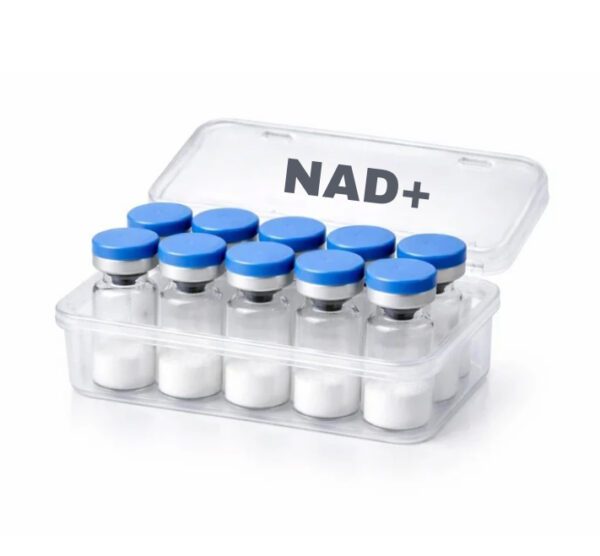
Buy NAD+ Research Grade | Pure Cellular Energy Coenzyme for Longevity Research | PrimaLab Peptide
NAD+ (Nicotinamide Adenine Dinucleotide) is a critical cellular coenzyme found in every living cell and one of the most widely studied molecules in cell biology — occupying a central position in cellular energy metabolism, redox biology, DNA repair, and longevity-associated signalling pathways. Researchers who buy NAD+ research grade use it to investigate sirtuin enzyme activation, PARP-mediated DNA repair, electron transport chain redox reactions, circadian rhythm regulation, mitochondrial function, and the cellular biology of ageing-associated NAD+ decline. PrimaLab Peptide supplies research-grade NAD+ at ≥99.1% purity, independently verified by HPLC with a third-party Certificate of Analysis, supplied as lyophilized powder with a 24-month sealed shelf life, in 100mg, 500mg, and 1000mg vials.
What Is NAD+?
NAD+ (Nicotinamide Adenine Dinucleotide, oxidised form) is a dinucleotide coenzyme consisting of two nucleotides joined by a phosphate bridge: one nucleotide carrying an adenine base, and one carrying a nicotinamide base. Its molecular formula is C₂₁H₂₇N₇O₁₄P₂ (MW: 663.43 g/mol, CAS: 53-84-9). The nicotinamide ring is the chemically active site — it accepts electrons (becoming NADH) and donates electrons (reverting to NAD+) in redox reactions, making NAD+/NADH the central electron carrier couple in cellular energy metabolism.
NAD+ exists in biological systems in four interconvertible forms — NAD+ (oxidised), NADH (reduced), NADP+ (phosphorylated oxidised), and NADPH (phosphorylated reduced) — each with distinct research applications. PrimaLab Peptide supplies NAD+ in its oxidised (NAD+) form — the substrate form for sirtuin deacylases and PARP enzymes, making it the appropriate form for research into these enzyme classes.
A comprehensive review of NAD+ biochemistry and its role in cellular metabolism and aging is available through NIH-published research on NAD+ in aging and metabolism.
NAD+ Research Applications
NAD+ is one of the most cited molecules in cell biology research, appearing in studies spanning energy metabolism, epigenetics, DNA repair, and ageing biology. Published research on PubMed has examined NAD+ across the following key research areas:
- Sirtuin (SIRT1-7) activation research: Sirtuins are NAD+-dependent protein deacylases that regulate histone modification, gene expression, and metabolic adaptation. As NAD+ is the essential co-substrate for all sirtuin deacylase activity, NAD+ availability directly controls sirtuin function — making it the central research tool for studying sirtuin biology, longevity-associated transcriptional regulation, and metabolic adaptation responses
- PARP enzyme and DNA repair research: PARP enzymes (Poly(ADP-ribose) polymerases) consume NAD+ to synthesise poly(ADP-ribose) chains at sites of DNA damage — a critical DNA repair signalling mechanism. NAD+ is therefore a key research substrate for studying DNA damage response, PARP activation kinetics, and the NAD+/PARP interaction relevant to genome stability research
- Electron transport chain and ATP production research: NADH (the reduced form produced during glycolysis and the TCA cycle) donates electrons to Complex I of the mitochondrial ETC, driving ATP synthesis via oxidative phosphorylation. Research into mitochondrial bioenergetics, Complex I function, and ATP production efficiency requires NAD+/NADH cycling research tools
- Circadian rhythm regulation research: The NAD+ biosynthesis pathway is directly regulated by circadian clock genes (CLOCK/BMAL1 regulate NAMPT, the rate-limiting enzyme in the NAD+ salvage pathway). Research has examined NAD+ oscillation as a key metabolic output of the circadian clock
- Mitochondrial biogenesis research: NAD+ and sirtuin activation — particularly SIRT1 and SIRT3 — are studied for their roles in mitochondrial biogenesis through PGC-1α deacetylation, relevant to exercise biology and mitochondrial health research
- Aging and cellular senescence research: NAD+ levels decline with age in most tissues — a well-documented phenomenon studied as a potential contributor to age-associated functional decline. Research programs examining NAD+ in aging biology frequently combine it with complementary longevity compounds including SS-31 (Elamipretide), Epitalon, MOTS-c, and Glutathione
- NAD+ precursor pathway research: NAD+ is used as the substrate reference standard in studies examining NAD+ biosynthetic pathways — including the salvage pathway (nicotinamide → NMN → NAD+ via NAMPT and NMNAT), the Preiss-Handler pathway (nicotinic acid → NAAD → NAD+), and the de novo pathway from tryptophan
Purity, Storage Stability & Third-Party Testing
PrimaLab Peptide’s NAD+ tests at ≥99.1% purity by HPLC, verified by a third-party COA included with every order. The testing process involves dual verification: HPLC analysis at synthesis stage and a second independent HPLC confirmation. The COA is included with every order and downloadable directly from the product page.
NAD+ stability considerations are particularly important in research:
- Oxidation sensitivity: NAD+ is susceptible to oxidative degradation — particularly by atmospheric oxygen when in solution. The lyophilized form dramatically slows oxidative degradation compared to aqueous NAD+ solutions
- Hydrolysis: NAD+ undergoes hydrolysis in neutral to alkaline aqueous solutions — degradation accelerating with increasing pH and temperature. Store lyophilized NAD+ at −20°C in a dry environment away from light and moisture
- 24-month sealed shelf life: Vacuum-sealed NAD+ vials shipped with desiccant maintain ≥99.1% purity for at least 24 months from manufacture date when stored correctly at −20°C
- Post-reconstitution stability: Once reconstituted, use within 24 hours or aliquot and refreeze — do not refreeze more than once. Stability drops significantly after reconstitution due to hydrolysis in aqueous solution
Storage & Reconstitution
- Sealed (lyophilized): −20°C in a dry environment, away from light and moisture. 24-month shelf life under these conditions. Vacuum-sealed with desiccant for transit
- After reconstitution: Use within 24 hours. If extended storage is needed, aliquot immediately and refreeze at −20°C — but do not refreeze more than once per aliquot
- Reconstitution: NAD+ is soluble in water at up to 50 mg/mL. Reconstitute with sterile water or your research buffer as required. Avoid alkaline pH conditions which accelerate hydrolysis. Use promptly after reconstitution
- Freeze-thaw cycles: Minimise — each freeze-thaw cycle introduces hydrolysis risk in the brief thawed window. Aliquot into single-use volumes before freezing to avoid repeated freeze-thaw of the same material
Product Specifications
| Full Name | Nicotinamide Adenine Dinucleotide (oxidised) — NAD+ |
| CAS Number | 53-84-9 |
| Molecular Formula | C₂₁H₂₇N₇O₁₄P₂ |
| Molecular Weight | 663.43 g/mol |
| Purity | ≥99.1% (HPLC — third-party COA verified) |
| Form | Lyophilized white to off-white powder |
| Solubility | Water (up to 50 mg/mL) |
| Available Sizes | 100mg, 500mg, 1000mg |
| Storage | −20°C, dry, away from light — 24 months sealed |
| Post-reconstitution stability | Use within 24 hours or aliquot and refreeze (once only) |
| Shipping | Vacuum-sealed with desiccant |
| COA | Third-party HPLC verified — included with every order |
| Intended Use | In vitro research only — not for human use |
Frequently Asked Questions — NAD+ Research Grade
What is NAD+ used for in research?
Researchers who buy NAD+ research grade use it to investigate sirtuin (SIRT1-7) deacylase enzyme activation and downstream epigenetic regulation, PARP enzyme DNA repair signalling, electron transport chain redox reactions and ATP production, circadian rhythm metabolic regulation, mitochondrial biogenesis through PGC-1α and sirtuin pathways, cellular senescence and age-associated NAD+ decline, and NAD+ biosynthetic pathway research. Published research is available on PubMed.
Why does NAD+ degrade quickly after reconstitution?
NAD+ undergoes chemical hydrolysis in aqueous solution — the N-glycosidic bond between nicotinamide and ribose is susceptible to hydrolytic cleavage, particularly at neutral to alkaline pH and elevated temperature. This degradation produces nicotinamide and ADP-ribose, neither of which has NAD+ coenzyme activity. The lyophilized (dry) form of NAD+ is dramatically more stable than aqueous solutions because hydrolysis requires water as a reactant. Once reconstituted, use NAD+ within 24 hours or aliquot and refreeze immediately to minimise hydrolytic losses during any thawed period.
What is the difference between NAD+ and NADH in research?
NAD+ (oxidised form) and NADH (reduced form) are interconvertible redox partners in cellular metabolism. NAD+ is the substrate for sirtuin deacylases and PARP enzymes — both enzyme classes require NAD+ specifically, not NADH. NADH is the electron-carrying reduced form that feeds electrons to the ETC at Complex I. Research into sirtuin biology, PARP-mediated DNA repair, and NAD+ availability studies should use the NAD+ (oxidised) form supplied by PrimaLab Peptide. Research examining NADH-specific ETC function requires the NADH form.
Is NAD+ from PrimaLab Peptide independently verified?
Yes. Every batch of NAD+ is tested by HPLC at synthesis and independently confirmed by a second HPLC analysis at a third-party laboratory, producing a COA with the confirmed purity figure (≥99.1%) that is included with every order. Vials are vacuum-sealed and shipped with desiccant to maintain purity throughout transit. The 24-month sealed shelf life at −20°C is validated under these storage conditions.
What compounds are commonly studied alongside NAD+ in longevity research?
Researchers buying NAD+ research grade for longevity and cellular aging research frequently explore complementary compounds from PrimaLab Peptide’s Wellness & Longevity category, including SS-31 (Elamipretide) (mitochondrial cardiolipin stabilisation), Epitalon (telomerase activation and longevity pathways), MOTS-c (mitochondria-derived AMPK activation peptide), and Glutathione (master antioxidant and redox balance research). Browse the complete Wellness & Longevity category.
What vial sizes are available, and is purity consistent across sizes?
NAD+ is available from PrimaLab Peptide in 100mg, 500mg, and 1000mg lyophilized vials. All sizes are manufactured to the same ≥99.1% purity standard and verified by the same HPLC testing process — there is no difference in quality between vial sizes. The COA and purity standard are consistent regardless of the vial size ordered.
Related Research Compounds
Researchers buying NAD+ research grade for longevity, sirtuin, and cellular energy research frequently explore:
- SS-31 (Elamipretide) — mitochondria-targeted cardiolipin-binding tetrapeptide for ETC and ROS research
- Epitalon — AEDG tetrapeptide for telomerase activation and longevity pathway research
- MOTS-c — mitochondria-derived peptide for AMPK activation and metabolic regulation
- Glutathione (GSH) — master antioxidant for redox balance and cellular protection research
- 5-Amino-1MQ — NNMT inhibitor studied for effects on NAD+ precursor availability and metabolic research
Browse our complete Wellness & Longevity category. Bulk researchers can apply for discounted rates through our Wholesale Portal.
⚠️ For in-vitro research only. Not intended for human use. Not a drug, supplement, or medical treatment. These statements have not been evaluated by any regulatory authority. Researchers are solely responsible for compliance with all applicable local, national, and international regulations.
Reviews
There are no reviews yet.