
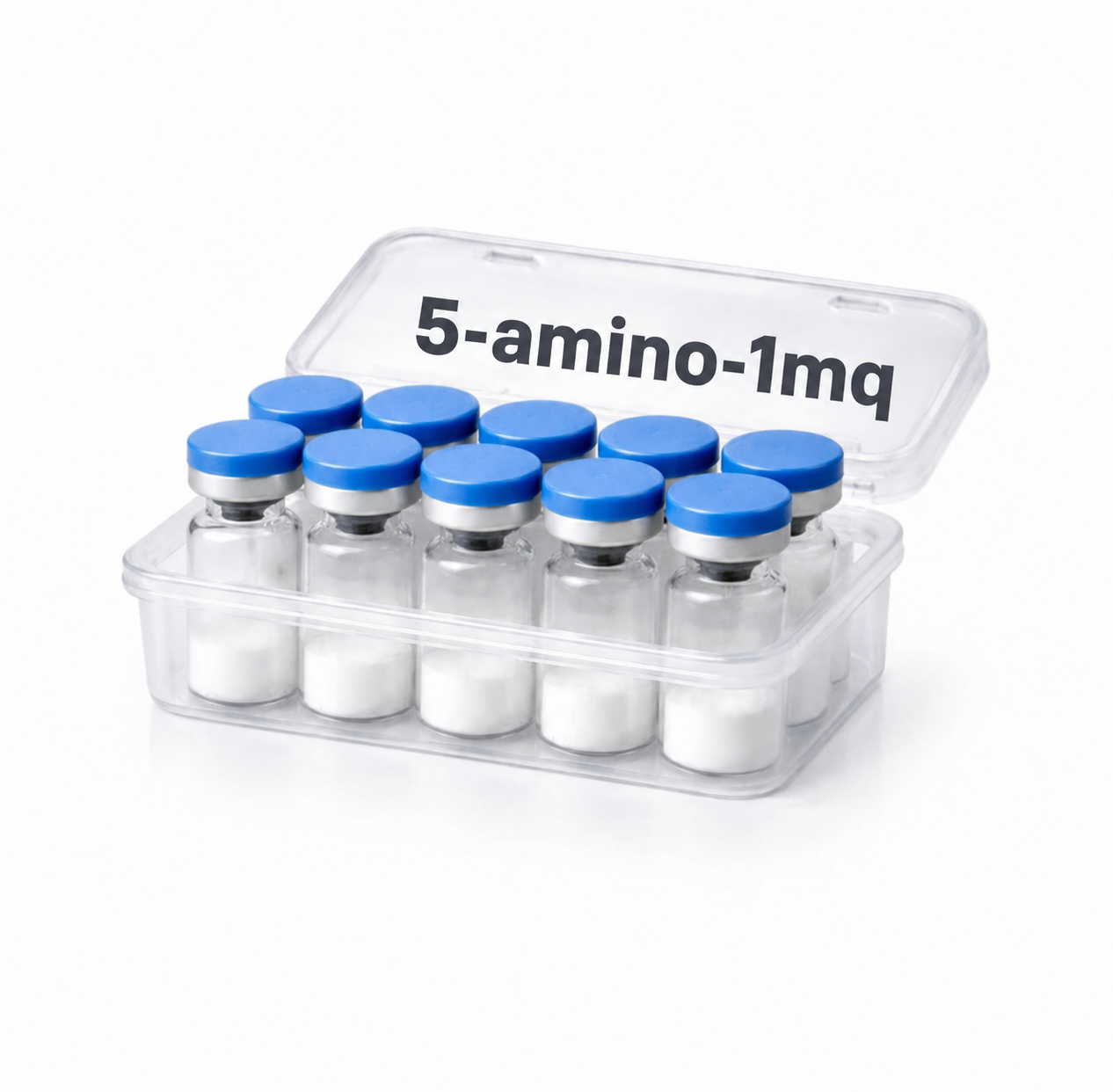
Buy 5-Amino-1MQ Research Compound | Pure NNMT Inhibitor for Metabolic Research | PrimaLab Peptide
5-Amino-1MQ (5-amino-1-methylquinolinium) is a small-molecule inhibitor of nicotinamide N-methyltransferase (NNMT) — an enzyme with an increasingly well-characterised role in cellular metabolism, epigenetic regulation, and adipose tissue biology. Researchers who buy 5-Amino-1MQ research compound use it to investigate NNMT enzyme inhibition, downstream effects on NAD+ availability and sirtuin pathway activation, adipocyte differentiation and lipid storage, and metabolic rate regulation in cell culture and preclinical research models. PrimaLab Peptide supplies research-grade 5-Amino-1MQ with purity independently verified by Janoshik Analytical via HPLC and mass spectrometry, with a full batch-specific Certificate of Analysis included with every order.
An important classification note: 5-Amino-1MQ is a small-molecule quinolinium compound — not a peptide in the traditional sense. It is categorised alongside research peptides at PrimaLab Peptide because of its directly overlapping applications in metabolic and adipose tissue research, where it is frequently studied alongside peptide-based metabolic research compounds such as AOD9604, MOTS-c, and NAD+.
What Is 5-Amino-1MQ?
5-Amino-1MQ (full name: 5-amino-1-methylquinolinium) is a quaternary ammonium salt of quinolinium with an amino group at position 5 and a methyl group at position 1. With a molecular formula of C₁₀H₁₀N₂ and a molecular weight of 174.20 g/mol, it is a compact, membrane-permeable small molecule that can enter cells to inhibit NNMT activity at the intracellular level.
NNMT (nicotinamide N-methyltransferase, EC 2.1.1.1) is an enzyme that catalyses the N-methylation of nicotinamide using S-adenosylmethionine (SAM) as the methyl donor, producing N-methylnicotinamide (MNA) and S-adenosylhomocysteine (SAH). This reaction sits at the intersection of NAD+ precursor metabolism, one-carbon (methyl group) metabolism, and epigenetic regulation — making NNMT a research-relevant enzyme target in multiple metabolic contexts. A detailed review of NNMT biology and its role in metabolic regulation is available through published PubMed research on NNMT and the NIH-archived NNMT inhibitor research review.
5-Amino-1MQ Research Applications
5-Amino-1MQ has emerged as one of the most studied small-molecule NNMT inhibitors in metabolic research, with a growing body of published preclinical literature examining its effects across multiple research contexts:
- NNMT enzyme inhibition research: 5-Amino-1MQ is studied as a competitive inhibitor of NNMT, blocking the N-methylation of nicotinamide and thereby altering downstream NAD+ precursor metabolism and methyl group availability in research models
- NAD+ pathway and sirtuin research: By inhibiting NNMT and reducing nicotinamide consumption, 5-Amino-1MQ research has explored effects on NAD+ bioavailability — a key substrate for sirtuin (SIRT1-7) deacylase enzymes involved in longevity-associated signalling, DNA repair, and mitochondrial regulation. This makes it a complementary research tool alongside NAD+ and MOTS-c in metabolic longevity research programs
- Adipocyte differentiation and lipid storage research: Cell culture studies have examined 5-Amino-1MQ’s effects on adipocyte differentiation, lipid droplet accumulation, and fat cell metabolic activity — research areas that overlap with peptide-based lipolytic compound studies using AOD9604 and Adipotide
- Energy expenditure research: Preclinical research has examined 5-Amino-1MQ’s effects on metabolic rate, oxygen consumption, and energy expenditure in animal models, studying NNMT inhibition as a potential metabolic regulator
- One-carbon metabolism and epigenetic research: NNMT inhibition reduces SAM consumption and SAH production, with downstream effects on cellular methylation capacity — relevant to epigenetic regulation research examining DNA and histone methylation patterns
- Muscle tissue and metabolic syndrome research: Research has explored 5-Amino-1MQ’s effects in skeletal muscle cell models and metabolic syndrome research contexts, examining NNMT’s role in muscle tissue metabolism and insulin signalling
Purity & Third-Party Testing
Every batch of 5-Amino-1MQ supplied by PrimaLab Peptide is independently tested by Janoshik Analytical using HPLC for quantitative purity determination and mass spectrometry for molecular identity confirmation (C₁₀H₁₀N₂, MW 174.20 g/mol, CAS: 65735-77-5). The batch-specific Janoshik COA is included with every order and available on request. Always review the current batch COA — purity values are batch-specific.
As with all PrimaLab Peptide research compounds, we do not publish unverified purity claims and do not batch-swap without notice. Third-party verification through Janoshik means the data is independently generated — not supplier-declared only.
Storage & Reconstitution
5-Amino-1MQ from PrimaLab Peptide is supplied as a lyophilized powder.
- Storage (sealed): −20°C, away from UV light and moisture. Use desiccant if possible. Keep sealed until ready for use
- Freeze-thaw cycles: Minimise repeated freeze-thaw cycles, which degrade compound quality over time. Aliquot before freezing if your protocol requires multiple uses from the same batch
- Reconstitution solvent: 5-Amino-1MQ can be reconstituted in sterile water or DMSO depending on your specific research protocol and target assay system. DMSO is frequently used for small-molecule quinolinium compounds where aqueous solubility is limited — always verify solubility data in current published literature for your specific application. Sterile BAC Water is suitable for aqueous reconstitution protocols where the compound’s aqueous solubility is adequate for the target concentration
- Concentration: Verify target working concentration against your specific assay system requirements and published 5-Amino-1MQ research literature before reconstituting
Product Specifications
| Compound Name | 5-Amino-1MQ (5-amino-1-methylquinolinium) |
| Molecular Formula | C₁₀H₁₀N₂ |
| Molecular Weight | 174.20 g/mol |
| Classification | Small-molecule NNMT inhibitor (quaternary ammonium quinolinium) |
| Purity | Janoshik batch-specific COA — HPLC + Mass Spectrometry verified |
| Form | Lyophilized powder |
| Storage | −20°C, away from light and moisture |
| Reconstitution | Sterile water or DMSO (protocol dependent) |
| Testing Lab | Janoshik Analytical (independent third-party) |
| COA | Batch-specific — included with every order |
| Intended Use | In vitro and laboratory research only — not for human use |
Frequently Asked Questions — 5-Amino-1MQ Research Compound
What is 5-Amino-1MQ used for in research?
Researchers who buy 5-Amino-1MQ research compound use it to investigate NNMT (nicotinamide N-methyltransferase) enzyme inhibition, downstream effects on NAD+ availability and sirtuin pathway activation, adipocyte differentiation and lipid storage biology, energy expenditure mechanisms, one-carbon metabolism and epigenetic regulation, and metabolic syndrome research in cell culture and preclinical models. Its unique position at the intersection of NAD+ metabolism, epigenetic regulation, and adipose tissue biology makes it a versatile research tool across multiple metabolic research areas. Current published literature is available on PubMed.
Is 5-Amino-1MQ a peptide?
No. 5-Amino-1MQ (5-amino-1-methylquinolinium) is a small-molecule quinolinium compound — not a peptide. It is classified alongside research peptides at PrimaLab Peptide because of its overlapping applications in metabolic and adipose tissue research, where it is frequently studied alongside peptide-based metabolic compounds including AOD9604, MOTS-c, and NAD+. Its mechanism of action — NNMT enzyme inhibition — is distinct from receptor agonism or peptide signalling mechanisms.
How does NNMT inhibition by 5-Amino-1MQ affect NAD+ metabolism?
NNMT catalyses the N-methylation of nicotinamide — a key NAD+ precursor — using SAM as the methyl donor. By inhibiting NNMT activity, 5-Amino-1MQ research has explored effects on reducing nicotinamide consumption through the methylation pathway, potentially increasing nicotinamide availability for NAD+ biosynthesis via the Preiss-Handler or salvage pathways. This connection between NNMT inhibition and NAD+ precursor metabolism is one of the primary reasons 5-Amino-1MQ is studied alongside direct NAD+ supplementation research using NAD+. Detailed mechanistic research is available through NIH-archived NNMT inhibitor research.
What solvent should I use to reconstitute 5-Amino-1MQ?
5-Amino-1MQ can be reconstituted in sterile water or DMSO depending on your specific research protocol and target assay system. DMSO is frequently preferred for small-molecule quinolinium compounds where higher solubility is required, but introduces DMSO vehicle controls into assay design. Sterile BAC Water is suitable for aqueous reconstitution where the compound’s aqueous solubility is adequate for your target concentration. Always verify solubility data and reconstitution recommendations in current published 5-Amino-1MQ research literature for your specific application before proceeding.
What compounds are commonly studied alongside 5-Amino-1MQ?
Researchers buying 5-Amino-1MQ for metabolic and NAD+ pathway research frequently explore complementary compounds from PrimaLab Peptide including NAD+ (direct NAD+ supplementation and sirtuin research), MOTS-c (mitochondrial peptide studied for AMPK and metabolic regulation), AOD9604 (GH fragment studied for lipolytic mechanisms), and Adipotide (pro-apoptotic peptidomimetic for adipose vascular research). Browse the full Metabolic Peptides and Wellness & Longevity categories.
Is 5-Amino-1MQ independently tested?
Yes. Every batch is independently verified by Janoshik Analytical via HPLC purity analysis and mass spectrometry identity confirmation (C₁₀H₁₀N₂, MW 174.20 g/mol). The batch-specific COA is included with every order and available on request. Purity values are batch-specific — always review the current batch COA for your order.
Related Research Compounds
Researchers buying 5-Amino-1MQ research compound for NNMT inhibition and metabolic research frequently explore:
- NAD+ (Nicotinamide Adenine Dinucleotide) — direct NAD+ coenzyme supplementation for sirtuin, DNA repair, and cellular energy research
- MOTS-c — mitochondria-derived peptide studied for AMPK activation and metabolic regulation
- AOD9604 — modified HGH fragment for receptor-mediated lipolytic and fat metabolism research
- Adipotide (FTPP) — pro-apoptotic peptidomimetic for adipose tissue vascular biology research
- Glutathione (GSH) — master antioxidant tripeptide for redox and cellular protection research
Browse our complete Metabolic Peptides and Wellness & Longevity categories. Bulk researchers can apply for discounted rates through our Wholesale Portal.
⚠️ For in-vitro and laboratory research use only. Not intended for human or veterinary consumption. Not a drug, supplement, food, or medical treatment. Researchers are solely responsible for compliance with all applicable local, national, and international regulations governing the purchase, storage, and use of research compounds.
Reviews
There are no reviews yet.