
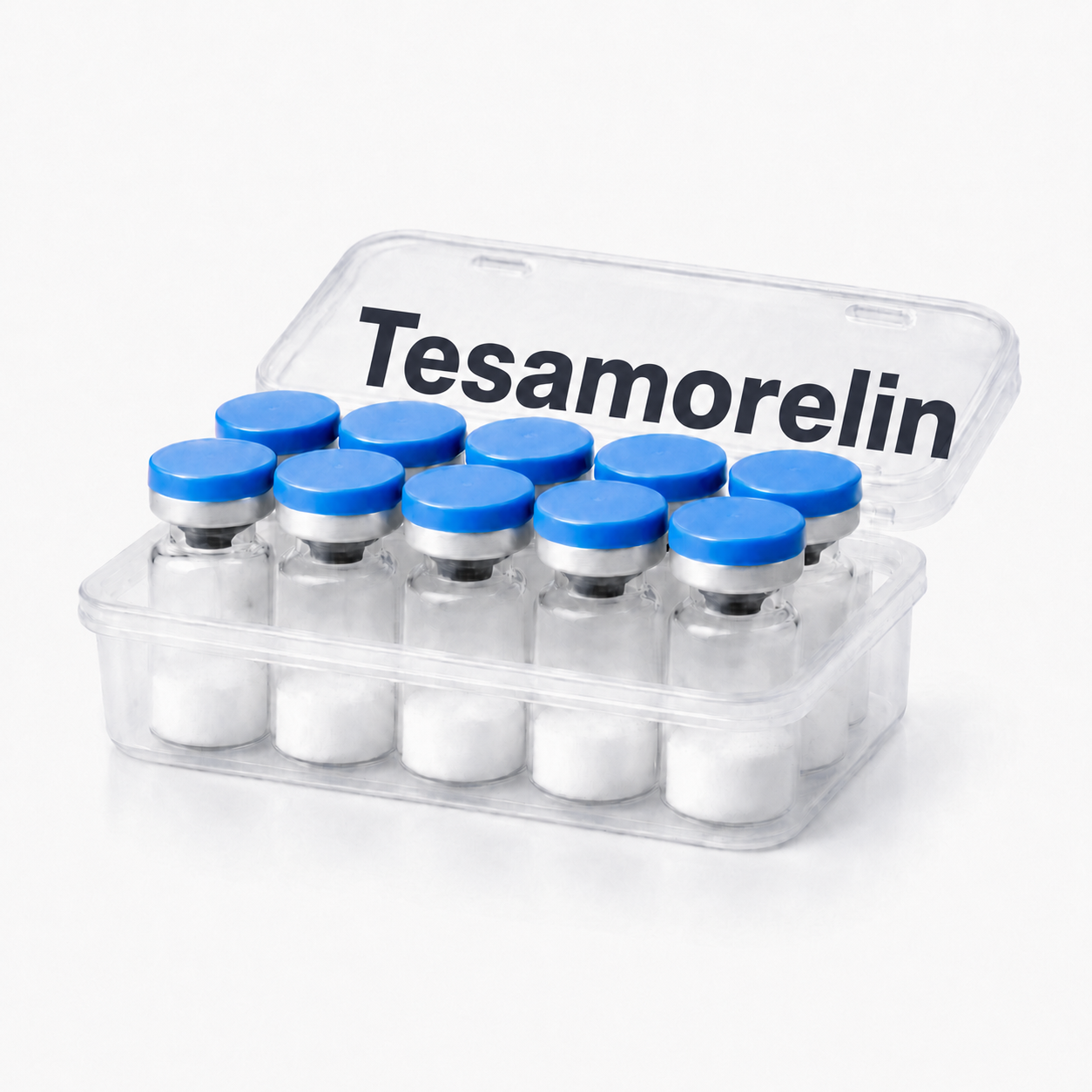
Buy Tesamorelin Peptide | Proven GHRH Analogue for GH Axis Research | PrimaLab Peptide
Tesamorelin is a synthetic analogue of endogenous growth hormone-releasing hormone (GHRH) consisting of the complete 44-amino acid GHRH sequence with a trans-3-hexenoyl group attached to the N-terminus. Researchers who buy Tesamorelin peptide use it to investigate GHRH receptor binding and pituitary somatotroph biology, pulsatile GH secretion mechanics, IGF-1 axis signalling, visceral adipose tissue metabolic pathways, lipid metabolism, and comparative GHRH analogue pharmacokinetics in laboratory research models. PrimaLab Peptide supplies research-grade Tesamorelin at 99.36% purity, independently verified by Janoshik Analytical via HPLC and mass spectrometry, with a full batch-specific Certificate of Analysis included with every order.
What Is Tesamorelin?
Tesamorelin is a synthetic GHRH analogue engineered with a specific N-terminal modification — the attachment of a trans-3-hexenoyl group to the N-terminus of the full 44-amino acid GHRH sequence. This modification is structurally significant for research: the trans-3-hexenoyl group confers resistance to dipeptidyl peptidase IV (DPP-IV) and other N-terminal peptidases that rapidly degrade native GHRH at the Tyr¹-Ala² dipeptide bond. The result is a GHRH analogue with improved enzymatic stability in research systems compared to native GHRH, while retaining the complete 44-amino acid GHRH sequence and full GHRH receptor agonist activity.
The full sequence of Tesamorelin is:
trans-3-Hexenoyl-Tyr-Ala-Asp-Ala-Ile-Phe-Thr-Asn-Ser-Tyr-Arg-Lys-Val-Leu-Gly-Gln-Leu-Ser-Ala-Arg-Lys-Leu-Leu-Gln-Asp-Ile-Met-Ser-Arg-Gln-Gln-Gly-Glu-Ser-Asn-Gln-Glu-Arg-Gly-Ala-Arg-Ala-Arg-Leu-NH₂
CAS: 218949-48-5 | MW: 5135.9 g/mol | 44 amino acids + N-terminal hexenoyl group
For researchers designing comparative GHRH analogue studies, Tesamorelin’s key research-relevant distinction from other GHRH analogues in the PrimaLab Peptide catalog is: it is the only analogue retaining the complete 44-amino acid GHRH sequence with a stability-enhancing N-terminal modification, compared to the truncated 29-amino acid fragment of Sermorelin Acetate (GHRH 1-29) and the tetrasubstituted analogues CJC-1295 with and without DAC. A comprehensive GHRH biology overview is available from NIH StatPearls on Growth Hormone-Releasing Hormone.
Tesamorelin Research Applications
Tesamorelin’s combination of the complete GHRH sequence with improved stability makes it a versatile and well-characterised GHRH receptor research tool. Published research on PubMed has examined Tesamorelin across the following research areas:
- GHRH receptor biology research: Tesamorelin binds the GHRH receptor on pituitary somatotroph cells with the same binding site as native GHRH, triggering cAMP-mediated GH secretion. Its improved stability allows more sustained receptor engagement in research systems compared to native GHRH — making it a practical GHRH receptor research tool
- Pulsatile GH secretion research: Like native GHRH, Tesamorelin stimulates pulsatile GH release that preserves natural somatostatin feedback inhibition — maintaining intact GH axis feedback loop dynamics in research models. This distinguishes it from direct exogenous GH administration using HGH
- IGF-1 axis and hepatic signalling research: Tesamorelin-stimulated GH secretion produces downstream IGF-1 responses in research models, making it a tool for studying GH/IGF-1 axis dynamics from pituitary stimulation to hepatic IGF-1 production — frequently studied alongside IGF-1 LR3
- Visceral adipose tissue (VAT) metabolism research: Tesamorelin has been studied specifically in the context of visceral adipose tissue biology and lipid metabolism — examining how GHRH receptor-mediated GH secretion modulates the hormonal signals regulating visceral fat metabolism. This is a key research application distinguishing Tesamorelin from shorter GHRH fragments like Sermorelin
- Lipid metabolism and lipoprotein research: Research has examined Tesamorelin’s effects on lipid metabolism pathways, including lipoprotein profiles and fatty acid metabolism, in metabolic research models
- Cognitive and neurological research: Some research has explored Tesamorelin’s effects on cognitive function and neurological parameters in research models, reflecting the broader expression of GHRH receptors beyond the pituitary gland
- Comparative GHRH analogue pharmacokinetics: Tesamorelin’s unique N-terminal hexenoyl modification and complete GHRH sequence make it an important comparator in studies examining the pharmacokinetic and pharmacodynamic differences between GHRH analogues of varying length and structural modification — alongside Sermorelin Acetate, CJC-1295, and related compounds
Why the N-Terminal Hexenoyl Group Matters for Research
The trans-3-hexenoyl group at Tesamorelin’s N-terminus is not merely a manufacturing artefact — it has direct implications for research utility:
- DPP-IV resistance: Native GHRH is rapidly cleaved by DPP-IV at the Tyr¹-Ala² dipeptide bond in plasma and tissue. The hexenoyl group blocks this cleavage site, protecting the N-terminus from enzymatic degradation and extending the compound’s stability in research systems
- Research system stability: Improved stability means more predictable concentrations in cell culture and in vitro research systems over time — reducing the confounds introduced by rapid peptide degradation during assay incubation periods
- Full GHRH sequence preservation: Unlike Sermorelin (GHRH 1-29, missing 15 C-terminal residues), Tesamorelin retains the complete 44-amino acid GHRH sequence — ensuring all potential GHRH receptor interaction sites are preserved for receptor binding studies
- Light and heat sensitivity: The hexenoyl group is sensitive to light and heat degradation. This is why Tesamorelin vials should be wrapped in foil and protected from bench-top light exposure during reconstitution and handling
Purity & Third-Party Testing
Every batch of Tesamorelin supplied by PrimaLab Peptide is independently tested by Janoshik Analytical:
- HPLC — quantitative purity confirmed at 99.36%
- Mass Spectrometry — molecular identity confirmation (MW: 5135.9 g/mol, CAS: 218949-48-5), verifying the complete sequence including the N-terminal hexenoyl modification
The batch-specific COA is included with every order. Mass spectrometry confirmation of MW 5135.9 g/mol is particularly important for Tesamorelin — it verifies the presence of the N-terminal hexenoyl modification and the complete 44-amino acid sequence, distinguishing correctly synthesised Tesamorelin from incomplete or improperly modified batches.
Storage & Reconstitution
- Lyophilized (sealed): Store at −20°C or colder. Stable for up to 2 years under correct sealed storage. Light and heat degrade the hexenoyl group — wrap vials in foil and avoid bench-top light exposure
- After reconstitution: Store at 2–8°C (do not freeze). Use within 21 days. Once reconstituted, protect from light — keep foil-wrapped when not in active use
- Reconstitution solvent: Reconstitute with sterile Bacteriostatic Water (BAC Water). Inject solvent slowly down the inside vial wall — never directly onto the lyophilized powder. Swirl gently — do not shake. The hexenoyl group makes Tesamorelin slightly more susceptible to mechanical agitation degradation than standard peptides
- Light protection during reconstitution: Work quickly and minimise light exposure during the reconstitution process. Wrap the reconstituted vial in foil for storage
- Freeze-thaw cycles: Avoid repeated freeze-thaw — each cycle risks hexenoyl group degradation in addition to standard peptide chain degradation
Product Specifications
| Product Name | Tesamorelin (GHRH Analogue) |
| CAS Number | 218949-48-5 |
| Sequence | 44 amino acids + N-terminal trans-3-hexenoyl group |
| Molecular Weight | 5135.9 g/mol |
| Purity | 99.36% (Janoshik HPLC + Mass Spectrometry verified) |
| Form | Lyophilized white to off-white powder |
| Available Sizes | 2mg, 5mg, 10mg |
| Storage (lyophilized) | −20°C or colder — stable up to 2 years |
| Storage (reconstituted) | 2–8°C, use within 21 days — protect from light |
| Reconstitution | Bacteriostatic Water (BAC Water) — inject slowly down vial wall |
| Light Sensitivity | Light-sensitive — wrap in foil during reconstitution and storage |
| Testing Lab | Janoshik Analytical (independent third-party) |
| COA | Batch-specific — included with every order |
| Intended Use | In vitro / laboratory research only |
Frequently Asked Questions — Tesamorelin Peptide
What is Tesamorelin used for in research?
Researchers who buy Tesamorelin peptide use it to investigate GHRH receptor binding and cAMP signalling in pituitary somatotroph research, pulsatile GH secretion with intact somatostatin feedback, IGF-1 axis dynamics and hepatic signalling, visceral adipose tissue and lipid metabolism research, comparative GHRH analogue pharmacokinetics, and neurological research examining GHRH receptor expression beyond the pituitary. Published research is available on PubMed.
What makes Tesamorelin different from Sermorelin Acetate?
The two primary differences are sequence length and N-terminal modification. Sermorelin Acetate consists of the first 29 amino acids of GHRH (GHRH 1-29-NH₂) with no additional modification — it is the minimal active GHRH fragment with a short half-life (~10–20 minutes). Tesamorelin contains the complete 44-amino acid GHRH sequence with a trans-3-hexenoyl N-terminal group providing DPP-IV resistance and improved stability. Tesamorelin is used for research requiring the complete GHRH sequence and improved research system stability; Sermorelin for research prioritising the most physiologically acute and pulsatile GHRH receptor stimulation.
Why is the hexenoyl group light-sensitive and how should this affect lab handling?
The trans-3-hexenoyl unsaturated fatty acid chain is susceptible to photo-oxidation — light exposure, particularly UV, can oxidise the double bond in the hexenoyl group, chemically altering the N-terminal modification and potentially affecting GHRH receptor binding. This means Tesamorelin vials should be wrapped in foil or stored in light-protected containers throughout their shelf life, and reconstitution should be performed quickly while minimising bench-top light exposure. Reconstituted vials should remain foil-wrapped during refrigerated storage. Proper light protection ensures the 99.36% purity from Janoshik testing translates into maintained research utility throughout the vial’s use period.
Is Tesamorelin from PrimaLab Peptide independently tested?
Yes. Every batch is independently verified by Janoshik Analytical at 99.36% purity via HPLC and mass spectrometry identity confirmation (MW: 5135.9 g/mol, CAS: 218949-48-5). Mass spectrometry verification of the correct MW confirms both the complete 44-amino acid sequence and the presence of the N-terminal hexenoyl modification — the definitive batch characterisation for correctly synthesised Tesamorelin. The batch-specific COA is included with every order.
How does Tesamorelin compare to CJC-1295 in research design?
CJC-1295 is a tetrasubstituted GHRH analogue based on GHRH(1-29) with four amino acid substitutions and (in the DAC version) albumin-binding technology for very long half-life. Tesamorelin retains the complete 44-amino acid GHRH sequence with a stability-enhancing hexenoyl group rather than amino acid substitutions or albumin binding. For research examining the effects of the complete GHRH sequence vs. truncated or substituted analogues on GHRH receptor activation, Tesamorelin and CJC-1295 provide useful comparators with different structural modification strategies.
What peptides are commonly studied alongside Tesamorelin?
Researchers buying Tesamorelin peptide for GHRH and GH axis research frequently explore Sermorelin Acetate (GHRH 1-29 for comparative pharmacokinetic research), CJC-1295 (long-acting GHRH analogue for comparative structural research), Ipamorelin (GHSR-1a agonist for complementary GH secretion research), HGH (direct GH receptor activation reference), and IGF-1 LR3 (downstream GH/IGF-1 axis effector).
Related Research Peptides
Researchers buying Tesamorelin peptide for GHRH and GH axis research frequently explore:
- Sermorelin Acetate — GHRH(1-29) for acute pulsatile GH secretion research
- CJC-1295 (with DAC) — long-acting GHRH analogue for sustained GH axis research
- Ipamorelin — selective GHSR-1a agonist for complementary GH frequency research
- CJC-1295 + Ipamorelin Blend — dual-pathway GH research stack
- HGH (Somatropin) — recombinant growth hormone for direct GHR activation research
- IGF-1 LR3 — downstream GH axis effector for comprehensive axis research
Browse our complete Growth Hormone Peptides category. Bulk researchers can apply for discounted rates through our Wholesale Portal. Reconstitute with BAC Water, available in our Accessories & Reconstitution Supplies section.
⚠️ For in-vitro and laboratory research use only. Not approved by the FDA or any regulatory authority for human or veterinary use. Not a drug, supplement, or medical treatment. Researchers are solely responsible for compliance with all applicable local, national, and international regulations governing the purchase, storage, and use of research compounds.
Reviews
There are no reviews yet.