
Buy CJC-1295 Ipamorelin blend Research Peptide | Proven Dual-Pathway GH Research Stack | PrimaLab Peptide
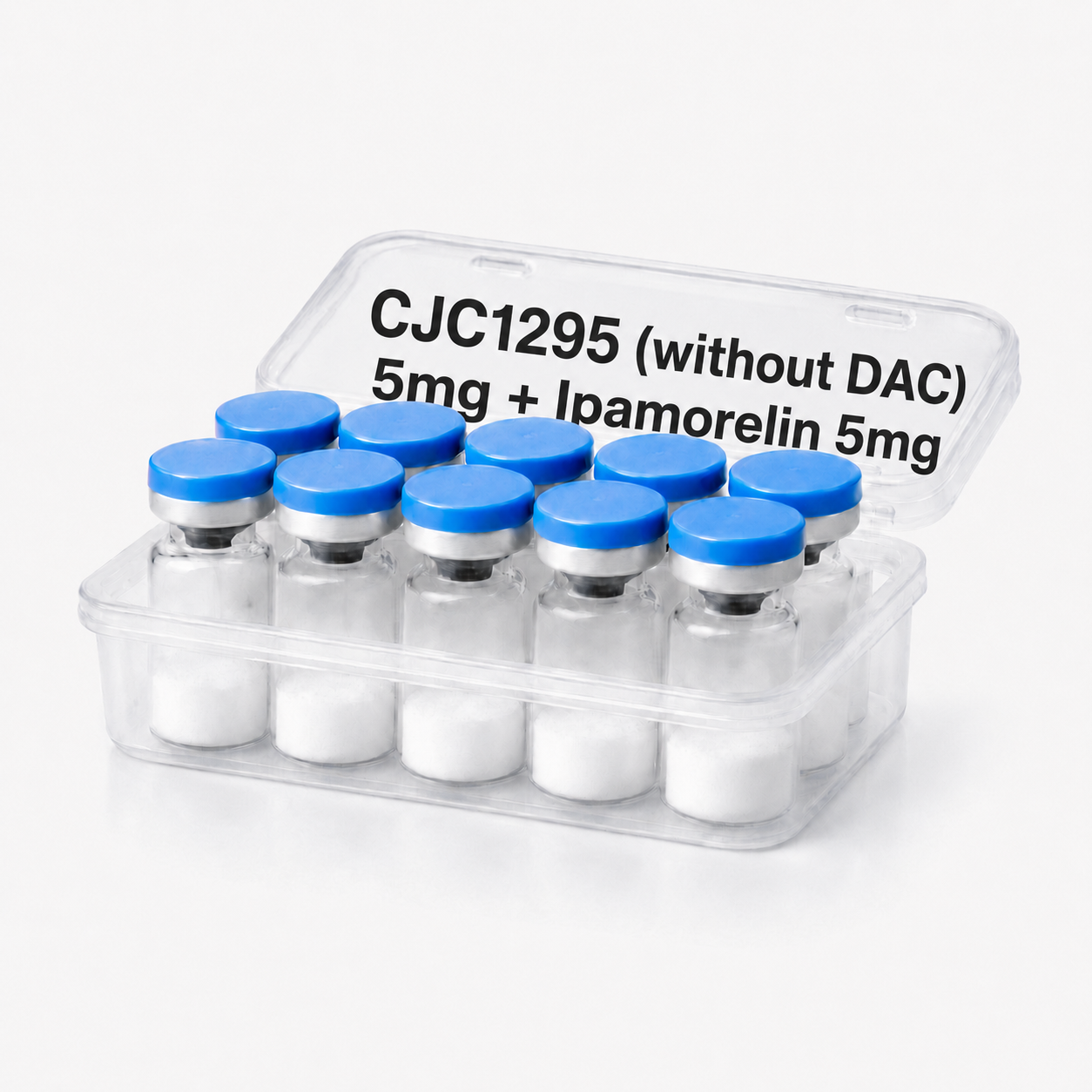
The CJC-1295 (without DAC) + Ipamorelin blend is the most widely used dual growth hormone peptide research combination in the research peptide field, combining two mechanistically complementary GH axis compounds in a single co-lyophilized vial. Researchers who buy CJC-1295 Ipamorelin blend research peptide use it to investigate synergistic dual-pathway stimulation of the GH/IGF-1 axis — CJC-1295 without DAC targeting GHRH receptors to increase GH pulse amplitude, while Ipamorelin targets GHS-R1a ghrelin receptors to increase GH pulse frequency — allowing comprehensive study of pulsatile GH secretion dynamics in a single research formulation. PrimaLab Peptide supplies this blend with ≥99% purity verified for both components by Janoshik Analytical, with a full batch-specific Certificate of Analysis included with every order.
What Is the CJC-1295 (Without DAC) + Ipamorelin Blend?
This blend contains two research peptides co-lyophilized in a single vial, each present at 5mg, for a total peptide content of 10mg per vial:
CJC-1295 (without DAC) — Modified GRF 1-29:
CJC-1295 without DAC, also referred to as Modified GRF (1-29) or Mod GRF 1-29, is a tetrasubstituted analogue of the first 29 amino acids of endogenous GHRH. Unlike CJC-1295 with DAC — which uses Drug Affinity Complex technology to bind albumin and extend half-life to several days — the without-DAC version lacks this albumin-binding modification, producing a shorter half-life of approximately 30–60 minutes. This shorter half-life is research-relevant rather than a limitation: it produces pulsatile GH release patterns that more closely mimic endogenous GHRH secretion dynamics, making it preferred for studies of physiological GH pulsatility and feedback loop integrity. CJC-1295 without DAC acts on pituitary GHRH receptors to increase GH pulse amplitude.
Ipamorelin — Selective GH Secretagogue:
Ipamorelin is a selective pentapeptide ghrelin receptor agonist (GHS-R1a) with a highly selective GH secretagogue profile — notably lacking the significant cortisol, prolactin, and ACTH release associated with less selective GH secretagogues such as GHRP-2 and GHRP-6. Ipamorelin acts independently of the GHRH receptor, instead stimulating GH release through the ghrelin receptor pathway to increase GH pulse frequency. This receptor selectivity makes Ipamorelin particularly valuable for GH research requiring clean GH axis stimulation without confounding hormonal effects.
The dual-pathway rationale for combining these two compounds in research is well-established: GHRH receptor activation (CJC-1295 without DAC) and GHS-R1a activation (Ipamorelin) are independent but synergistic GH secretion pathways. Combining both in research allows study of amplitude and frequency modulation simultaneously through a single research formulation. Published research supporting this dual-pathway GH research approach is available through PubMed research on GHRH and ghrelin receptor synergy.
Why Choose Without DAC (No DAC) for Research?
The choice between CJC-1295 with DAC and CJC-1295 without DAC represents a meaningful research protocol decision, not merely a preference:
- CJC-1295 without DAC (this blend): Half-life ~30–60 minutes. Produces pulsatile GH release that mimics endogenous GHRH secretion patterns. Preferred for studying natural GH pulsatility, feedback loop mechanisms, and avoiding receptor desensitisation that can occur with prolonged continuous GH axis stimulation. The short half-life allows precise temporal control over GH stimulation windows in research protocols
- CJC-1295 with DAC: Half-life extended to several days through albumin binding. Produces sustained, non-pulsatile GH elevation. Appropriate for research protocols studying sustained GH axis activation and downstream IGF-1 effects over extended study periods
For physiological pulsatility research and feedback loop integrity studies — which require GH release that mirrors natural endogenous patterns — the without-DAC version in combination with Ipamorelin is the preferred research design.
Research Applications of the CJC-1295 + Ipamorelin Blend
- Dual-pathway GH axis stimulation research: The primary application — simultaneous GHRH receptor and GHS-R1a receptor activation for studying combined amplitude and frequency modulation of GH secretion dynamics
- Pulsatile GH secretion research: The without-DAC formulation produces GH pulses that mirror endogenous pulsatile patterns, making this blend valuable for circadian GH rhythm and pulsatility research
- IGF-1 axis research: GH stimulation through dual-pathway activation produces downstream IGF-1 responses studied alongside IGF-1 LR3 for comprehensive GH/IGF-1 axis research
- Somatostatin feedback research: The pulsatile GH release from CJC-1295 without DAC maintains normal somatostatin feedback inhibition — unlike prolonged GH stimulation — making it valuable for studying intact feedback loop dynamics
- Receptor desensitisation studies: Comparative research examining receptor desensitisation differences between pulsatile (without DAC) and sustained (with DAC) GHRH receptor activation
- Tissue repair and metabolic GH research: GH axis downstream effects on protein synthesis, fat metabolism, and tissue repair are studied alongside healing peptides including BPC-157 and TB-500 in comprehensive research programs
Purity & Third-Party Testing
Both components of the CJC-1295 + Ipamorelin blend are independently verified by Janoshik Analytical at ≥99% purity via HPLC and mass spectrometry before co-lyophilization. The batch-specific COA is included with every order. Blend purity verification is more complex than single-compound testing — Janoshik’s HPLC analysis must resolve and quantify both peptide components independently to confirm purity for each. This level of analytical rigour ensures that the research blend meets the same purity standard as individually supplied research peptides.
Storage & Reconstitution
- Sealed (lyophilized): Store at −20°C, protected from light and moisture. Keep the vial sealed until ready for use
- After reconstitution: Store at 2–8°C and use within 30 days. Do not re-freeze after reconstitution
- Reconstitution solvent: Reconstitute with sterile Bacteriostatic Water (BAC Water) only — bacteriostatic water is essential for this multi-use research blend to maintain sterility across multiple draws during the 30-day post-reconstitution window
- Technique: Add BAC Water slowly down the inside wall of the vial. Do not inject directly onto the lyophilized powder. Swirl gently — never shake. Allow 2–5 minutes for complete dissolution. Solution should be clear and colourless
- Freeze-thaw cycles: Avoid repeated freeze-thaw of reconstituted solution. Aliquot if your protocol requires extended multi-use storage
Product Specifications
| Product Name | CJC-1295 (without DAC) 5mg + Ipamorelin 5mg Blend |
| Contents | CJC-1295 without DAC (Modified GRF 1-29) 5mg + Ipamorelin 5mg |
| Total Content | 10mg per vial |
| Form | Co-lyophilized powder |
| Purity | ≥99% for both components (Janoshik HPLC + Mass Spectrometry verified) |
| Appearance | White to off-white solid |
| CJC-1295 (no DAC) Receptor Target | GHRH receptor (pituitary) — increases GH pulse amplitude |
| Ipamorelin Receptor Target | GHS-R1a ghrelin receptor — increases GH pulse frequency |
| Storage (lyophilized) | −20°C, protected from light and moisture |
| Storage (reconstituted) | 2–8°C, use within 30 days — do not re-freeze |
| Reconstitution | Bacteriostatic Water (BAC Water) only |
| Testing Lab | Janoshik Analytical (independent third-party) |
| COA | Batch-specific — included with every order |
| Intended Use | In vitro laboratory research only |
Frequently Asked Questions — CJC-1295 + Ipamorelin Blend
Why combine CJC-1295 (without DAC) and Ipamorelin in research?
CJC-1295 without DAC and Ipamorelin target two independent but synergistic GH secretion pathways — GHRH receptors (CJC-1295 without DAC, increasing pulse amplitude) and GHS-R1a ghrelin receptors (Ipamorelin, increasing pulse frequency). Research combining both compounds allows simultaneous study of both amplitude and frequency modulation of GH axis activity through a single research formulation. This dual-pathway approach is the basis for this being the most commonly studied GH peptide research combination in published preclinical literature. See PubMed research on combined GHRH and ghrelin receptor agonism.
What is the difference between CJC-1295 with DAC and without DAC?
The DAC (Drug Affinity Complex) modification in CJC-1295 with DAC enables albumin binding, extending half-life to several days and producing sustained, non-pulsatile GH elevation. CJC-1295 without DAC lacks this modification, producing a half-life of approximately 30–60 minutes and pulsatile GH release that mimics natural endogenous GHRH secretion patterns. The without-DAC version is preferred for physiological pulsatility research and feedback loop integrity studies; the with-DAC version is used for sustained GH axis activation research. The choice between them is a research protocol decision based on the GH release profile your study requires.
Is the CJC-1295 + Ipamorelin blend independently tested?
Yes. Both components are independently verified by Janoshik Analytical at ≥99% purity via HPLC and mass spectrometry before co-lyophilization. Janoshik’s HPLC analysis resolves and quantifies both peptide components independently to confirm purity for each in the blend. The batch-specific COA is included with every order.
Can I reconstitute this blend with plain sterile water instead of BAC Water?
BAC Water is strongly recommended over plain sterile water for this blend. Because the reconstituted vial will likely be accessed multiple times over a 30-day research period, the bacteriostatic preservation provided by BAC Water’s 0.9% benzyl alcohol is essential for maintaining sterility across multiple draws. Plain sterile water provides no bacteriostatic protection and should only be used for single-use immediate reconstitution. BAC Water is available separately from PrimaLab Peptide.
What other research peptides are commonly studied alongside this blend?
Researchers buying CJC-1295 Ipamorelin blend frequently explore related GH axis compounds from PrimaLab Peptide including Sermorelin Acetate (GHRH(1-29) for comparative pulsatile GH research), HGH (full-length growth hormone for direct GH receptor activation studies), IGF-1 LR3 (downstream GH axis effector), and Tesamorelin (GHRH analogue for visceral fat and metabolic research). For healing research, this blend is studied alongside BPC-157 and TB-500.
How does Ipamorelin’s selectivity compare to other GH secretagogues like GHRP-2 or GHRP-6?
Ipamorelin has a significantly more selective GH secretagogue profile than GHRP-2 and GHRP-6. GHRP-2 and GHRP-6 stimulate GH release but also produce notable cortisol, prolactin, and ACTH secretion — confounding variables in GH axis research. Ipamorelin selectively stimulates GH release through GHS-R1a with minimal effect on cortisol and prolactin at research concentrations, making it a cleaner research tool for studying GH axis-specific effects without endocrine confounders. This selectivity is a primary reason Ipamorelin is the preferred GH secretagogue for pairing with GHRH analogues in GH research blend formulations. Published selectivity data is available through PubMed research on Ipamorelin selectivity.
Related Research Peptides
Researchers buying CJC-1295 Ipamorelin blend research peptide for GH axis studies frequently explore:
- CJC-1295 (with DAC) — long-acting GHRH analogue for sustained GH elevation research
- Ipamorelin — selective GH secretagogue available as a standalone research peptide
- Sermorelin Acetate — GHRH(1-29) analogue for comparative pulsatile GH research
- Tesamorelin — full GHRH analogue studied for GH secretion and metabolic research
- HGH (Somatropin) — full-length growth hormone for direct GH receptor research
- IGF-1 LR3 — downstream GH axis effector for GH/IGF-1 axis research
Browse our complete Peptide Blends & Stacks and Growth Hormone Peptides categories. Bulk researchers can apply for discounted rates through our Wholesale Portal. Reconstitute with BAC Water, available in our Accessories & Reconstitution Supplies section.
⚠️ For in-vitro laboratory research use only. Not intended for human or veterinary consumption. Not a drug, supplement, or medical treatment. Researchers are solely responsible for compliance with all applicable local, national, and international regulations governing the purchase, storage, and use of research compounds.
Reviews
There are no reviews yet.