
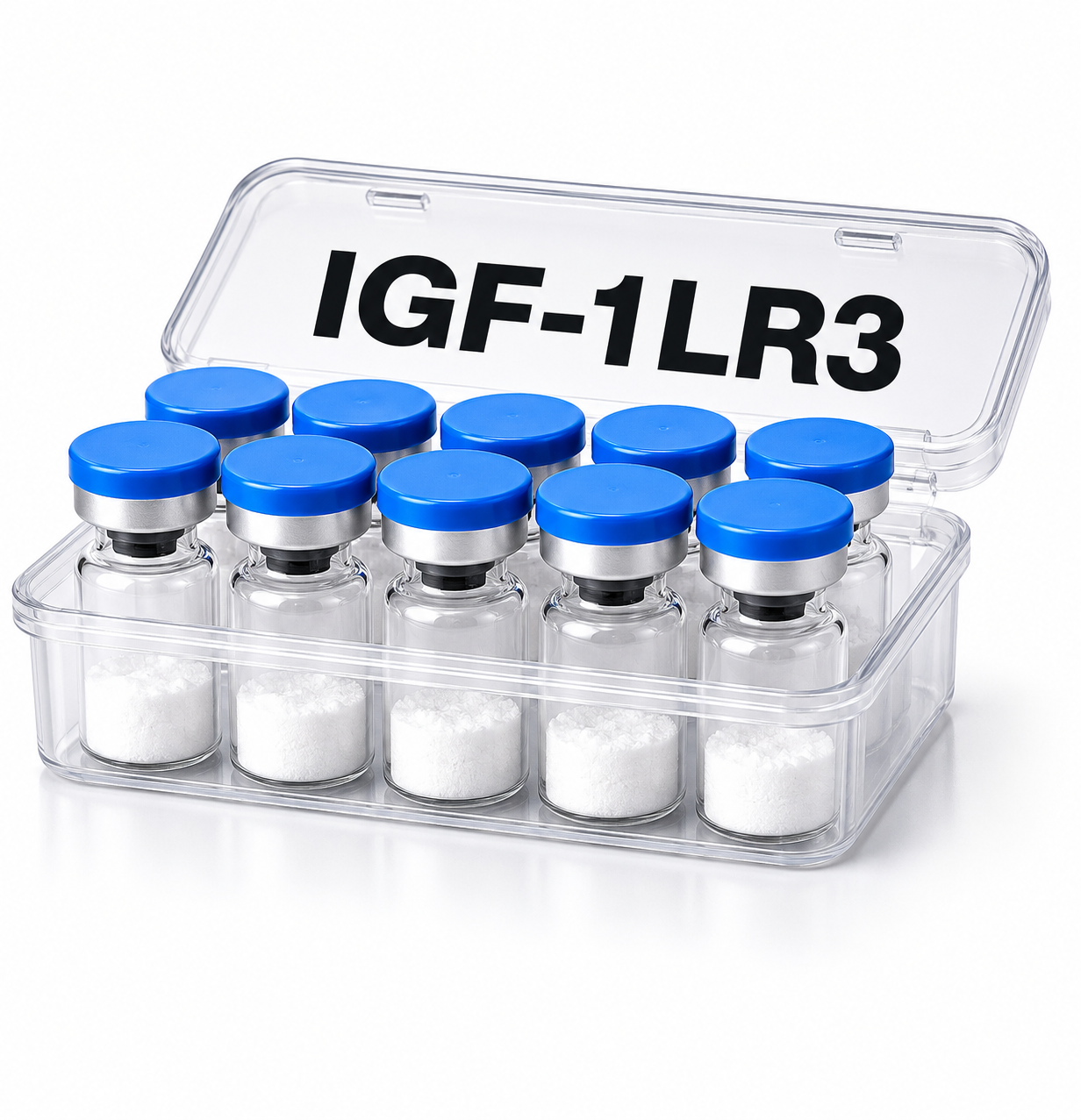
Buy IGF-1 LR3 Research Peptide | Superior Extended Half-Life IGF-1 Analogue | PrimaLab Peptide
IGF-1 LR3 (Long R3 Insulin-like Growth Factor-1) is a synthetic analogue of endogenous human IGF-1, engineered with two strategic structural modifications that dramatically extend its circulating half-life and biological activity compared to native IGF-1. Researchers who buy IGF-1 LR3 research peptide use it in cell culture and in vitro research models to investigate IGF-1 receptor signalling, protein synthesis mechanisms, cellular proliferation pathways, muscle cell biology, and metabolic effects of the IGF-1 axis — with the practical advantage of significantly reduced binding to IGF binding proteins (IGFBPs) compared to native IGF-1. PrimaLab Peptide supplies research-grade IGF-1 LR3 with batch-specific purity independently verified by Janoshik Analytical, with a full COA available with every order.
What Is IGF-1 LR3?
IGF-1 LR3, also known as Long R3 IGF-1, is an 83-amino acid synthetic analogue of human Insulin-like Growth Factor-1 (IGF-1) with two key structural modifications relative to the native 70-amino acid IGF-1 sequence:
- Arginine substitution at position 3 (R3) — replaces glutamic acid with arginine at the third amino acid position, significantly reducing binding affinity for IGF binding proteins (IGFBPs), particularly IGFBP-3
- 13-amino acid N-terminal extension — adds the sequence MFPAMPLSSLFVNG to the N-terminus, further reducing IGFBP binding and contributing to the extended half-life
Together, these modifications produce a compound with dramatically reduced IGFBP binding compared to native IGF-1. Since IGFBPs sequester native IGF-1 and limit its receptor availability in biological systems, the reduced IGFBP binding of IGF-1 LR3 results in a significantly extended effective half-life and more sustained receptor activation in research models. A comprehensive review of IGF-1 biology and its binding protein interactions is available through NIH StatPearls: Insulin-like Growth Factor and published PubMed research on IGF-1 LR3 IGFBP interactions.
The full amino acid sequence of IGF-1 LR3 is:
MFPAMPLSSLFVNGPRTLCGAELVDALQFVCGDRGFYFNKPTGYGSSSRRAPQTGIVDECCFRSCDLRRLEMYCAPLKPAKSA
Molecular formula: C₄₀₀H₆₂₅N₁₁₁O₁₁₅S₉ | MW: ~9.1 kDa | Length: 83 amino acids
IGF-1 LR3 Research Applications
IGF-1 LR3 is one of the most widely used research tools for studying IGF-1 receptor biology and downstream signalling in cell culture systems. Its extended effective half-life compared to native IGF-1 makes it particularly practical for research protocols requiring sustained IGF-1 receptor activation without repeated dosing intervals. Published research on PubMed has examined IGF-1 LR3 across a wide range of research applications:
- IGF-1 receptor signalling research: IGF-1 LR3 activates IGF-1R and insulin receptor (IR) in cell culture models, making it a standard tool for studying downstream signalling cascades including PI3K/Akt and MAPK/ERK pathways
- Protein synthesis research: Studies have examined IGF-1 LR3’s effects on mTOR pathway activation and downstream protein synthesis in skeletal muscle cell culture models — fundamental research in muscle biology and anabolic signalling
- Satellite cell activation and myogenesis research: IGF-1 LR3 is widely used in myoblast and satellite cell research to investigate muscle fibre formation, differentiation, and the molecular biology of myogenesis
- Cell proliferation and anti-apoptotic research: Research has examined IGF-1 LR3’s effects on cell survival pathways, proliferation rates, and anti-apoptotic signalling in multiple cell line research models
- Adipose tissue metabolism research: Studies have investigated IGF-1 LR3’s effects on adipocyte differentiation, glucose uptake, and lipid metabolism in fat cell research models
- GH axis research: As a key downstream mediator of growth hormone action, IGF-1 LR3 is used in GH axis research alongside CJC-1295, Ipamorelin, Sermorelin Acetate, and HGH to study downstream signalling at the effector level of the somatotropic axis
Critical Note on Reconstitution Solvent Selection
IGF-1 LR3 has a specific reconstitution requirement that differs from most standard research peptides. Due to its molecular structure and solubility profile, IGF-1 LR3 requires Acetic Acid Water 0.6% — not standard BAC Water — as the initial reconstitution solvent. The mildly acidic conditions (pH ~3.0–4.0) provided by the 0.6% acetic acid solution are necessary to achieve adequate initial dissolution. After reconstitution in Acetic Acid Water, the solution can be further diluted with BAC Water or sterile saline to reach the working concentration required for your specific research protocol.
Using an incorrect reconstitution solvent for IGF-1 LR3 can result in incomplete dissolution, peptide aggregation, and significantly reduced yield and biological activity in downstream research assays. Both Acetic Acid Water 0.6% and BAC Water are available separately from PrimaLab Peptide in our Accessories & Reconstitution Supplies section.
Purity & Third-Party Testing
Every batch of IGF-1 LR3 supplied by PrimaLab Peptide is independently tested by Janoshik Analytical. Due to the complexity of large peptide analytical characterisation at ~9.1 kDa, batch-specific COA documentation is provided with each order, confirming purity and identity by HPLC and mass spectrometry. Always review the current batch COA before ordering, as purity values are batch-specific. The COA is available on request — researchers should verify the batch document for their specific order.
Storage Guidelines
IGF-1 LR3 is supplied as a lyophilized powder for maximum stability during storage and transit.
- Sealed (lyophilized): Store at −20°C, protected from heat, moisture, and light. Keep the vial sealed until use
- Temperature: Minimise time at room temperature. Reduce temperature fluctuations during handling
- After reconstitution: Store at 2–8°C for short-term use. For longer storage, aliquot and freeze at −20°C. Avoid repeated freeze-thaw cycles
- Reconstitution solvent: Acetic Acid Water 0.6% for initial reconstitution — then dilute with BAC Water or sterile saline to working concentration
- Aseptic technique: Mandatory throughout all handling steps
Product Specifications
| Product Name | IGF-1 LR3 (Long R3 IGF-1) |
| Other Name | Long R3 Insulin-like Growth Factor-1 |
| Sequence | MFPAMPLSSLFVNGPRTLCGAELVDALQFVCGDRGFYFNKPTGYGSSSRRAPQTGIVDECCFRSCDLRRLEMYCAPLKPAKSA |
| Length | 83 amino acids |
| Molecular Formula | C₄₀₀H₆₂₅N₁₁₁O₁₁₅S₉ |
| Molecular Weight | ~9.1 kDa |
| Purity | Batch-specific — Janoshik COA provided with every order |
| Form | Lyophilized powder |
| Available Sizes | 0.5mg, 1mg |
| Storage (lyophilized) | −20°C, protect from heat, moisture and light |
| Storage (reconstituted) | 2–8°C short-term; −20°C aliquoted for longer storage |
| Reconstitution Solvent | Acetic Acid Water 0.6% (initial); dilute with BAC Water |
| Testing Lab | Janoshik Analytical |
| COA | Batch-specific — available on request |
| Intended Use | In vitro / in vivo laboratory research only |
Frequently Asked Questions — IGF-1 LR3 Research Peptide
What is IGF-1 LR3 used for in research?
Researchers who buy IGF-1 LR3 research peptide use it to investigate IGF-1 receptor signalling, downstream PI3K/Akt and MAPK/ERK pathway activation, protein synthesis and mTOR pathway research, satellite cell biology and myogenesis, cell proliferation and anti-apoptotic mechanisms, adipocyte metabolism, and GH axis downstream signalling. Its extended effective half-life compared to native IGF-1 makes it particularly practical for cell culture research protocols requiring sustained IGF-1 receptor activation. A comprehensive research literature base is available on PubMed.
What makes IGF-1 LR3 different from native IGF-1?
IGF-1 LR3 has two structural modifications relative to native IGF-1: an arginine substitution at position 3 and a 13-amino acid N-terminal extension. These modifications dramatically reduce binding to IGF binding proteins (IGFBPs) — particularly IGFBP-3 — which normally sequester native IGF-1 and limit its receptor availability. The result is a significantly extended effective half-life and more sustained IGF-1 receptor activation in research models. Native IGF-1 is rapidly bound and inactivated by IGFBPs in biological systems; IGF-1 LR3 remains receptor-active for substantially longer, making it more practical for most cell culture research applications.
What reconstitution solvent should I use for IGF-1 LR3?
IGF-1 LR3 requires Acetic Acid Water 0.6% for initial reconstitution — not standard BAC Water. The mildly acidic conditions (pH ~3.0–4.0) are necessary for adequate dissolution of IGF-1 LR3’s molecular structure. After initial reconstitution in Acetic Acid Water, the solution can be diluted to working concentration with BAC Water or sterile saline as required by your specific protocol. Both solvents are available from PrimaLab Peptide in our Accessories & Reconstitution Supplies section.
Is IGF-1 LR3 from PrimaLab Peptide independently tested?
Yes. Every batch is independently tested by Janoshik Analytical using HPLC and mass spectrometry. Due to the complexity of large peptide analytical characterisation at ~9.1 kDa, purity values are batch-specific — always review the current batch COA, which is available on request with every order. We do not publish unverified purity figures and do not batch-swap without notice.
What peptides are commonly studied alongside IGF-1 LR3?
As a downstream mediator of GH axis signalling, IGF-1 LR3 is frequently studied alongside upstream GH axis research compounds including HGH (Somatropin), CJC-1295, Ipamorelin, and Sermorelin Acetate — allowing researchers to study GH axis signalling at multiple levels simultaneously. For metabolic research, it is also studied alongside HGH Fragment 176-191 and AOD9604 in comparative GH fragment studies.
How should IGF-1 LR3 be stored after reconstitution?
After reconstitution in Acetic Acid Water 0.6%, store at 2–8°C for short-term research use. For longer-term storage, aliquot the reconstituted solution into single-use volumes and freeze at −20°C. Avoid repeated freeze-thaw cycles as each cycle degrades peptide integrity. Always maintain aseptic technique during handling and label vials with reconstitution date and concentration. Discard any solution that appears cloudy or precipitated.
What is the recommended vial size for IGF-1 LR3 research?
PrimaLab Peptide supplies IGF-1 LR3 in 0.5mg and 1mg lyophilized vials. The appropriate size depends on your specific research protocol, target working concentration, and frequency of use. Given IGF-1 LR3’s potency in cell culture systems — where it is typically used at nanogram-per-millilitre concentrations — even a 0.5mg vial provides substantial research capacity for most in vitro protocols. Consider aliquoting after reconstitution to avoid repeated freeze-thaw cycles regardless of which vial size you select.
Related Research Peptides
Researchers buying IGF-1 LR3 research peptide for GH axis and growth factor signalling studies frequently explore the following related compounds from PrimaLab Peptide:
- HGH (Somatropin) — full-length human growth hormone, upstream activator of endogenous IGF-1 production
- CJC-1295 — long-acting GHRH analogue for GH secretion research
- Ipamorelin — selective GH secretagogue frequently combined with CJC-1295
- Sermorelin Acetate — GHRH(1-29) analogue for pulsatile GH secretion research
- HGH Fragment 176-191 — C-terminal GH fragment studied for lipolytic pathway research
- AOD9604 — modified C-terminal GH fragment for comparative fat metabolism studies
Browse our complete Growth Hormone Peptides category. Bulk researchers and laboratory procurement teams can apply for discounted rates through our Wholesale Portal. Reconstitution supplies — including Acetic Acid Water 0.6% and BAC Water — are available in our Accessories & Reconstitution Supplies section.
⚠️ For in-vitro and in-vivo laboratory research use only. Not intended for human or veterinary consumption. Not a drug, supplement, food, cosmetic, or medical treatment. Researchers are solely responsible for compliance with all applicable local, national, and international regulations governing the purchase, storage, and use of research compounds. Must be handled by qualified research professionals in a controlled laboratory environment.
Reviews
There are no reviews yet.