
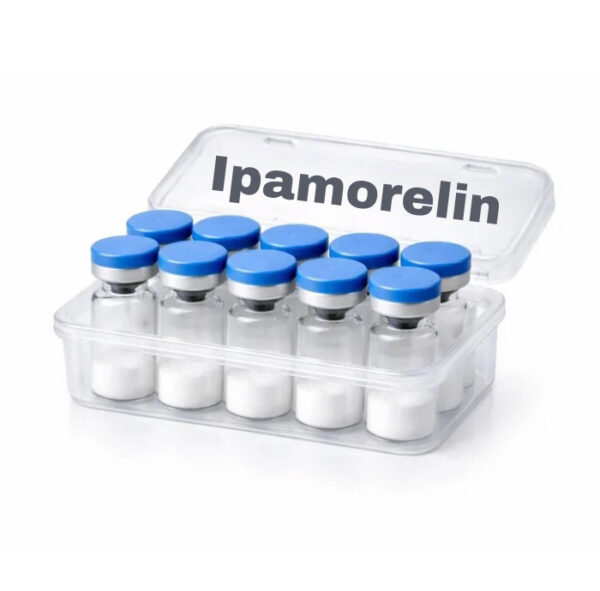
Buy Ipamorelin Peptide | Pure Selective GHSR-1a Growth Hormone Secretagogue | PrimaLab Peptide
Ipamorelin (NNC 26-0161) is a synthetic pentapeptide and one of the most selective growth hormone secretagogues (GHS) available for research use. Researchers who buy Ipamorelin peptide use it to investigate GHSR-1a (ghrelin receptor) biology, pulsatile GH secretion mechanisms, dose-dependent GH axis responses, and selective GH pathway activation without the cortisol, ACTH, or prolactin confounders associated with less selective growth hormone releasing peptides. Originally developed by Novo Nordisk in the late 1990s, Ipamorelin has accumulated a well-characterised research profile making it one of the most widely cited selective GHSR-1a agonists in published GH research. PrimaLab Peptide supplies research-grade Ipamorelin at ≥99% purity, independently verified by Janoshik Analytical via HPLC, with a full batch-specific Certificate of Analysis included with every order.
What Is Ipamorelin?
Ipamorelin is a synthetic pentapeptide (five amino acids) with the sequence Aib-His-D-2-Nal-D-Phe-Lys-NH₂. Its unusual sequence features three non-natural amino acid residues — Aib (alpha-aminoisobutyric acid), D-2-Nal (D-2-naphthylalanine), and D-Phe (D-phenylalanine) — that confer both metabolic stability and selectivity at the GHSR-1a ghrelin receptor. With a molecular formula of C₃₈H₄₉N₉O₅ and a molecular weight of 711.85 g/mol (CAS: 170851-70-4), it is a compact, well-characterised research tool for GH secretagogue pathway studies.
The ghrelin receptor (GHSR-1a) is a G protein-coupled receptor (GPCR) expressed on pituitary somatotroph cells, hypothalamic neurons, and peripheral tissues. Its activation by Ipamorelin stimulates GH secretion in a dose-dependent, pulsatile pattern — mimicking the episodic GH release characteristic of endogenous GH biology. A review of GHSR-1a biology and ghrelin receptor pharmacology is available through published PubMed research on ghrelin receptor agonists.
Why Ipamorelin’s Selectivity Profile Matters for Research
The most research-significant characteristic of Ipamorelin compared to other growth hormone releasing peptides (GHRPs) is its exceptional selectivity at GHSR-1a. Most other GHRPs — including GHRP-2, GHRP-6, and Hexarelin — also stimulate the release of ACTH, cortisol, and/or prolactin at research doses, introducing confounding hormonal variables that complicate data interpretation in GH-specific research designs:
- GHRP-6: Stimulates GH release but also significantly increases cortisol and ACTH, and produces notable ghrelin-mediated appetite stimulation effects — creating multiple confounders in GH research protocols
- GHRP-2: More potent GH stimulation than GHRP-6 but also raises cortisol, ACTH, and prolactin at research doses
- Hexarelin: Potent GH stimulation but associated with the most pronounced cortisol and prolactin elevation of the major GHRPs
- Ipamorelin: Selective GHSR-1a agonism with dose-dependent, pulsatile GH stimulation and minimal effect on ACTH, cortisol, or prolactin at research doses — providing the cleanest GH-specific research data of the GHRP class
This selectivity profile makes Ipamorelin the preferred GHSR-1a research tool when studies require isolation of GH secretagogue effects without endocrine confounders. Published research supporting this selectivity profile is available through PubMed research on Ipamorelin selectivity.
Ipamorelin Research Applications
- GHSR-1a receptor biology research: Ipamorelin is the reference selective GHSR-1a agonist for studying ghrelin receptor signalling, GHS-R1a binding kinetics, and downstream cAMP and calcium signalling cascades in pituitary somatotroph cell research
- Pulsatile GH secretion research: Ipamorelin’s ~2-hour plasma half-life produces well-defined pulsatile GH release windows — making experimental dosing windows predictable and allowing precise temporal control of GHSR-1a activation in research protocols
- Dose-dependent GH axis research: Research has established clear dose-response relationships for Ipamorelin-mediated GH release, making it a quantitative research tool for studying GH axis responsiveness
- Dual-pathway GH axis research: Ipamorelin is most commonly studied in combination with GHRH analogues — particularly as part of the CJC-1295 + Ipamorelin Blend — for research examining synergistic GH axis stimulation through simultaneous GHRH receptor (amplitude modulation) and GHSR-1a (frequency modulation) activation
- Comparative GHRP selectivity research: Ipamorelin’s clean selectivity profile makes it an important comparator in studies examining the relative endocrine effects of different GHRPs, helping researchers isolate GH-specific effects from off-target hormonal activity
- IGF-1 axis downstream research: GH release stimulated by Ipamorelin produces downstream IGF-1 responses studied alongside IGF-1 LR3 for comprehensive GH/IGF-1 axis research from receptor activation to effector level
Purity & Third-Party Testing
Every batch of Ipamorelin supplied by PrimaLab Peptide is independently tested by Janoshik Analytical:
- HPLC — quantitative purity confirmed at ≥99%
- COA — batch-specific Certificate of Analysis showing purity percentage, identity confirmation, and lot number — available for download, no account required
Third-party testing through an independent laboratory is the standard for credible research peptides. The Janoshik report shows independently generated data — not internal supplier testing. The batch-specific COA is included with every order. Stable for up to 4 years as lyophilized powder under correct −20°C storage.
Storage & Reconstitution
- Lyophilized (sealed): Store at −20°C in a sealed container, away from moisture. Stable for up to 4 years under these conditions. Moisture is the primary degradation risk for lyophilized Ipamorelin — keep sealed and dry
- After reconstitution: Store at 2–8°C and use within 2–3 weeks
- Reconstitution solvent: Reconstitute in sterile water or Bacteriostatic Water (BAC Water). BAC Water is preferred for multi-use vials over the 2–3 week post-reconstitution window. Add solvent slowly down the inside vial wall — do not inject directly onto powder. Swirl gently — do not shake
- Freeze-thaw cycles: Avoid repeated freeze-thaw of reconstituted solution — each cycle degrades peptide integrity. Reconstitute only the volume needed for your current research window
Product Specifications
| Name | Ipamorelin (NNC 26-0161) |
| CAS Number | 170851-70-4 |
| Sequence | Aib-His-D-2-Nal-D-Phe-Lys-NH₂ |
| Molecular Formula | C₃₈H₄₉N₉O₅ |
| Molecular Weight | 711.85 g/mol |
| Amino Acids | 5 (pentapeptide) |
| Receptor Target | GHSR-1a (ghrelin receptor) |
| Plasma Half-Life | ~2 hours |
| Purity | ≥99% (Janoshik HPLC verified) |
| Form | Lyophilized white powder |
| Available Sizes | 2mg, 5mg, 10mg |
| Storage (lyophilized) | −20°C, sealed, away from moisture — stable up to 4 years |
| Storage (reconstituted) | 2–8°C, use within 2–3 weeks |
| Reconstitution | Sterile water or Bacteriostatic Water (BAC Water) |
| Testing Lab | Janoshik Analytical (independent) |
| COA | Batch-specific — included with every order |
| Intended Use | Laboratory research only — not for human use |
Frequently Asked Questions — Ipamorelin Peptide
What is Ipamorelin used for in research?
Researchers who buy Ipamorelin peptide use it to investigate GHSR-1a ghrelin receptor biology, pulsatile GH secretion mechanisms, dose-dependent GH axis responses, selective GH secretagogue pharmacology without cortisol/ACTH confounders, dual-pathway GH axis research in combination with GHRH analogues, and downstream IGF-1 axis effector studies. Its well-defined ~2-hour half-life makes experimental dosing windows predictable, and its exceptional selectivity profile provides the cleanest GH-specific research data of the GHRP class. Published literature is available on PubMed.
Why is Ipamorelin more selective than GHRP-2 or GHRP-6?
Ipamorelin’s selectivity arises from its unique pentapeptide sequence featuring non-natural amino acids (Aib, D-2-Nal, D-Phe) that produce a distinct GHSR-1a binding profile. Unlike GHRP-2 and GHRP-6 — which stimulate GH release but also significantly raise cortisol, ACTH, and prolactin at research doses — Ipamorelin’s GHSR-1a engagement produces dose-dependent GH release with minimal effect on other pituitary hormones. This selectivity makes Ipamorelin the preferred research tool when GH-specific data is required without endocrine confounders from cortisol or prolactin elevation.
How does Ipamorelin complement CJC-1295 in dual-pathway GH research?
Ipamorelin and CJC-1295 act on completely independent GH secretion pathways — Ipamorelin through GHSR-1a (increasing GH pulse frequency) and CJC-1295 through GHRH receptors (increasing GH pulse amplitude). Research combining both allows simultaneous study of amplitude and frequency modulation of GH axis activity — a dual-pathway approach that produces synergistic GH secretion in research models. This combination is available as the CJC-1295 + Ipamorelin Blend from PrimaLab Peptide.
Is Ipamorelin from PrimaLab Peptide independently tested?
Yes. Every batch is independently verified by Janoshik Analytical at ≥99% purity via HPLC. The batch-specific COA is included with every order and available for download — no account required. Lyophilized Ipamorelin is stable for up to 4 years under correct −20°C storage conditions.
What is the significance of Ipamorelin’s ~2-hour plasma half-life for research?
The ~2-hour plasma half-life of Ipamorelin is a research design advantage rather than a limitation. It produces discrete, predictable GH release pulses with well-defined experimental windows — allowing researchers to study acute GHSR-1a-mediated GH responses, recovery periods, and repeated pulse dynamics with precise temporal control. This is particularly valuable for research comparing pulsatile GH secretion patterns, studying receptor desensitisation kinetics, and designing protocols where defined GH stimulation and clearance windows are required.
What peptides are commonly studied alongside Ipamorelin?
Researchers buying Ipamorelin peptide for GH axis research frequently explore CJC-1295 (GHRH analogue for dual-pathway combination research), Sermorelin Acetate (GHRH(1-29) for comparative GHRH research), Tesamorelin (full GHRH analogue for metabolic GH research), HGH (direct GH receptor activation), and IGF-1 LR3 (downstream GH axis effector). The CJC-1295 + Ipamorelin Blend is also available as a convenient pre-combined dual-pathway research formulation.
Related Research Peptides
Researchers buying Ipamorelin peptide for GH secretagogue and pituitary research frequently explore:
- CJC-1295 + Ipamorelin Blend — pre-combined dual-pathway GH research stack
- CJC-1295 (with DAC) — long-acting GHRH analogue for sustained GH axis research
- Sermorelin Acetate — GHRH(1-29) for comparative pulsatile GH research
- Tesamorelin — full GHRH analogue for metabolic and visceral fat GH research
- HGH (Somatropin) — recombinant growth hormone for direct GHR activation research
- IGF-1 LR3 — downstream GH axis effector for GH/IGF-1 axis research
Browse our complete Growth Hormone Peptides category. Bulk researchers can apply for discounted rates through our Wholesale Portal. Reconstitute with BAC Water, available in our Accessories & Reconstitution Supplies section.
⚠️ For laboratory research use only. Not approved for human use or therapeutic application. Not a drug, supplement, or medical treatment. Researchers are solely responsible for compliance with all applicable local, national, and international regulations governing the purchase, storage, and use of research compounds.
Reviews
There are no reviews yet.