
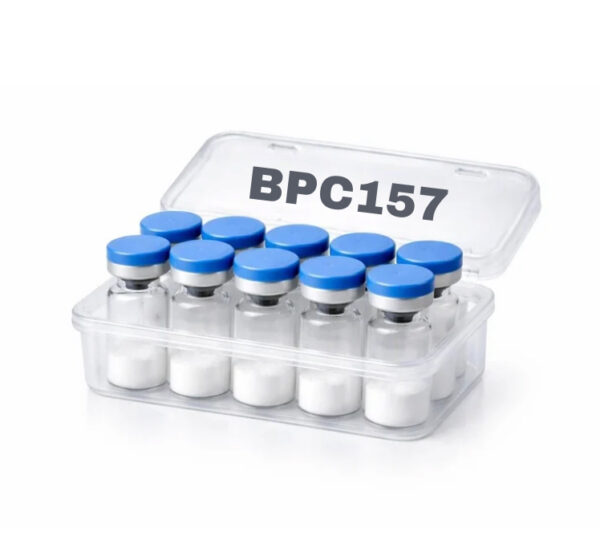
Buy BPC-157 Peptide | Proven Body Protection Compound for Tissue Repair Research | PrimaLab Peptide
BPC-157 (Body Protection Compound 157) is a synthetic 15-amino acid pentadecapeptide and one of the most extensively studied healing research peptides in published preclinical science. Derived from a protective protein sequence found in human gastric juice, BPC-157 has been the subject of a broad and growing body of preclinical research examining multi-system tissue repair, gastrointestinal mucosal protection, angiogenesis, tendon and ligament biology, and neuroprotective mechanisms.
Researchers who buy BPC-157 peptide use it across a wide range of in vitro and in vivo research models for its versatile and well-characterised healing pathway activity. PrimaLab Peptide supplies research-grade BPC-157 at 99.36% purity, independently verified by Janoshik Analytical via HPLC and mass spectrometry, with a full batch-specific Certificate of Analysis included with every order.
What Is BPC-157?
BPC-157 (Body Protection Compound 157) is a synthetic pentadecapeptide — a chain of 15 amino acids — with the sequence Gly-Glu-Pro-Pro-Pro-Gly-Lys-Pro-Ala-Asp-Asp-Ala-Gly-Leu-Val. It was identified as a partial sequence derived from a larger protective protein (Body Protection Compound) found in human gastric juice — the body’s own gastric environment, which has evolved robust tissue-protective mechanisms. The isolated BPC-157 sequence was synthesised and studied independently of the parent protein.
Key technical identifiers: CAS: 137525-51-0 | Molecular formula: C₆₂H₉₈N₁₆O₂₂ | MW: 1419.53 g/mol. BPC-157 is also referred to in research literature as BPC 157, pentadecapeptide BPC 157, and by the CAS number 137525-51-0. A comprehensive overview of BPC-157’s research background is available through published PubMed research on BPC-157.
One important note on BPC-157’s research profile: it is notably stable in human gastric juice in vitro — a property relevant to gastrointestinal research models and that distinguishes it from many peptides that would be rapidly degraded in gastric conditions. This stability in acidic environments also contributes to its suitability for a range of research buffer conditions.
BPC-157 Research Applications
BPC-157 has one of the broadest research profiles of any synthetic healing peptide, with published preclinical research spanning multiple tissue types and biological systems. The published literature available on PubMed has examined BPC-157 across the following research areas:
- Gastrointestinal mucosal biology research: BPC-157 was originally studied in the context of gastrointestinal protection, with published research examining its effects on gastric mucosal integrity, ulcer healing research models, intestinal anastomosis repair research, and protection against NSAID-induced gastric damage in animal models. Its gastric juice origin and gastric acid stability make it a particularly relevant tool for GI research
- Angiogenesis research: Studies have examined BPC-157’s effects on VEGF (vascular endothelial growth factor) upregulation and new blood vessel formation in wound healing and tissue repair research models — a key mechanism for supplying nutrients and oxygen to regenerating tissue
- Tendon and ligament biology research: Research has examined BPC-157’s effects on tendon cell proliferation, collagen organisation, and repair in tendon injury research models — one of its most published research areas alongside gastrointestinal biology
- Muscle tissue repair research: Studies have examined BPC-157’s effects on muscle cell repair and regeneration in research models, frequently studied alongside TB-500 (Thymosin Beta-4) for complementary actin-regulated and growth factor-mediated healing mechanisms
- Neuroprotective mechanism research: Research has explored BPC-157’s effects on neurological tissue in various research models, including effects on dopaminergic system pathways and neuroprotective signalling
- Anti-inflammatory pathway research: Studies have examined BPC-157’s interaction with nitric oxide system pathways and pro-inflammatory cytokine modulation in tissue repair research contexts
- Growth factor pathway research: Research has investigated BPC-157’s interactions with growth factor receptor pathways — including VEGFR and EGFR — as potential mediators of its multi-system tissue repair research activity
BPC-157 is the foundational compound in PrimaLab Peptide’s Healing & Repair Peptides category. It is available individually and as part of several research combinations: the BPC-157 + TB-500 Blend, the Glow Blend (TB-500 + BPC-157 + GHK-Cu), and the Klow Blend (TB-500 + BPC-157 + GHK-Cu + KPV).
Purity & Third-Party Testing
Every batch of BPC-157 supplied by PrimaLab Peptide is independently tested by Janoshik Analytical:
- HPLC (High-Performance Liquid Chromatography) — quantitative purity determination confirmed at 99.36%
- Mass Spectrometry — molecular identity confirmation (MW: 1419.53 g/mol, CAS: 137525-51-0), verifying the complete 15-amino acid sequence
The 99.36% purity figure is an independently generated Janoshik lab result — not a supplier claim. The batch-specific COA is available on the product page and included with every order. Verify the batch number on your vial against the COA document before use in any research protocol. The purity floor across PrimaLab Peptide’s full catalog is ≥99% — BPC-157 at 99.36% exceeds this standard.
Storage & Reconstitution
BPC-157 is supplied as a white to off-white lyophilized powder.
- Long-term storage (sealed): −20°C, sealed and away from light — standard lyophilized peptide freezer storage
- Short-term storage (sealed): 4°C for up to 4 weeks is acceptable with minimal disruption
- After reconstitution: Store at 4°C. Use within 4 weeks post-reconstitution. Do not freeze reconstituted solution — freeze-thaw cycles degrade peptide integrity rapidly
- Reconstitution solvent: Reconstitute with Bacteriostatic Water (BAC Water) or sterile saline. BAC Water extends post-reconstitution stability through bacteriostatic preservation. Add solvent slowly down the inside vial wall — never directly onto the lyophilized powder. Swirl gently — do not shake or vortex
- Light protection: Keep vial away from direct light during reconstitution and storage
- Freeze-thaw cycles: Avoid — aliquot working doses before storage if multiple experiments are planned from the same batch
Product Specifications
| Full Name | Body Protection Compound 157 (BPC-157) |
| CAS Number | 137525-51-0 |
| Sequence | Gly-Glu-Pro-Pro-Pro-Gly-Lys-Pro-Ala-Asp-Asp-Ala-Gly-Leu-Val |
| Amino Acids | 15 (pentadecapeptide) |
| Molecular Formula | C₆₂H₉₈N₁₆O₂₂ |
| Molecular Weight | 1419.53 g/mol |
| Purity | 99.36% (Janoshik HPLC + Mass Spectrometry verified) |
| Form | Lyophilized white to off-white powder |
| Available Sizes | 2mg, 5mg, 10mg |
| Appearance | White to off-white powder |
| Storage (long-term) | −20°C sealed, away from light |
| Storage (short-term) | 4°C for up to 4 weeks sealed |
| Storage (reconstituted) | 4°C, use within 4 weeks — do not freeze |
| Reconstitution | BAC Water or sterile saline |
| Testing Lab | Janoshik Analytical (independent third-party) |
| COA | Batch-specific — included with every order |
| Intended Use | For research purposes only — not for human or veterinary use |
Frequently Asked Questions — BPC-157 Peptide
What is BPC-157 used for in research?
Researchers who buy BPC-157 peptide use it to investigate gastrointestinal mucosal protection and ulcer healing mechanisms, VEGF-mediated angiogenesis in tissue repair research, tendon and ligament repair biology, muscle tissue regeneration research, neuroprotective signalling, nitric oxide and anti-inflammatory pathway interactions, and growth factor receptor (VEGFR, EGFR) pathway modulation. Its gastric acid stability and multi-system tissue repair profile make it one of the most versatile healing research peptides available. The published preclinical literature is available on PubMed.
Why is BPC-157 stable in gastric juice, and why does this matter for research?
BPC-157’s notable stability in human gastric juice in vitro is a distinctive research property. Most peptides would be rapidly degraded by gastric proteases (pepsin) and the highly acidic gastric environment (pH ~1.5–3.5). BPC-157’s resistance to this degradation reflects features of its amino acid composition and sequence — and is directly relevant to its utility as a research tool in gastrointestinal mucosal biology studies, where stability in gastric conditions allows study of its effects in highly relevant in vitro gut models. This stability also provides practical research flexibility across a range of acidic buffer conditions.
How pure is PrimaLab Peptide’s BPC-157?
Our BPC-157 tests at 99.36% purity — independently verified by Janoshik Analytical via HPLC and mass spectrometry identity confirmation (MW: 1419.53 g/mol). This is a documented independent lab result — not a supplier-generated marketing claim. The batch-specific COA is available on the product page and included with every order. Verify the batch number against the COA before use.
How should BPC-157 be reconstituted?
Reconstitute BPC-157 with Bacteriostatic Water (BAC Water) or sterile saline. Add the solvent slowly down the inside wall of the vial — never spray directly onto the lyophilized powder. Swirl gently until fully dissolved — do not shake. The reconstituted solution should be clear and colourless. Store at 4°C and use within 4 weeks. Do not freeze reconstituted BPC-157 — freeze-thaw cycling rapidly degrades peptide integrity.
What peptides are most commonly studied alongside BPC-157?
BPC-157 is most frequently studied in combination with TB-500 (Thymosin Beta-4) for complementary dual-pathway healing research — available as the BPC-157 + TB-500 Blend. For extended triple-compound healing stacks, researchers explore the Glow Blend (TB-500 + BPC-157 + GHK-Cu) and Klow Blend (TB-500 + BPC-157 + GHK-Cu + KPV). Individual companion compounds also studied alongside BPC-157 include GHK-Cu (collagen synthesis research) and KPV Peptide (anti-inflammatory melanocortin research).
Is BPC-157 the same as Semax or TB-500?
No — these are completely distinct research peptides. BPC-157 (15 amino acids, gastric juice origin, CAS 137525-51-0) is studied for multi-system tissue repair, gastrointestinal protection, and angiogenesis research. TB-500 (43 amino acids, Thymosin Beta-4 fragment) is studied for actin-mediated cellular migration and tissue regeneration. Semax (7 amino acids, ACTH analogue) is studied for BDNF modulation and neuroprotection. Each serves distinct research applications and should not be substituted for one another.
Related Research Peptides
Researchers buying BPC-157 peptide for tissue repair and healing research frequently explore:
- TB-500 (Thymosin Beta-4 Acetate) — actin-regulated cellular migration and tissue regeneration peptide
- BPC-157 + TB-500 Blend — foundational dual healing research combination
- GHK-Cu (Copper Peptide) — collagen synthesis and dermal matrix research peptide
- KPV Peptide — alpha-MSH C-terminal tripeptide for anti-inflammatory pathway research
- Glow Blend (TB-500 + BPC-157 + GHK-Cu) — triple healing research stack
- Klow Blend (TB-500 + BPC-157 + GHK-Cu + KPV) — quad healing research stack
- Thymosin Alpha-1 — immunomodulatory peptide for immune function and healing research
Browse our complete Healing & Repair Peptides category. Bulk researchers can apply for discounted rates through our Wholesale Portal. Reconstitute with BAC Water or sterile saline, available in our Accessories & Reconstitution Supplies section.
⚠️ For research purposes only. Not for human or veterinary use. Not a drug. Not intended to diagnose, treat, cure, or prevent any condition. All products are sold strictly for in-vitro laboratory research. Comply with all applicable laws in your jurisdiction.
Reviews
There are no reviews yet.