
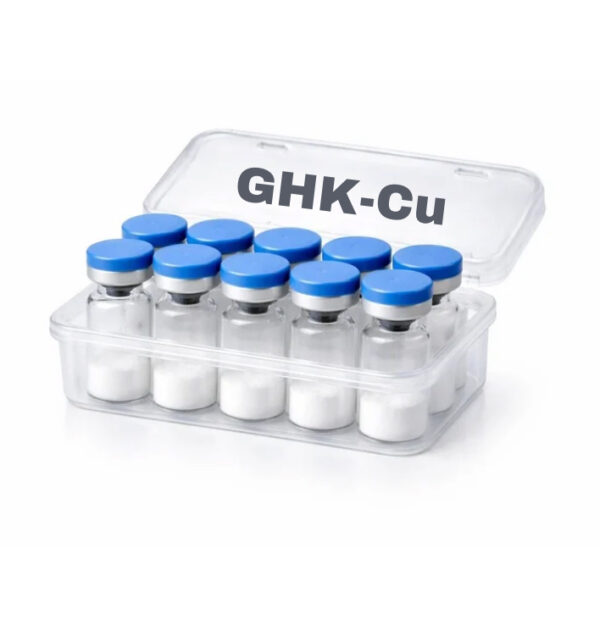
Buy GHK-Cu Peptide | Pure Copper Peptide for Wound Healing & Tissue Research | PrimaLab Peptide
GHK-Cu (Glycyl-L-histidyl-L-lysine copper II) is a naturally occurring copper peptide complex found in human blood, saliva, and urine — first identified in the 1970s by Dr. Loren Pickart and now one of the most extensively studied peptides in wound healing, tissue remodelling, and dermal biology research. Researchers who buy GHK-Cu peptide use it to investigate collagen synthesis stimulation, wound healing and repair mechanisms, antioxidant pathway biology, anti-inflammatory signalling, extracellular matrix remodelling, and gene expression regulation in cell culture and research models. PrimaLab Peptide supplies research-grade GHK-Cu at ≥98% purity, independently verified by Janoshik Analytical via HPLC, with a full batch-specific Certificate of Analysis included with every order.
What Is GHK-Cu?
GHK-Cu is the copper (II) complex of the tripeptide Glycyl-L-histidyl-L-lysine (Gly-His-Lys). The free tripeptide has the molecular formula C₁₄H₂₂N₆O₄ and MW ~340.84 g/mol, while the copper complex (the biologically active form studied in research) has the formula C₁₄H₂₄CuN₆O₄ and MW 403.92 g/mol (CAS: 49557-75-7). The copper (II) ion is coordinated through the peptide’s histidine imidazole nitrogen, the N-terminal amine, and the lysine residue — forming a stable copper-peptide complex with distinct biological activity compared to either the free peptide or free copper ion alone.
Visually, GHK-Cu is immediately distinguishable from most research peptides by its blue crystalline powder appearance — the characteristic colour of the copper complex — rather than the white powder of copper-free peptides. This visual characteristic also serves as a useful quality indicator: correctly complexed GHK-Cu should appear distinctly blue; colourless or white powder may indicate incomplete copper complexation.
GHK-Cu is one of the longest-studied synthetic peptides in biomedical research, with peer-reviewed publications dating back to the 1970s. The full published research literature is available through PubMed research on GHK-Cu.
GHK-Cu Research Applications
GHK-Cu has one of the most extensive published research profiles of any synthetic copper peptide, spanning wound healing biology, dermal science, antioxidant research, and gene expression regulation. Key published research areas include:
- Collagen and glycosaminoglycan synthesis research: GHK-Cu has been studied extensively for its effects on collagen synthesis stimulation in fibroblast cell culture research models — one of its most published research applications since the earliest studies in the 1980s. Research has examined effects on collagen I, III, and IV production and glycosaminoglycan synthesis in dermal research contexts
- Wound healing and tissue repair research: Published research has examined GHK-Cu’s effects on wound contraction, epithelial cell migration, granulation tissue formation, and overall wound healing rate in research models — establishing it as a key copper peptide tool in tissue repair research
- Antioxidant pathway research: GHK-Cu has been studied for its interactions with superoxide dismutase (SOD) pathways and its role in managing reactive oxygen species in research models — relevant to oxidative stress biology research alongside compounds such as Glutathione
- Anti-inflammatory marker research: Multiple in-vitro studies have examined GHK-Cu’s effects on cytokine modulation and inflammatory marker expression in cell culture research models
- Gene expression regulation research: A landmark 2010 study by Pickart et al. identified over 4,000 human genes potentially influenced by GHK-Cu, including genes involved in tissue remodelling, anti-inflammatory responses, antioxidant defence, and DNA repair — making GHK-Cu one of the most gene-active small peptides identified. This research is available through PubMed research on GHK-Cu gene expression
- Hair follicle biology research: Studies have examined GHK-Cu’s effects on hair follicle size, hair shaft diameter, and hair growth in research models — an application area driven by its known roles in tissue remodelling and growth factor signalling
- Nerve tissue regeneration research: Research has examined GHK-Cu in neural tissue repair research models, expanding its tissue repair research profile beyond dermal applications
GHK-Cu is a dual-category research compound at PrimaLab Peptide — classified in both Healing & Repair Peptides and as a component of cosmetic peptide research. It is available individually and as a component of the Glow Blend (TB-500 + BPC-157 + GHK-Cu) and the Klow Blend (TB-500 + BPC-157 + GHK-Cu + KPV).
The Importance of Copper Complexation for Research Validity
A critical quality consideration for GHK-Cu research is the completeness of copper complexation. GHK-Cu (the copper complex) is not the same research compound as GHK (the free tripeptide without copper). They have different molecular weights, different spectroscopic characteristics, and different biological activities in research models. Researchers should verify:
- Correct MW by mass spectrometry: GHK-Cu complex MW is 403.92 g/mol; the free GHK tripeptide without copper is ~340.84 g/mol. Mass spectrometry confirmation of the correct MW verifies complete copper complexation
- Blue appearance: Correctly complexed GHK-Cu should appear as a blue crystalline powder. Colourless or white powder may indicate incomplete copper complexation or decomplexation during storage
- CAS number: GHK-Cu is CAS 49557-75-7; the copper-free GHK tripeptide has a different CAS. Confirm the CAS on your COA matches the copper complex
PrimaLab Peptide’s GHK-Cu is verified by Janoshik Analytical at ≥98% purity with identity confirmation — ensuring the copper complex is correctly formed before dispatch.
Purity & Third-Party Testing
Every batch of GHK-Cu supplied by PrimaLab Peptide is independently tested by Janoshik Analytical:
- HPLC — quantitative purity confirmed at ≥98%
- Contaminant verification — confirmed absence of contaminants and correct peptide sequence identity
The batch-specific COA is a downloadable PDF included with every order. Every batch has its own COA — not a recycled template. Check the purity figure and batch number on your COA against the vial before use in any research protocol.
Storage & Reconstitution
- Long-term storage (lyophilized): −20°C, sealed, away from moisture and UV light. Standard lyophilized peptide freezer storage
- Short-term storage: 4°C (standard fridge). Use within 4 weeks after reconstitution
- Pre-reconstitution: Allow the sealed vial to warm to room temperature before opening — this prevents condensation from entering the vial and contacting the powder
- Reconstitution: Reconstitute with Bacteriostatic Water (BAC Water) or sterile water. Add solvent slowly down the inside vial wall. Swirl gently — do not shake. The blue colour should dissolve into a clear blue-tinted solution
- Freeze-thaw cycles: Avoid repeated freeze-thaw cycles — each cycle risks disrupting copper complexation stability. Aliquot before freezing if multiple research uses are planned
- Light protection: GHK-Cu is sensitive to UV — protect from direct light during reconstitution and storage
Product Specifications
| Full Name | Glycyl-L-histidyl-L-lysine copper (II) — GHK-Cu |
| CAS Number | 49557-75-7 |
| Sequence | Gly-His-Lys + Cu(II) ion |
| Molecular Formula | C₁₄H₂₄CuN₆O₄ (copper complex) |
| Molecular Weight | 403.92 g/mol (copper complex) |
| Purity | ≥98% (Janoshik HPLC verified) |
| Form | Blue crystalline lyophilized powder |
| Available Sizes | 50mg, 100mg |
| Appearance | Blue crystalline powder (characteristic of Cu(II) complex) |
| Storage | −20°C, away from light and moisture |
| Reconstitution | BAC Water or sterile water |
| Testing Lab | Janoshik Analytical (independent third-party) |
| COA | Batch-specific downloadable PDF — included with every order |
| Intended Use | Research purposes only — not for human consumption |
Frequently Asked Questions — GHK-Cu Peptide
What is GHK-Cu used for in research?
Researchers who buy GHK-Cu peptide use it to investigate collagen and glycosaminoglycan synthesis stimulation, wound healing and tissue repair mechanisms, antioxidant pathway biology (including SOD interactions), anti-inflammatory cytokine modulation, gene expression regulation (including the landmark finding of 4,000+ potentially influenced genes), hair follicle biology, and nerve tissue regeneration. Its research history spans from the 1970s to the present, with an extensive peer-reviewed literature base on PubMed.
Why does GHK-Cu appear blue instead of white like most peptides?
The blue colour of GHK-Cu is the characteristic visible absorption of the copper (II) ion in its complexed form — the same reason copper compounds are blue in chemistry. The GHK tripeptide without copper is colourless/white; GHK-Cu with the Cu(II) ion complexed appears distinctly blue. This colour is both a quality indicator (correctly complexed product) and a practical identification feature. A colourless or white GHK-Cu product may indicate incomplete copper complexation and should be verified by mass spectrometry MW confirmation (403.92 g/mol for the copper complex vs. ~340.84 g/mol for the free peptide).
What is the difference between GHK (free peptide) and GHK-Cu (copper complex) in research?
GHK (Gly-His-Lys, the copper-free tripeptide) and GHK-Cu (the copper complex) are distinct research compounds with different molecular weights, spectroscopic properties, and biological activities in research models. The copper (II) ion in GHK-Cu is not merely a spectator — it contributes to the compound’s biological research activity through electron transfer chemistry, superoxide dismutase interactions, and the specific spatial geometry of the copper-peptide complex. Research specifically examining GHK-Cu biology requires the correctly complexed copper form, not the free peptide. Always confirm CAS 49557-75-7 and MW 403.92 g/mol on your COA to verify you have the correct copper complex.
Is GHK-Cu from PrimaLab Peptide independently tested?
Yes. Every batch is independently verified by Janoshik Analytical at ≥98% purity via HPLC with contaminant verification and sequence identity confirmation. The batch-specific COA is a downloadable PDF available per batch — check the purity figure and batch number against your vial. Every batch has its own COA, not a recycled template from a previous lot.
What peptides are commonly studied alongside GHK-Cu?
Researchers buying GHK-Cu peptide for healing and tissue repair research frequently explore complementary compounds from PrimaLab Peptide’s Healing & Repair Peptides category including BPC-157 (multi-system tissue repair and angiogenesis research), TB-500 (Thymosin Beta-4) (actin-mediated cellular migration), and KPV Peptide (anti-inflammatory melanocortin pathway research). GHK-Cu is also a component of both the Glow Blend and Klow Blend healing research stacks.
How should GHK-Cu be reconstituted and stored after reconstitution?
Reconstitute GHK-Cu with Bacteriostatic Water or sterile water. Allow the sealed vial to reach room temperature before opening to prevent condensation. Add solvent slowly down the inside vial wall and swirl gently — do not shake. The reconstituted solution should be clear with a light blue tint from the copper complex. Store at 4°C after reconstitution and use within 4 weeks. Avoid repeated freeze-thaw cycles. Protect from direct UV light during handling and storage.
Related Research Peptides
Researchers buying GHK-Cu peptide for tissue repair and healing research frequently explore:
- BPC-157 — body protection compound for multi-system tissue repair research
- TB-500 (Thymosin Beta-4 Acetate) — actin-regulated tissue regeneration peptide
- KPV Peptide — alpha-MSH C-terminal tripeptide for anti-inflammatory research
- Glow Blend (TB-500 + BPC-157 + GHK-Cu) — triple healing research stack
- Klow Blend (TB-500 + BPC-157 + GHK-Cu + KPV) — quad healing research stack
- Glutathione (GSH) — master antioxidant for complementary redox and oxidative stress research
Browse our complete Healing & Repair Peptides category. Bulk researchers can apply for discounted rates through our Wholesale Portal. Reconstitute with BAC Water, available in our Accessories & Reconstitution Supplies section.
⚠️ For research purposes only. Not for human consumption. Not a drug, supplement, or medical treatment. No medical claims are made. Researchers are solely responsible for compliance with all applicable local regulations governing the purchase, storage, and use of research compounds.
Reviews
There are no reviews yet.