
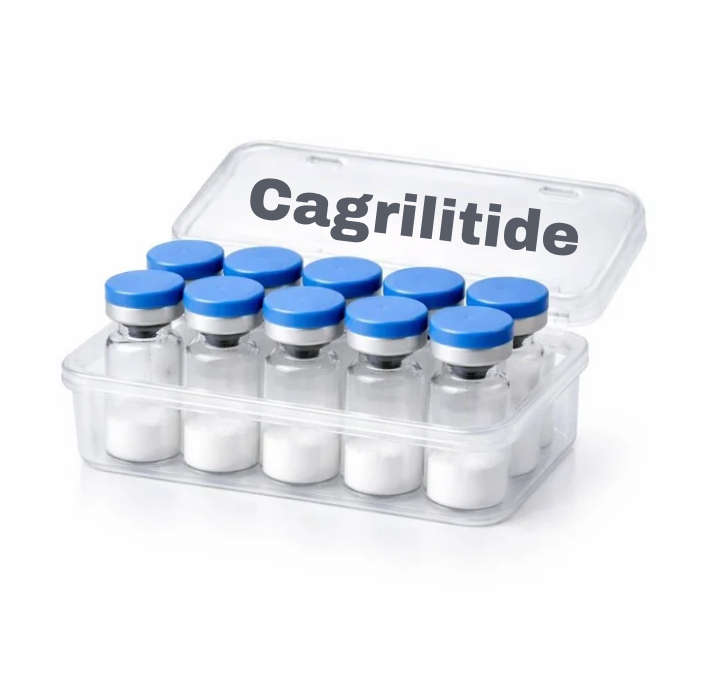
Buy Cagrilitide Peptide | Trusted Long-Acting Amylin Analogue for Metabolic Research | PrimaLab Peptide
Cagrilitide (also known as Cagrilintide and AM833) is a synthetic long-acting non-selective dual amylin and calcitonin receptor agonist (DACRA), one of the most structurally characterised and frequently studied amylin analogue research compounds available. Originally developed by Novo Nordisk, Cagrilitide addresses the principal limitations of native amylin as a research tool: extremely short half-life, rapid enzymatic degradation, and a tendency toward amyloid fibril formation.
Through two targeted structural modifications, C20 fatty diacid N-terminal acylation and a Cys3–Cys8 disulfide bond, Cagrilitide achieves a dramatically extended half-life of approximately 159–195 hours in research models, enabling once-weekly dosing protocols in preclinical studies. Researchers who buy Cagrilitide peptide use it to investigate amylin receptor (AMY1R, AMY3R) and calcitonin receptor (CTR) biology, metabolic satiety signalling, postprandial glucose dynamics, and dual amylin/GLP-1 receptor research in combination with Semaglutide, available as the convenient Cagri+Sema Blend. PrimaLab Peptide supplies research-grade Cagrilitide at ≥99% purity, independently verified by Janoshik Analytical via HPLC and mass spectrometry, with a full batch-specific Certificate of Analysis included with every order.
What Is Cagrilitide?
Cagrilitide is a modified synthetic amylin analogue designed to overcome the research limitations of native amylin. Native amylin (islet amyloid polypeptide, IAPP) is a 37-amino acid peptide hormone co-secreted with insulin from pancreatic beta cells — but its extremely short half-life (minutes in vivo), propensity to form amyloid fibrils, and rapid degradation by NEP (neutral endopeptidase) make it impractical for sustained research protocols. Cagrilitide incorporates two key structural solutions:
- Cys3–Cys8 disulfide bond: An intramolecular disulfide bridge between cysteine residues at positions 3 and 8 stabilises the peptide backbone, reduces amyloid fibril formation, and improves molecular stability — directly addressing native amylin’s most problematic research characteristics
- C20 fatty diacid N-terminal acylation: A C20 fatty diacid chain attached at the N-terminus promotes reversible albumin binding — the same extended half-life mechanism used by Semaglutide. This albumin binding protects Cagrilitide from renal clearance and proteolytic degradation, extending the half-life to approximately 159–195 hours in research models
Molecular formula: C₁₉₄H₃₁₂N₅₄O₅₉S₂ | MW: ~4409.01 Da | CAS: 1415456-99-3
An important pharmacological distinction for research design: Cagrilitide is a non-selective DACRA (Dual Amylin and Calcitonin Receptor Agonist) — it activates amylin receptors (AMY1R, AMY3R) and the calcitonin receptor (CTR) simultaneously. Native amylin shows more selective amylin receptor pharmacology. This broader receptor profile means Cagrilitide’s research pharmacology is distinct from native amylin and must be accounted for in experimental design. A review of amylin receptor biology and DACRA pharmacology is available through published PubMed research on Cagrilitide.
Cagrilitide Research Applications
Cagrilitide’s extended half-life and well-defined receptor pharmacology make it the primary research tool for amylin receptor biology and sustained amylinergic signalling studies. Published research has examined Cagrilitide across the following areas:
- Amylin receptor (AMY1R, AMY3R) biology research: Cagrilitide is the most characterised long-acting tool for studying amylin receptor signalling — including downstream cAMP production, calcium mobilisation, and the downstream metabolic effects of sustained AMY1R and AMY3R activation in pancreatic, hypothalamic, and brainstem research models
- Calcitonin receptor (CTR) pharmacology research: As a non-selective DACRA, Cagrilitide also engages the calcitonin receptor — enabling research into CTR-mediated signalling pathways alongside amylin receptor activation. This receptor combination is relevant to bone metabolism research as well as metabolic biology
- Metabolic satiety and appetite regulation research: Amylin receptors in the area postrema and nucleus tractus solitarius play well-documented roles in satiety signalling. Cagrilitide research has examined its effects on food intake regulation and satiety pathway activation in preclinical research models. Published preclinical data includes significant reductions in body weight and food intake in high-fat diet rodent models compared to controls
- Postprandial glucose and glucagon dynamics research: Research has examined Cagrilitide’s effects on postprandial glucose excursions, glucagon suppression, and gastric emptying rate in pancreatic islet and metabolic research models
- Dual amylin/GLP-1 receptor combination research: One of the most published research applications for Cagrilitide is its combination with GLP-1 receptor agonists — particularly Semaglutide — for studying dual amylin receptor + GLP-1R co-activation. Amylin receptors and GLP-1R are expressed in overlapping but distinct brain regions involved in energy balance regulation, and their co-activation is studied for additive or synergistic satiety effects. This combination is available as the Cagri+Sema Blend
- Pharmacokinetic and peptide formulation research: Cagrilitide’s C20 fatty acid albumin-binding mechanism and extended half-life make it a useful tool in peptide stability, formulation, and sustained-release research — studying the pharmacokinetic consequences of fatty acid acylation chemistry
- Active clinical investigation context: Cagrilitide is under active Phase 3 clinical investigation in the REDEFINE and REIMAGINE programs as of the research knowledge cutoff. All preclinical and in vitro research findings must be interpreted within the context of an investigational compound under ongoing clinical study. The developing clinical literature enriches the preclinical research context available to researchers
Cagrilitide vs. Native Amylin — Why the Structural Modifications Matter
Understanding why Cagrilitide was engineered with its specific structural modifications is essential for interpreting research data correctly:
- Half-life: Native amylin half-life: minutes in vivo. Cagrilitide half-life: ~159–195 hours. This 1000-fold difference fundamentally changes what research protocols are practically feasible
- Amyloid fibril formation: Native amylin is notoriously prone to forming amyloid fibrils — the same process implicated in type 2 diabetes islet amyloid deposits. These fibrils introduce significant research confounds and aggregation artefacts. Cagrilitide’s Cys3–Cys8 disulfide bond substantially reduces fibril formation, improving research reproducibility
- Receptor selectivity: Native amylin: predominantly amylin receptor selective. Cagrilitide: non-selective DACRA activating AMY1R, AMY3R, and CTR. Researchers must account for CTR engagement in Cagrilitide experimental designs that would not be relevant to native amylin studies
- Research practicality: The combination of extended half-life, reduced fibril formation, and defined receptor pharmacology makes Cagrilitide significantly more tractable for sustained research protocols than native amylin
Purity & Third-Party Testing
Every batch of Cagrilitide supplied by PrimaLab Peptide is independently tested by Janoshik Analytical:
- HPLC — quantitative purity confirmed at ≥99%
- Mass Spectrometry — molecular identity confirmation (MW: ~4409.01 Da, CAS: 1415456-99-3), verifying correct sequence, C20 acylation, and Cys3–Cys8 disulfide bridge formation
Mass spectrometry verification of the correct MW is particularly important for Cagrilitide — it confirms both the disulfide bridge (a reduced non-bridged form would show a different MW) and the C20 fatty diacid acylation (absent acylation would produce a lower MW). The batch-specific COA is available on request and included with every order. Always review the COA before research use — purity matters particularly in metabolic research where lower-grade material introduces experimental variables.
Storage & Reconstitution
- Long-term storage (sealed, lyophilized): −20°C, away from light and moisture
- Short-term storage (lyophilized): 4°C for a few days if regular access is required
- After reconstitution: Store at 4°C and use within 28–30 days. Do not re-freeze reconstituted solution
- Reconstitution: Reconstitute with sterile Bacteriostatic Water (BAC Water). The C20 fatty diacid acylation may slow initial dissolution — add solvent slowly down the inside vial wall and allow adequate time. Swirl gently — do not shake or vortex
- Freeze-thaw cycles: Avoid repeated freeze-thaw cycling. Aliquot before freezing if your protocol requires multiple uses from the same batch
- Light and moisture: Keep away from both throughout storage and handling
Product Specifications
| Name | Cagrilitide (Cagrilintide / AM833) |
| CAS Number | 1415456-99-3 |
| Molecular Formula | C₁₉₄H₃₁₂N₅₄O₅₉S₂ |
| Molecular Weight | ~4409.01 Da |
| Receptor Targets | AMY1R, AMY3R (amylin receptors), CTR (calcitonin receptor) — non-selective DACRA |
| Half-Life (research models) | ~159–195 hours |
| Key Structural Modifications | C20 fatty diacid N-terminal acylation; Cys3–Cys8 disulfide bond |
| Purity | ≥99% (Janoshik HPLC + Mass Spectrometry verified) |
| Form | Lyophilized powder |
| Available Sizes | 5mg, 10mg |
| Storage (long-term) | −20°C, away from light and moisture |
| Storage (reconstituted) | 4°C, use within 28–30 days — do not refreeze |
| Reconstitution | Bacteriostatic Water (BAC Water) |
| Testing Lab | Janoshik Analytical (independent third-party) |
| COA | Batch-specific — available on request, included with every order |
| Intended Use | Laboratory research purposes only |
Frequently Asked Questions — Cagrilitide Peptide
What is Cagrilitide used for in research?
Researchers who buy Cagrilitide peptide use it to investigate amylin receptor (AMY1R, AMY3R) and calcitonin receptor (CTR) signalling biology, metabolic satiety and appetite regulation through central amylin pathways, postprandial glucose dynamics and glucagon suppression, dual amylin/GLP-1 receptor co-activation research in combination with Semaglutide (available as the Cagri+Sema Blend), and peptide pharmacokinetic research examining albumin-binding fatty acid acylation mechanisms. Published preclinical research is available on PubMed.
Why does Cagrilitide have such a much longer half-life than native amylin?
Two structural modifications work together. The C20 fatty diacid N-terminal acylation enables reversible albumin binding — protecting Cagrilitide from renal clearance and proteolytic degradation, extending half-life from minutes (native amylin) to approximately 159–195 hours. The Cys3–Cys8 disulfide bond additionally stabilises the peptide backbone and reduces the amyloid fibril formation that accelerates native amylin degradation. Together these modifications produce an amylin analogue that is vastly more tractable for sustained preclinical research protocols than native amylin.
What makes Cagrilitide a DACRA and why does this matter for research design?
DACRA stands for Dual Amylin and Calcitonin Receptor Agonist. Unlike native amylin (predominantly amylin receptor selective), Cagrilitide is non-selective — it activates amylin receptors (AMY1R, AMY3R) and the calcitonin receptor (CTR) simultaneously. This broader receptor profile means Cagrilitide-based research will capture both amylin receptor-mediated and CTR-mediated signalling effects. Researchers designing studies specifically aimed at amylin receptor biology must account for the CTR contribution to observed effects when using Cagrilitide, which would not be relevant in native amylin research designs.
Is Cagrilitide from PrimaLab Peptide independently tested?
Yes. Every batch is independently verified by Janoshik Analytical at ≥99% purity via HPLC and mass spectrometry identity confirmation (MW: ~4409.01 Da, CAS: 1415456-99-3). Mass spectrometry verification confirms both the Cys3–Cys8 disulfide bridge and the C20 fatty diacid acylation — the two defining structural modifications of Cagrilitide. The batch-specific COA is included with every order.
How does Cagrilitide combine with Semaglutide in research?
Cagrilitide (amylin/calcitonin receptor agonist) and Semaglutide (GLP-1 receptor agonist) target completely independent receptor populations. Research examining their combination explores whether dual amylin receptor + GLP-1R co-activation produces additive or synergistic effects on satiety, energy intake, and metabolic parameters compared to either compound alone — a mechanistic research question distinct from any single-receptor approach. This combination is available as the convenient Cagri+Sema Blend (5mg + 5mg) from PrimaLab Peptide.
What other metabolic peptides are commonly studied alongside Cagrilitide?
Researchers buying Cagrilitide peptide for metabolic research frequently explore the complete GLP-1 class and metabolic peptide catalog at PrimaLab Peptide including Semaglutide (GLP-1R reference agonist), Tirzepatide (dual GIP/GLP-1R agonist), Mazdutide (GLP-1R/GCGR dual agonist), and Retatrutide (triple GLP-1R/GIP/GCGR agonist) for comparative multi-receptor metabolic research. Browse the complete Metabolic Peptides category.
Related Research Peptides
Researchers buying Cagrilitide peptide for amylin receptor and metabolic research frequently explore:
- Semaglutide — GLP-1R agonist for dual amylin/GLP-1R combination research
- Cagri+Sema Blend (5mg + 5mg) — pre-combined dual amylin/GLP-1R research formulation
- Tirzepatide — dual GIP/GLP-1R agonist for comparative multi-receptor research
- Mazdutide — dual GLP-1R/GCGR agonist for comparative research
- Retatrutide — triple GLP-1R/GIP/GCGR agonist for comprehensive metabolic research
- AOD9604 — modified GH fragment for complementary fat metabolism research
Browse our complete Metabolic Peptides and Peptide Blends & Stacks categories. Bulk researchers can apply for discounted rates through our Wholesale Portal. Reconstitute with BAC Water, available in our Accessories & Reconstitution Supplies section.
⚠️ For laboratory research purposes only. Not approved by the FDA. Not for human consumption. Not a therapeutic product. Not intended to diagnose, treat, cure, or prevent any disease. Researchers are solely responsible for compliance with all applicable local, national, and international regulations governing the purchase, storage, and use of research compounds.
Reviews
There are no reviews yet.