
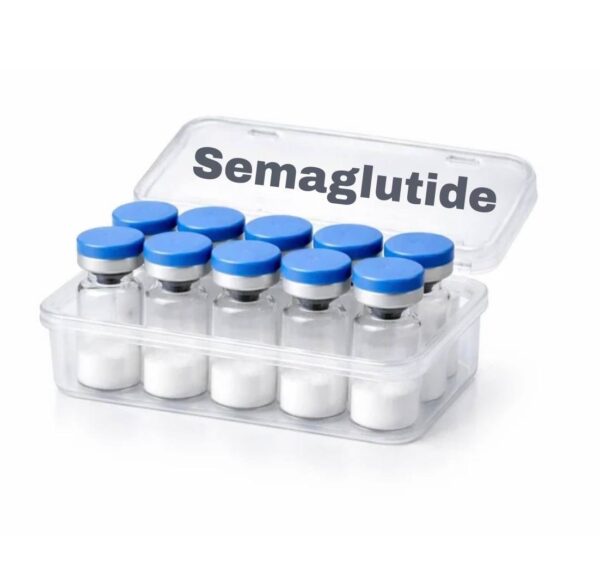
Buy Semaglutide Peptide | Proven GLP-1 Receptor Agonist for Metabolic Research | PrimaLab Peptide
Semaglutide is a synthetic 31-amino acid GLP-1 (glucagon-like peptide-1) receptor agonist and one of the most structurally characterised tools in metabolic research — sharing approximately 94% structural similarity with endogenous human GLP-1 while incorporating a C18 fatty diacid acylation that confers albumin binding and dramatically extends its half-life compared to native GLP-1.
Researchers who buy Semaglutide peptide use it to investigate GLP-1 receptor binding kinetics, downstream cAMP signalling cascades, glucose-dependent insulin secretion mechanisms, satiety and appetite suppression pathways, and the pharmacology of long-acting GLP-1R agonism in in vitro and in vivo research models. PrimaLab Peptide supplies research-grade Semaglutide at ≥98% purity, independently verified by Janoshik Analytical via HPLC and mass spectrometry, with a full batch-specific Certificate of Analysis included with every order.
What Is Semaglutide?
Semaglutide is a modified GLP-1 receptor agonist with the following full 31-amino acid sequence:
His-Aib-Glu-Gly-Thr-Phe-Thr-Ser-Asp-Val-Ser-Ser-Tyr-Leu-Glu-Gly-Gln-Ala-Ala-Lys(C18diacid)-Glu-Phe-Ile-Ala-Trp-Leu-Val-Arg-Gly-Arg-NH₂
CAS: 910463-68-2 | Molecular formula: C₁₈₇H₂₉₁N₄₅O₅₉ | MW: 4113.58 g/mol
Two structural modifications relative to native GLP-1(7-37) are particularly research-relevant:
- Aib (alpha-aminoisobutyric acid) at position 2: Replaces the alanine at position 2 of native GLP-1, conferring resistance to DPP-IV (dipeptidyl peptidase IV) cleavage — the primary enzymatic degradation pathway for native GLP-1 in plasma. This single substitution substantially extends Semaglutide’s metabolic half-life compared to native GLP-1 (which has a half-life of only 1–2 minutes in vivo)
- C18 fatty diacid chain at Lys26: A C18 fatty diacid is attached via a linker to the lysine residue at position 26. This acylation enables reversible non-covalent albumin binding in physiological conditions — further extending half-life to approximately one week in vivo through albumin-mediated protection from renal clearance and proteolytic degradation
Together, these modifications produce a GLP-1 receptor agonist with dramatically extended effective half-life compared to native GLP-1 — making it suitable for research protocols requiring sustained GLP-1R activation without repeated peptide addition to research systems. A comprehensive overview of GLP-1 receptor biology is available through NIH-published research on GLP-1 receptor signalling.
Semaglutide Research Applications
Semaglutide is the most widely used reference GLP-1 receptor agonist in metabolic research, providing a structurally characterised tool with well-defined receptor pharmacology. Published research on PubMed has examined Semaglutide across the following research areas:
- GLP-1 receptor binding kinetics research: Semaglutide is the primary tool for studying GLP-1R binding affinity, receptor occupancy dynamics, and receptor-agonist dissociation kinetics at the molecular level — with its albumin-bound form creating research-relevant extended receptor engagement
- cAMP signalling cascade research: GLP-1R is a Gs-coupled GPCR — receptor activation by Semaglutide stimulates adenylyl cyclase and cAMP production, activating PKA and EPAC signalling cascades. Research examines these downstream pathways in pancreatic beta cells, gut enteroendocrine cells, and CNS neurons
- Glucose-dependent insulin secretion research: Semaglutide stimulates insulin secretion from pancreatic beta cells in a glucose-dependent manner — a key pharmacological characteristic of GLP-1R agonism that differs from sulphonylureas. Research examines the molecular mechanisms of glucose-dependency in GLP-1R-mediated insulin secretion
- Glucagon suppression research: GLP-1R activation by Semaglutide suppresses glucagon secretion from pancreatic alpha cells in a glucose-dependent manner. Research has examined this mechanism as a contribution to GLP-1R agonist metabolic effects
- Central appetite and satiety research: GLP-1R is expressed in hypothalamic and brainstem neurons involved in appetite regulation. Semaglutide has been studied for its central effects on GLP-1R-expressing appetite-regulatory neurons and downstream effects on food intake behaviour in research models
- Gastric emptying rate research: GLP-1R activation slows gastric emptying — research has examined this mechanism and its contribution to postprandial glucose regulation and satiety signalling
- Comparative GLP-1 class research: As the reference single-receptor GLP-1R agonist, Semaglutide is the essential comparator in studies examining dual and triple agonists — Tirzepatide (GIP/GLP-1R dual agonist), Mazdutide (GLP-1R/GCGR dual agonist), and Retatrutide (GLP-1R/GIP/GCGR triple agonist). It is also the Semaglutide component of the Cagri+Sema Blend with Cagrilitide for dual amylin/GLP-1R research
Why Semaglutide’s Extended Half-Life Matters for Research
Semaglutide’s albumin-binding C18 diacid modification produces a week-long effective half-life in vivo — a pharmacological property with direct implications for in vitro research design:
- Sustained receptor activation: For cell culture research requiring prolonged GLP-1R stimulation over hours to days without repeated peptide addition, Semaglutide’s stability in culture conditions makes it more practical than native GLP-1 (half-life ~1–2 min) or shorter-acting GLP-1 analogues
- Albumin-binding research: The fatty acid acylation chemistry enables research into albumin-binding peptide pharmacology — a drug delivery mechanism of broader scientific interest beyond GLP-1R biology
- Comparative pharmacokinetics: Semaglutide’s extended half-life makes it a useful comparator for studying how half-life duration affects GLP-1R downstream signalling pattern, receptor internalisation kinetics, and desensitisation profiles compared to shorter-acting GLP-1R tools
Purity & Third-Party Testing
Every batch of Semaglutide supplied by PrimaLab Peptide is independently tested by Janoshik Analytical:
- HPLC — quantitative purity confirmed at ≥98%
- Mass Spectrometry — molecular identity confirmation (MW: 4113.58 g/mol, CAS: 910463-68-2), verifying both the 31-amino acid sequence and the C18 fatty diacid acylation at Lys26
The batch-specific COA is a downloadable PDF included with every order — you can verify the test results yourself before or after ordering. The batch number on your vial links directly to the Janoshik test report. No guessing, no supplier-generated certificates.
Storage & Reconstitution
- Long-term storage (lyophilized): −20°C in a dark, dry environment. This is standard lab freezer temperature and easily maintained. Light and humidity both accelerate degradation — store sealed until needed
- Short-term storage (lyophilized): 4°C for up to 4 weeks when regular access is required
- After reconstitution: Store at 4°C. Do not store at room temperature — degradation accelerates rapidly above 4°C once in solution
- Freeze-thaw cycles: Avoid. If your protocol requires multiple uses from the same vial, aliquot before freezing and label each aliquot with the date. Keep the stock vial sealed until needed
- Reconstitution solvent: Reconstitute with sterile Bacteriostatic Water (BAC Water). The C18 fatty acid acylation can make Semaglutide slightly more slowly soluble than unacylated peptides — allow adequate time for complete dissolution. Add solvent slowly down the inside vial wall and swirl gently. Do not shake or vortex
Product Specifications
| Full Name | Semaglutide |
| CAS Number | 910463-68-2 |
| Sequence | His-Aib-Glu-Gly-Thr-Phe-Thr-Ser-Asp-Val-Ser-Ser-Tyr-Leu-Glu-Gly-Gln-Ala-Ala-Lys(C18diacid)-Glu-Phe-Ile-Ala-Trp-Leu-Val-Arg-Gly-Arg-NH₂ |
| Molecular Formula | C₁₈₇H₂₉₁N₄₅O₅₉ |
| Molecular Weight | 4113.58 g/mol |
| Purity | ≥98% (Janoshik HPLC + Mass Spectrometry verified) |
| Form | Lyophilized powder |
| Available Sizes | 5mg, 10mg |
| Storage (long-term) | −20°C, dark, dry environment |
| Storage (short-term) | 4°C up to 4 weeks sealed |
| Storage (reconstituted) | 4°C, do not store at room temperature |
| Reconstitution | Bacteriostatic Water (BAC Water) |
| COA | Batch-specific downloadable PDF — Janoshik verified |
| Testing Lab | Janoshik Analytical (independent third-party) |
| Research Use | Laboratory and in-vitro research only |
Frequently Asked Questions — Semaglutide Peptide
What is Semaglutide used for in research?
Researchers who buy Semaglutide peptide use it to investigate GLP-1 receptor binding kinetics, downstream cAMP/PKA/EPAC signalling cascades, glucose-dependent insulin secretion mechanisms, glucagon suppression biology, central appetite and satiety pathway research through hypothalamic and brainstem GLP-1R, gastric emptying rate mechanisms, and as the reference GLP-1R agonist comparator in multi-receptor agonist research alongside Tirzepatide, Mazdutide, and Retatrutide. Published research is available on PubMed.
Why does Semaglutide have a much longer half-life than native GLP-1?
Two structural modifications work together to extend Semaglutide’s half-life. The Aib substitution at position 2 blocks DPP-IV cleavage — the primary enzymatic degradation of native GLP-1 which has a half-life of only 1–2 minutes in vivo. The C18 fatty diacid acylation at Lys26 enables reversible non-covalent albumin binding, protecting Semaglutide from renal clearance and further proteolytic degradation. Together these modifications extend the effective half-life to approximately one week — making Semaglutide the longest-acting GLP-1R agonist in PrimaLab Peptide’s metabolic research catalog as a single-receptor tool.
Is Semaglutide from PrimaLab Peptide independently tested?
Yes. Every batch is independently verified by Janoshik Analytical at ≥98% purity via HPLC and mass spectrometry identity confirmation (MW: 4113.58 g/mol, CAS: 910463-68-2). Mass spectrometry verification confirms both the 31-amino acid sequence and the C18 fatty diacid acylation at Lys26. The COA is a downloadable PDF available per batch — the batch number on your vial links directly to the Janoshik test report.
How does Semaglutide differ from Tirzepatide in research?
Tirzepatide is a dual GIP receptor + GLP-1R agonist — it simultaneously activates both GIP receptor and GLP-1R. Semaglutide is a single GLP-1R agonist. This makes Semaglutide the essential single-receptor reference comparator for isolating GLP-1R-specific effects from the combined GIP/GLP-1R pharmacology of Tirzepatide. Comparing Semaglutide and Tirzepatide in parallel research designs allows researchers to identify the specific contribution of GIP receptor engagement to the metabolic effects observed with Tirzepatide.
What reconstitution solvent should I use for Semaglutide?
Reconstitute Semaglutide with sterile Bacteriostatic Water (BAC Water). The C18 fatty acid acylation may cause Semaglutide to dissolve more slowly than unacylated peptides — add solvent slowly down the inside vial wall, swirl gently, and allow adequate time for complete dissolution before use. Do not shake or vortex. Store the reconstituted solution at 4°C and avoid room temperature storage.
What peptides are commonly studied alongside Semaglutide?
As the reference single GLP-1R agonist, Semaglutide is studied alongside the full range of GLP-1 class research compounds at PrimaLab Peptide: Tirzepatide (GIP/GLP-1R dual agonist), Mazdutide (GLP-1R/GCGR dual agonist), Retatrutide (triple agonist), and Cagrilitide (amylin analogue). It is also available as the Semaglutide component of the Cagri+Sema Blend for dual amylin/GLP-1R research. Browse the complete Metabolic Peptides category.
Related Research Peptides
Researchers buying Semaglutide peptide for GLP-1 receptor and metabolic research frequently explore:
- Tirzepatide — dual GIP/GLP-1R agonist for comparative dual receptor research
- Mazdutide — dual GLP-1R/GCGR agonist for comparative dual receptor research
- Retatrutide — triple GLP-1R/GIP/GCGR agonist for comprehensive multi-receptor research
- Cagrilitide — long-acting amylin analogue for amylin/GLP-1R co-agonism research
- Cagri+Sema Blend — Cagrilitide + Semaglutide dual amylin/GLP-1R research stack
- AOD9604 — modified GH fragment for complementary fat metabolism research
Browse our complete Metabolic Peptides category. Bulk researchers can apply for discounted rates through our Wholesale Portal. Reconstitute with BAC Water, available in our Accessories & Reconstitution Supplies section.
⚠️ For laboratory and in-vitro research use only. Not for human or veterinary use. No therapeutic or clinical outcome claims are made. Not a drug, supplement, or medical treatment. Researchers are solely responsible for compliance with all applicable local, national, and international regulations.
Reviews
There are no reviews yet.