
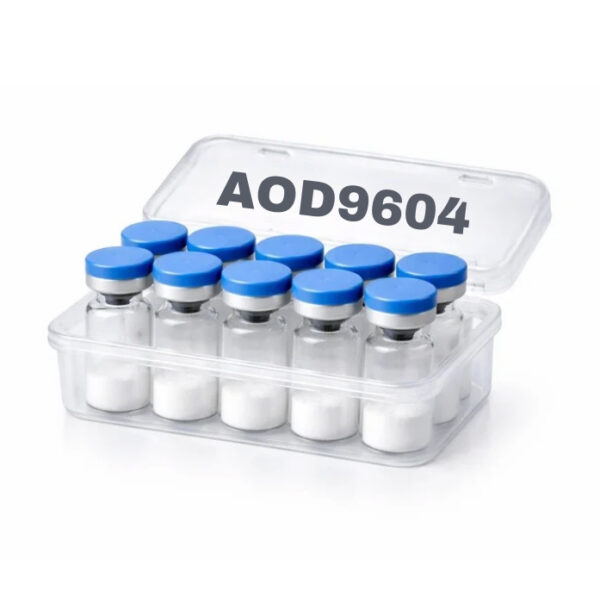
Buy AOD9604 Peptide | Proven Modified HGH Fragment for Metabolic Research | PrimaLab Peptide
AOD9604 (Anti-Obesity Drug 9604) is a synthetic 16-amino acid modified fragment of human growth hormone, corresponding to the C-terminal region of hGH at amino acids 177–191 with an N-terminal tyrosine residue added. Researchers who buy AOD9604 peptide use it to investigate fat metabolism pathways, lipolytic signalling mechanisms, adipocyte biology, lipogenesis inhibition, and the specific metabolic activity of the C-terminal region of GH in isolation from the broad receptor-mediated effects of full-length HGH. PrimaLab Peptide supplies research-grade AOD9604 at ≥99.2% purity, independently verified by Janoshik Analytical via HPLC and mass spectrometry, cold-chain shipped, with a full batch-specific Certificate of Analysis included with every order.
What Is AOD9604?
AOD9604 is a 16-amino acid synthetic peptide derived from the C-terminal region of human growth hormone. Its development arose from structure-activity relationship research that identified the C-terminal domain of hGH (amino acids 176-191 and adjacent) as the region responsible for hGH’s lipolytic (fat-burning) properties — distinct from the N-terminal growth-promoting region that drives insulin desensitisation and tissue anabolism through GH receptor activation.
The two structural features that define AOD9604 and distinguish it from related C-terminal GH fragments:
- Modified fragment region: AOD9604 corresponds to amino acids 177–191 of hGH — spanning a slightly different region than the related compound HGH Fragment 176-191 (which spans 176–191)
- N-terminal tyrosine addition: A tyrosine residue is added at the N-terminus of the 177–191 fragment (hence the sequence starting with Tyr-), which modifies the pharmacological profile compared to the unmodified fragment and is a key structural differentiator from HGH Fragment 176-191
The complete sequence of AOD9604 is: Tyr-Leu-Arg-Ile-Val-Gln-Cys-Arg-Ser-Val-Glu-Gly-Ser-Cys-Gly-Phe (CAS: 221231-10-3, Molecular formula: C₇₈H₁₂₃N₂₃O₂₃S₂, MW: 1817.08 g/mol). The Cys-Cys disulfide bridge within this sequence is essential for correct structural conformation and research activity — mass spectrometry MW confirmation of 1817.08 g/mol verifies correct disulfide bridge formation.
A review of the C-terminal GH fragment research literature is available through published PubMed research on AOD9604.
AOD9604 Research Applications
AOD9604’s primary research interest lies in its selective C-terminal GH fragment activity on fat metabolism pathways — independent of the full GH receptor-mediated effects of HGH. Published and preclinical research has examined AOD9604 across the following areas:
- Lipolysis activation research: AOD9604 has been studied for its ability to stimulate lipolysis — the breakdown of stored triglycerides into free fatty acids — in adipocyte research models. The C-terminal GH region is understood to mediate this lipolytic activity through mechanisms distinct from full GH receptor activation
- Lipogenesis inhibition research: Complementary to lipolysis activation, studies have examined AOD9604’s effects on inhibiting de novo fat storage (lipogenesis) in adipocyte cell culture models
- Insulin sensitivity research: Unlike full-length HGH — which can reduce insulin sensitivity at research concentrations through GH receptor-mediated insulin resistance mechanisms — AOD9604 has been studied for a more insulin-neutral metabolic profile in research models, allowing investigation of lipolytic effects without GH-mediated insulin antagonism
- Adipocyte biology and differentiation research: Research has examined AOD9604’s effects on adipocyte differentiation, fat cell phenotype, and adipokine production in cell culture research models
- Cartilage and bone metabolism research: Some preclinical research has explored potential effects of AOD9604 on cartilage and bone tissue in research models, expanding its research profile beyond primary fat metabolism applications
- Comparative C-terminal GH fragment research: AOD9604 is frequently studied in comparative research alongside HGH Fragment 176-191 to investigate structure-activity relationships between the overlapping but distinct C-terminal GH fragments — particularly the effect of the N-terminal tyrosine addition on lipolytic activity profile
AOD9604 is also studied alongside other metabolic research compounds for comprehensive fat metabolism research programs, including 5-Amino-1MQ (NNMT inhibitor), Adipotide (adipose vascular targeting), Tesamorelin (GHRH analogue for visceral fat metabolism), and Lemon Bottle (enzyme-based lipolytic blend). Browse the complete Metabolic Peptides category.
AOD9604 vs. HGH Fragment 176-191 — Research Design Distinction
These are two structurally related but distinct research compounds that are frequently confused. Understanding their differences is critical for research protocol design:
- AOD9604: Corresponds to hGH amino acids 177–191 + N-terminal Tyr addition. MW: 1817.08 g/mol. The N-terminal tyrosine modifies the N-terminal chemistry and pharmacological profile. CAS: 221231-10-3
- HGH Fragment 176-191: Corresponds to hGH amino acids 176–191 exactly, with a Tyr at position 176 (the natural sequence, no addition). MW: 1815.09 g/mol. No N-terminal modification beyond the natural hGH sequence at position 176. CAS: 177036-94-1
These structural differences — one additional N-terminal Tyr, different starting position, slightly different MW — produce distinct pharmacological profiles in research. They should not be used interchangeably and make excellent comparative research tools for studying structure-activity relationships in C-terminal GH fragment lipolytic research.
Purity & Third-Party Testing
Every batch of AOD9604 supplied by PrimaLab Peptide is independently tested by Janoshik Analytical:
- HPLC — quantitative purity confirmed at ≥99.2%
- Mass Spectrometry — molecular identity confirmation (MW: 1817.08 g/mol, CAS: 221231-10-3), verifying correct sequence including N-terminal Tyr and Cys-Cys disulfide bridge
The batch-specific COA is public, posted per batch, and included with every order — not a generic or recycled stock document. Additional endotoxin and residual moisture checks are performed before any batch ships. All batches are cold-chain shipped to maintain integrity during transit.
Storage & Reconstitution
- Upon receipt: Place in freezer immediately — AOD9604 is cold-chain shipped and should be transferred to −20°C storage on arrival
- Lyophilized (sealed): Store at −20°C, sealed, away from light. Allow the sealed vial to reach room temperature before opening to prevent condensation entering the vial
- After reconstitution: Store at 4°C and use within 28 days. Avoid repeated freeze-thaw cycles
- Reconstitution solvent: Reconstitute with sterile water or Bacteriostatic Water (BAC Water). BAC Water is recommended for multi-use vials over the 28-day research window. Inject slowly down the inside vial wall — never directly onto the lyophilized powder. Swirl gently — do not shake
- Aliquoting: Aliquot working stock into single-use volumes if your protocol requires multiple experiments — each aliquot undergoes only one freeze-thaw cycle regardless of how many experiments are run
Product Specifications
| Full Name | AOD9604 (Anti-Obesity Drug 9604) |
| CAS Number | 221231-10-3 |
| Sequence | Tyr-Leu-Arg-Ile-Val-Gln-Cys-Arg-Ser-Val-Glu-Gly-Ser-Cys-Gly-Phe |
| Molecular Formula | C₇₈H₁₂₃N₂₃O₂₃S₂ |
| Molecular Weight | 1817.08 g/mol |
| Purity | ≥99.2% (Janoshik HPLC + Mass Spectrometry verified) |
| Form | Lyophilized white powder |
| Available Sizes | 5mg, 10mg |
| Storage (lyophilized) | −20°C, sealed, away from light |
| Storage (reconstituted) | 4°C, use within 28 days |
| Reconstitution | Sterile water or Bacteriostatic Water (BAC Water) |
| Shipping | Cold-chain shipped |
| Testing Lab | Janoshik Analytical (independent third-party) |
| COA | Batch-specific — included with every order, publicly posted |
| Intended Use | In vitro research only — not for human use |
Frequently Asked Questions — AOD9604 Peptide
What is AOD9604 used for in research?
Researchers who buy AOD9604 peptide use it to investigate lipolysis activation and lipogenesis inhibition in adipocyte research models, the metabolic activity of the C-terminal region of hGH in isolation from full GH receptor effects, insulin-neutral fat metabolism mechanisms, adipocyte differentiation biology, cartilage and bone metabolism research, and comparative structure-activity studies with the related HGH Fragment 176-191. Published research is available on PubMed.
What is the difference between AOD9604 and HGH Fragment 176-191?
Both are synthetic C-terminal GH fragments but they are structurally distinct compounds. AOD9604 spans hGH amino acids 177–191 with an added N-terminal tyrosine residue (MW: 1817.08 g/mol, CAS: 221231-10-3). HGH Fragment 176-191 spans hGH amino acids 176–191 exactly as they appear in the natural GH sequence (MW: 1815.09 g/mol). The different fragment boundaries and the N-terminal tyrosine addition in AOD9604 produce distinct pharmacological profiles — they should not be used interchangeably and serve as excellent comparators in C-terminal GH fragment structure-activity research.
Is AOD9604 from PrimaLab Peptide independently tested?
Yes. Every batch is independently verified by Janoshik Analytical at ≥99.2% purity via HPLC and mass spectrometry identity confirmation (MW: 1817.08 g/mol, CAS: 221231-10-3). Mass spectrometry verification confirms both the correct sequence including N-terminal Tyr addition and the Cys-Cys disulfide bridge integrity. Additional residual moisture and endotoxin checks are performed before any batch ships. The batch-specific COA is included with every order and publicly posted.
How does AOD9604 differ from full-length HGH in research?
This is a critical research design distinction. Full-length HGH activates the GH receptor through its N-terminal binding domain, producing broad systemic effects including IGF-1 stimulation, protein anabolism, bone growth plate activity, and insulin sensitivity reduction. AOD9604 targets only the C-terminal metabolic region, producing lipolytic and lipogenesis-inhibiting research activity without GH receptor-mediated systemic effects or insulin sensitivity changes in research models. AOD9604 is used when research requires isolating C-terminal GH metabolic activity from full GH biology.
Should AOD9604 be aliquoted before storage?
Yes — aliquoting before freezing is recommended if your protocol requires multiple experiments from the same batch. Each aliquot undergoes only one freeze-thaw cycle regardless of how many experiments are run, protecting peptide integrity across all research sessions. Store aliquots at −20°C and thaw only the volume needed for each experiment. Label each aliquot with the AOD9604 identity, batch number, concentration, and date of aliquoting.
What peptides are commonly studied alongside AOD9604?
Researchers buying AOD9604 peptide for fat metabolism and metabolic research frequently explore HGH Fragment 176-191 (related C-terminal GH fragment for comparative research), Tesamorelin (GHRH analogue for visceral fat GH axis research), 5-Amino-1MQ (NNMT inhibitor for complementary metabolic research), Adipotide (pro-apoptotic adipose vascular research), and Lipo-C (lipotropic blend for hepatic lipid metabolism research). Browse the complete Metabolic Peptides category.
Related Research Peptides
Researchers buying AOD9604 peptide for metabolic and fat biology research frequently explore:
- HGH Fragment 176-191 — related C-terminal GH fragment for comparative structure-activity research
- Tesamorelin — full GHRH analogue for visceral adipose tissue and GH axis metabolic research
- 5-Amino-1MQ — NNMT inhibitor for complementary NAD+ pathway and adipocyte metabolic research
- Adipotide (FTPP) — pro-apoptotic peptidomimetic for adipose vascular biology research
- Lemon Bottle — enzyme-based lipolytic solution for complementary fat cell research
- Lipo-C (LC216) — lipotropic blend for hepatic lipid metabolism research
Browse our complete Metabolic Peptides category. Bulk researchers can apply for discounted rates through our Wholesale Portal. Reconstitute with BAC Water, available in our Accessories & Reconstitution Supplies section.
⚠️ For in-vitro research only. Not intended for human or veterinary use. No medical claims are made or implied. All products comply with applicable regulations for in-vitro research. Researchers are solely responsible for compliance with all applicable local regulations governing the purchase, storage, and use of research compounds.
Reviews
There are no reviews yet.