
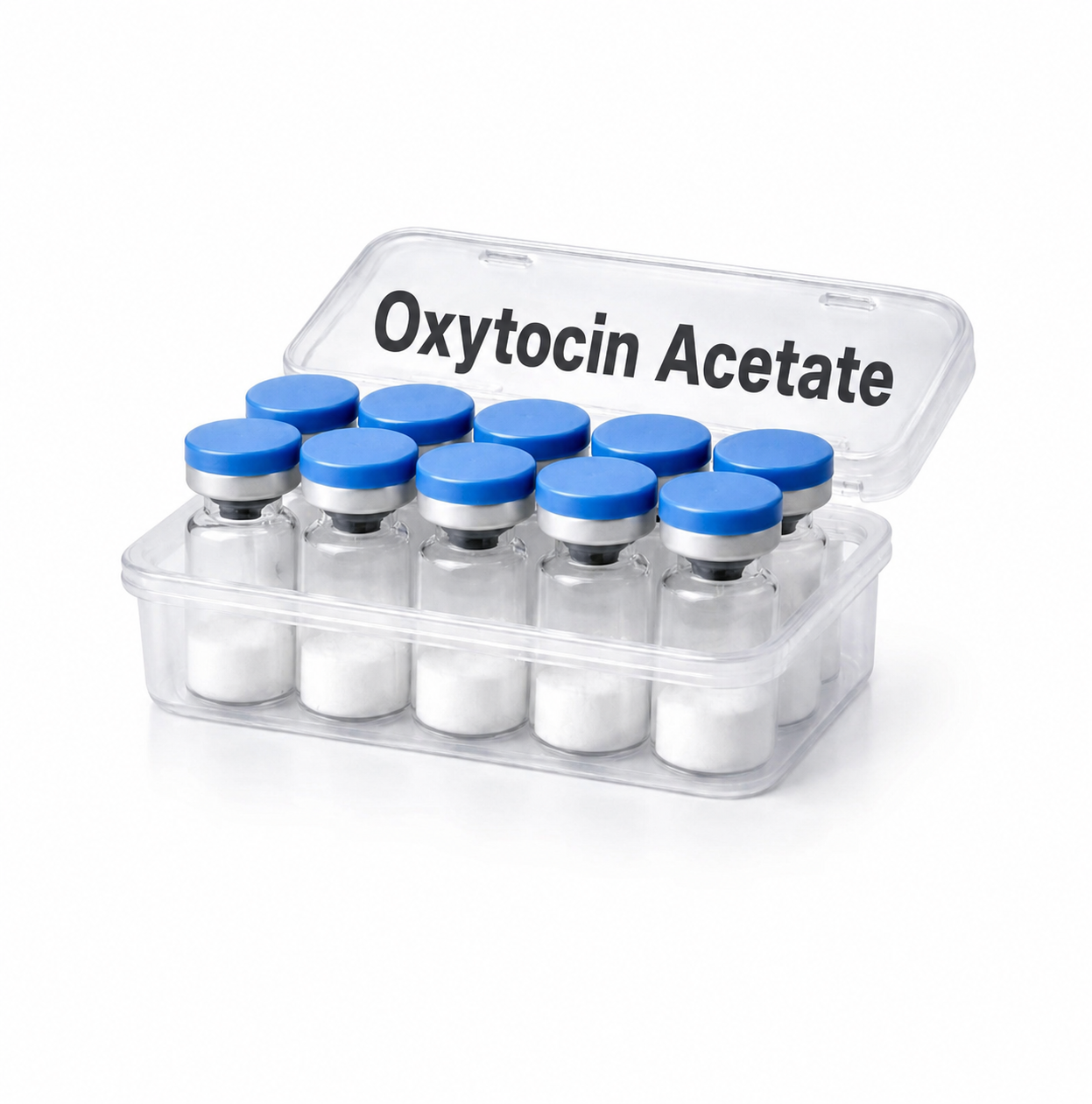
Buy Oxytocin Acetate Research Peptide | Trusted Neuropeptide for Neuroendocrine Research | PrimaLab Peptide
Oxytocin Acetate is the acetate salt form of oxytocin — a nine-amino acid neuropeptide hormone with one of the most diverse and extensively studied research profiles in all of neuropeptide science. Researchers who buy Oxytocin Acetate research peptide use it to investigate social behaviour neuroscience, pair bonding and maternal behaviour mechanisms, HPA (hypothalamic-pituitary-adrenal) axis modulation, anxiety regulation through central amygdala pathways, nociception and pain modulation, and a broad range of neuroendocrine signalling research applications. PrimaLab Peptide supplies research-grade Oxytocin Acetate at ≥99.36% purity, independently verified by Janoshik Analytical via HPLC-MS, with a full batch-specific Certificate of Analysis included with every order.
What Is Oxytocin Acetate?
Oxytocin is a nonapeptide (nine-amino acid peptide) neurohormone produced in the paraventricular nucleus (PVN) and supraoptic nucleus (SON) of the hypothalamus and released by the posterior pituitary gland. It was the first peptide hormone to be fully sequenced and synthesised — work completed by Vincent du Vigneaud, who received the 1955 Nobel Prize in Chemistry for this achievement. A full overview of oxytocin’s discovery, structure, and research history is available through the NIH StatPearls review of Oxytocin.
Oxytocin Acetate is the acetate salt form of oxytocin, preferred for research use over the free base because it offers improved storage stability and cleaner dissolution in aqueous research buffers. The complete amino acid sequence is:
Cys-Tyr-Ile-Gln-Asn-Cys-Pro-Leu-Gly-NH₂
CAS: 6233-83-6 | Molecular formula: C₄₃H₆₆N₁₂O₁₂S₂·CH₃COOH | MW: 1007.19 g/mol (free base)
A structurally critical feature is the C1-C6 disulfide bridge between cysteine residues at positions 1 and 6, which constrains the peptide into a bicyclic ring structure essential for oxytocin receptor binding and biological activity in research models. This disulfide bridge must be correctly formed in synthetic oxytocin for the compound to be research-valid — which is why mass spectrometry identity confirmation (MW 1007.19 g/mol for the correctly bridged form) is an essential component of Janoshik’s batch verification process.
Oxytocin Acetate Research Applications
Oxytocin has one of the broadest and most multidisciplinary research profiles of any neuropeptide, spanning neuroscience, neuroendocrinology, reproductive biology, immunology, and pain research. Published literature on PubMed has examined Oxytocin Acetate across the following key research areas:
- Social behaviour and bonding neuroscience: Oxytocin is the most studied neuropeptide in social neuroscience research, with an extensive literature examining its role in prosocial behaviour, pair bonding, trust, social recognition, and affiliative behaviour mechanisms in animal research models
- Maternal behaviour research: Studies have examined oxytocin’s role in maternal bonding, parturition signalling, and lactation-related neuroendocrine mechanisms in reproductive biology research
- HPA axis modulation research: Oxytocin interacts with the hypothalamic-pituitary-adrenal stress axis, with research exploring its anxiolytic and stress-dampening effects through CRF pathway interactions and glucocorticoid modulation
- Anxiety and amygdala research: Studies have investigated oxytocin’s modulation of amygdala activity and its anxiolytic effects in fear conditioning and anxiety research models — frequently compared with other anxiolytic research peptides such as Selank
- Autism spectrum disorder research models: Oxytocin has been extensively investigated in preclinical autism spectrum disorder (ASD) research models, examining social behaviour deficits and the role of the oxytocinergic system in social cognition
- Pain modulation research: Research has explored oxytocin’s effects on pain processing pathways, including spinal cord pain transmission and central pain modulation mechanisms
- Neuroendocrine feedback research: Oxytocin participates in complex neuroendocrine feedback loops relevant to reproductive axis research alongside compounds such as Kisspeptin-10 (GnRH axis regulation) and HCG (LH receptor biology)
Oxytocin Acetate is a core compound in our Nootropic & Neuro Peptides category, where it is frequently studied alongside Semax (ACTH analogue for BDNF and neuroprotective research) and Selank (tuftsin analogue for anxiolytic and GABAergic pathway research).
Why Acetate Salt Form Matters for Research
PrimaLab Peptide supplies oxytocin in its acetate salt form rather than the free base for research-relevant reasons:
- Storage stability: The acetate salt form is more stable during lyophilized storage than the free base, maintaining integrity over the 24-month lyophilized shelf life at −20°C
- Aqueous solubility: Oxytocin Acetate dissolves more cleanly in aqueous research buffers and sterile water than the free base, producing cleaner research solutions with less risk of aggregation at typical research concentrations
- Research standardisation: Oxytocin Acetate (CAS: 6233-83-6) is the standardised research and reference form used in the vast majority of published oxytocin literature, ensuring direct comparability with published experimental protocols
Purity & Third-Party Testing
Every batch of Oxytocin Acetate supplied by PrimaLab Peptide is independently tested by Janoshik Analytical using:
- HPLC-MS (High-Performance Liquid Chromatography — Mass Spectrometry) — combined quantitative purity determination and molecular identity confirmation. Our current batch tests at ≥99.36% purity with confirmed MW of 1007.19 g/mol (free base), verifying correct C1-C6 disulfide bridge formation
The Janoshik COA is included with every order. For a cyclic disulfide-containing neuropeptide like oxytocin, mass spectrometry MW confirmation is particularly critical — it verifies the disulfide bridge is correctly formed rather than reduced, confirming the compound’s structural integrity for research use.
Storage, Reconstitution & Handling
Oxytocin Acetate from PrimaLab Peptide is supplied as a lyophilized white to off-white powder, stable for 24 months at −20°C under correct storage conditions.
- Sealed (lyophilized): Store at −20°C, protected from light and moisture. Oxytocin is light-sensitive — amber vials or foil wrapping are recommended during reconstitution and handling. Properly stored lyophilized Oxytocin Acetate is stable for 24 months
- Equilibrate before opening: Allow the sealed vial to reach room temperature before opening to prevent condensation from forming inside the vial on the powder
- Reconstitution: Add sterile water or 1% acetic acid solution slowly — 1% acetic acid is the recommended reconstitution vehicle for oxytocin as it improves dissolution and short-term solution stability. Gently swirl — do not vortex or shake vigorously, as this risks disrupting the disulfide bridge through mechanical agitation and foaming
- Working solutions: Aliquot and store working solutions at −80°C for longest stability. Avoid repeated freeze-thaw cycles — each cycle degrades the C1-C6 disulfide bridge over time
- Light protection: Maintain light protection throughout reconstitution and handling — use amber vials or work quickly with foil-wrapped vials
Product Specifications
| Product Name | Oxytocin Acetate |
| CAS Number | 6233-83-6 |
| Sequence | Cys-Tyr-Ile-Gln-Asn-Cys-Pro-Leu-Gly-NH₂ |
| Disulfide Bridge | C1-C6 |
| Molecular Formula | C₄₃H₆₆N₁₂O₁₂S₂·CH₃COOH |
| Molecular Weight | 1007.19 g/mol (free base) |
| Purity | ≥99.36% (Janoshik HPLC-MS verified) |
| Form | Lyophilized powder |
| Appearance | White to off-white powder |
| Solubility | Water, 1% acetic acid (recommended) |
| Storage (lyophilized) | −20°C, protected from light and moisture |
| Storage (working solutions) | −80°C aliquoted; avoid repeated freeze-thaw |
| Stability (lyophilized) | 24 months at −20°C |
| Testing Method | HPLC-MS, third-party (Janoshik Analytical) |
| COA | Included with every order |
| Intended Use | Research only — not for human or veterinary use |
Frequently Asked Questions — Oxytocin Acetate Research Peptide
What is Oxytocin Acetate used for in research?
Researchers who buy Oxytocin Acetate research peptide use it to investigate social behaviour and bonding neuroscience, maternal behaviour mechanisms, HPA axis modulation and stress response research, anxiety and amygdala pathway regulation, autism spectrum disorder preclinical research models, pain processing and nociception, and neuroendocrine feedback loop research. With a Nobel Prize-connected discovery history and decades of published research, oxytocin has one of the most comprehensive neuropeptide research profiles available. Explore the full literature on PubMed.
Why is the C1-C6 disulfide bridge critical for Oxytocin Acetate research utility?
The C1-C6 disulfide bridge between the two cysteine residues at positions 1 and 6 constrains oxytocin into a bicyclic ring structure — this cyclic conformation is essential for oxytocin receptor (OXTR) binding and biological activity in research models. A linear, non-bridged (reduced) form of the same amino acid sequence would have a different molecular weight, different receptor binding properties, and would not be research-equivalent to authentic oxytocin. Janoshik’s mass spectrometry verification of MW 1007.19 g/mol (free base) confirms the correct disulfide bridge formation in every batch supplied by PrimaLab Peptide.
Why is Oxytocin Acetate preferred over oxytocin free base for research?
Oxytocin Acetate (CAS: 6233-83-6) is preferred for research use because it offers greater storage stability than the free base, cleaner aqueous dissolution in research buffers, and direct comparability with the vast majority of published oxytocin research literature, which uses the acetate salt form as the standard research compound. The acetate counterion does not participate in receptor binding and does not affect oxytocin’s biological activity in research models.
What is the recommended reconstitution solvent for Oxytocin Acetate?
The recommended initial reconstitution vehicle for Oxytocin Acetate is 1% acetic acid solution, which improves dissolution and short-term solution stability compared to neutral sterile water. Sterile water is also suitable for initial reconstitution. Add solvent slowly and swirl gently — do not vortex or shake vigorously as mechanical agitation can damage the disulfide bridge. Work in reduced light conditions and use amber vials where possible. For extended storage of working solutions, aliquot and store at −80°C to minimise freeze-thaw cycle exposure.
What neuropeptides are commonly researched alongside Oxytocin Acetate?
Researchers buying Oxytocin Acetate for neuroendocrine and social neuroscience research frequently explore complementary compounds from PrimaLab Peptide’s Nootropic & Neuro Peptides category, including Semax (ACTH analogue studied for BDNF modulation and neuroprotective mechanisms), Selank (tuftsin analogue studied for GABAergic and anxiolytic pathway research), and Kisspeptin-10 (GnRH axis neuroendocrine regulation). For reproductive axis research, HCG is a frequently studied complement.
Is Oxytocin Acetate from PrimaLab Peptide independently tested?
Yes. Every batch is independently verified by Janoshik Analytical via HPLC-MS at ≥99.36% purity, with mass spectrometry confirmation of the correct MW (1007.19 g/mol free base) verifying C1-C6 disulfide bridge integrity. The COA is included with every order. Oxytocin Acetate is stable for 24 months lyophilized at −20°C when stored correctly — always verify the batch COA for your specific order.
Related Research Peptides
Researchers buying Oxytocin Acetate research peptide for neuroendocrine and social neuroscience studies frequently explore:
- Semax — ACTH(4-7) analogue studied for BDNF, NGF modulation, and neuroprotective pathway research
- Selank — tuftsin analogue studied for GABAergic system modulation and anxiolytic mechanism research
- Kisspeptin-10 — decapeptide studied for GnRH axis and neuroendocrine reproductive research
- HCG (Human Chorionic Gonadotropin) — LH receptor agonist for reproductive endocrinology research
- Epitalon — tetrapeptide studied for pineal gland, melatonin regulation, and longevity pathway research
Browse our complete Nootropic & Neuro Peptides category. Bulk researchers can apply for discounted rates through our Wholesale Portal. Reconstitution supplies are available in our Accessories & Reconstitution Supplies section.
⚠️ For laboratory research use only. Not intended for human or veterinary consumption. Not a drug, supplement, or medical treatment. Researchers are solely responsible for compliance with all applicable local, national, and institutional regulations. Must be handled by qualified research professionals in a controlled laboratory environment.
Reviews
There are no reviews yet.