
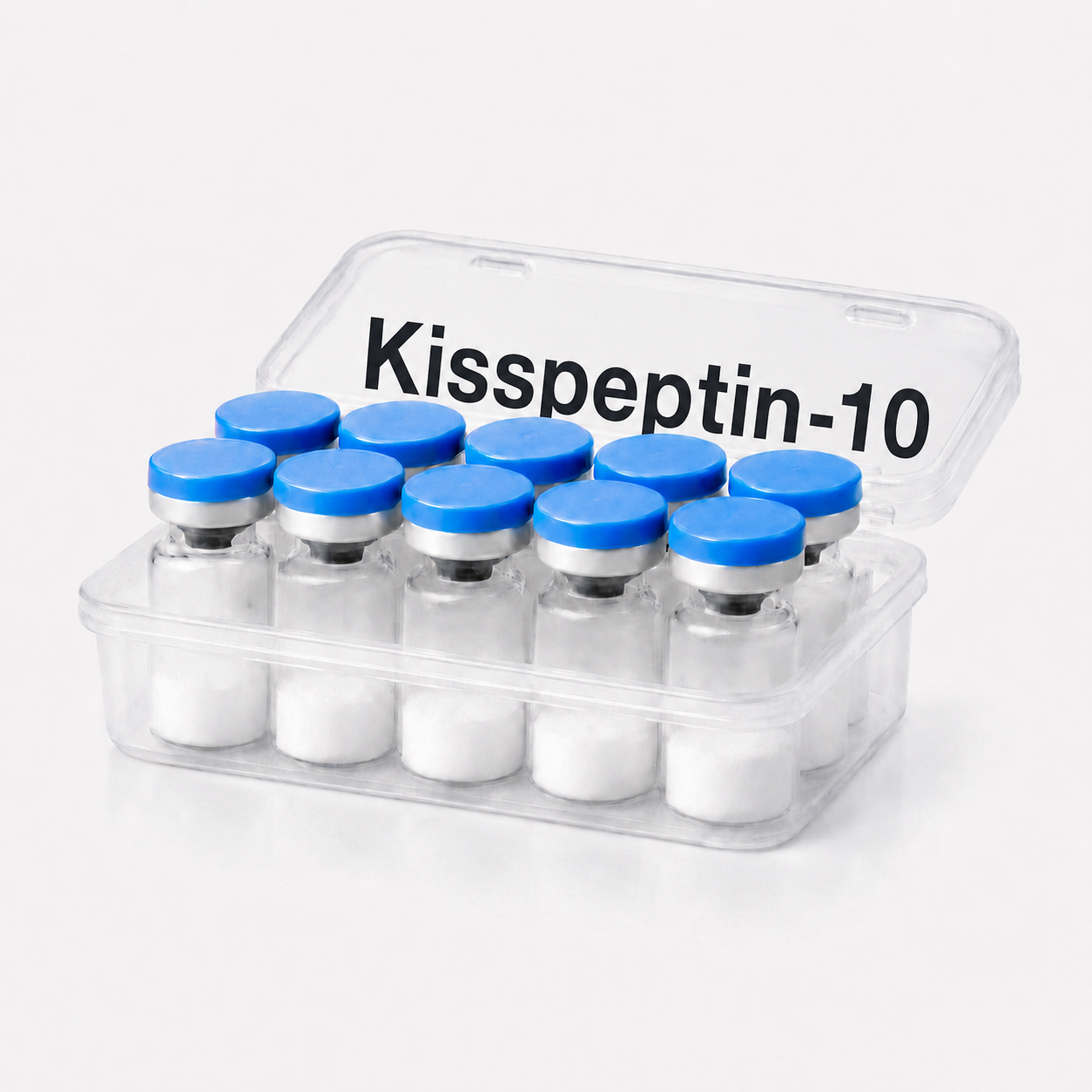
Buy Kisspeptin-10 Peptide | Trusted HPG Axis Research Decapeptide | PrimaLab Peptide
Kisspeptin-10 is a decapeptide and the most potent biologically active fragment of Kisspeptin-54 — a neuropeptide encoded by the KISS1 gene and recognised as a master upstream regulator of the hypothalamic-pituitary-gonadal (HPG) axis. Researchers who buy Kisspeptin-10 peptide use it to investigate GnRH pulse generation, LH and FSH secretion dynamics, puberty onset mechanisms, reproductive endocrinology, and neuroendocrine feedback loop research in in vitro and preclinical models. PrimaLab Peptide supplies research-grade Kisspeptin-10 at 99.36% purity, independently verified by Janoshik Analytical via HPLC, NMR, and mass spectrometry, with a full batch-specific Certificate of Analysis included with every order.
What Is Kisspeptin-10?
Kisspeptin-10 is the C-terminal decapeptide fragment of Kisspeptin-54 (also known as metastin), a neuropeptide encoded by the KISS1 gene — originally identified as a metastasis suppressor gene before its central role in neuroendocrine reproductive regulation was established. Kisspeptin-10 represents the shortest biologically active fragment of the kisspeptin family, retaining full agonist activity at the kisspeptin receptor (KISS1R / GPR54) while offering a significantly shorter half-life than the parent Kisspeptin-54 molecule.
The complete amino acid sequence of Kisspeptin-10 is:
Tyr-Asn-Trp-Asn-Ser-Phe-Gly-Trp-Leu-Met-NH₂
This specific C-terminal sequence — particularly the RF-amide motif common to kisspeptin family members — is essential for KISS1R receptor binding and GnRH-stimulating activity. Any sequence alteration changes biological activity in research models, which is why amino acid sequence verification by mass spectrometry is a mandatory component of Janoshik’s analytical process for every Kisspeptin-10 batch. A comprehensive review of KISS1 biology and kisspeptin’s role in HPG axis regulation is available through NIH-published research on Kisspeptin and the HPG axis.
Kisspeptin-10 Research Applications
Kisspeptin-10’s position as the master upstream trigger of GnRH pulse generation makes it one of the most important research tools in reproductive neuroendocrinology. Its shorter half-life compared to Kisspeptin-54 makes it particularly well-suited for acute response studies requiring precise experimental windows without prolonged receptor activation. Published research on PubMed has examined Kisspeptin-10 across the following research areas:
- GnRH pulse generation research: Kisspeptin-10 acts on hypothalamic GnRH neurons via KISS1R to trigger GnRH secretion — the upstream initiating event in the HPG axis cascade. Research has examined both the acute GnRH pulse response to Kisspeptin-10 and the sustained regulation of GnRH pulse frequency and amplitude
- LH and FSH secretion dynamics: Downstream of GnRH stimulation, studies have examined the LH and FSH secretory responses to Kisspeptin-10 in research models, making it a valuable tool for studying gonadotropin secretion patterns and pituitary responsiveness
- Puberty onset and timing research: KISS1 gene expression increases dramatically at puberty onset, and Kisspeptin-10 has been extensively studied in research models investigating the neuroendocrine mechanisms of puberty initiation and the role of kisspeptin signalling in pubertal timing
- Reproductive cycle research: Studies have examined Kisspeptin-10’s role in generating the preovulatory LH surge and its cyclical regulation by sex steroid feedback — key mechanisms in reproductive cycle research
- Metabolic-reproductive axis research: Research has explored the intersection of energy homeostasis and reproductive function through kisspeptin pathways, studying how nutritional status and metabolic signals modulate KISS1R signalling and HPG axis activity
- Neuroendocrine feedback loop research: Kisspeptin neurons in the arcuate nucleus (KNDy neurons co-expressing kisspeptin, neurokinin B, and dynorphin) serve as the GnRH pulse generator, making Kisspeptin-10 a key research tool for pulse generation mechanism studies
- Comparative HPG axis research: Kisspeptin-10 is frequently studied alongside HCG (LH receptor agonist for gonadal steroidogenesis research) and Oxytocin Acetate (neuroendocrine reproductive signalling) in comprehensive HPG and neuroendocrine research programs
Kisspeptin-10 vs. Kisspeptin-54 — Research Design Considerations
Researchers choosing between Kisspeptin-10 and the parent Kisspeptin-54 peptide should consider the following research-relevant differences:
- Potency: Kisspeptin-10 is the most potent active fragment of the kisspeptin family at the KISS1R receptor — it retains full receptor agonist activity in research models despite being substantially smaller than Kisspeptin-54
- Half-life: Kisspeptin-10 has a significantly shorter half-life than Kisspeptin-54, making it preferable for acute response studies requiring precise experimental timing and clean data without prolonged receptor activation artefacts
- Research applications: Kisspeptin-10’s shorter half-life is a research design feature — it allows precise temporal control of KISS1R activation windows, making it ideal for pulse generation studies, acute LH surge research, and protocols where receptor activation timing must be tightly controlled
Purity & Third-Party Testing
Every batch of Kisspeptin-10 supplied by PrimaLab Peptide is independently tested by Janoshik Analytical using a comprehensive three-method analytical approach:
- HPLC (High-Performance Liquid Chromatography) — quantitative purity determination confirmed at 99.36%
- NMR (Nuclear Magnetic Resonance Spectroscopy) — structural confirmation of amino acid composition and sequence integrity
- Mass Spectrometry — molecular identity and molecular weight verification, confirming correct decapeptide sequence
The triple analytical approach — HPLC purity + NMR structural confirmation + MS identity — represents a higher level of batch characterisation than HPLC alone, ensuring that the Kisspeptin-10 supplied matches both the correct amino acid sequence and the expected purity standard. The batch-specific COA is included with every order and can be cross-referenced directly on the Janoshik database using the batch number on your vial.
Reconstitution Protocol
Correct reconstitution technique is as important as correct storage for maintaining Kisspeptin-10 research utility:
- Materials preparation: Gather sterile bacteriostatic water, sterile insulin syringes, and alcohol swabs before beginning. Clean vial tops with an alcohol swab before every puncture
- Calculate your dilution: A standard starting point is 1mL of Bacteriostatic Water per 5mg peptide, yielding 500µg per 0.1mL working concentration. Always verify target concentration against your specific protocol requirements
- Add solvent to the vial wall: Inject solvent slowly down the inside glass wall of the vial — never spray directly onto the lyophilized powder cake, which causes aggregation and incomplete dissolution
- Dissolve gently: Swirl the vial gently until fully dissolved — do not shake or vortex. Mechanical agitation damages peptide structure. Allow 2–3 minutes for complete dissolution
- Inspect: The reconstituted solution should be clear and colourless. Cloudiness or particulates indicate a problem — review solvent choice and storage conditions
Storage Guidelines
- Lyophilized (sealed): −20°C, away from light and moisture. Stable for up to 24 months under correct conditions
- After reconstitution: 2–8°C (standard lab refrigerator). Use within 4 weeks
- Freeze-thaw cycles: Avoid — each cycle degrades peptide integrity. Aliquot before freezing if multiple uses are required from the same batch
- Planning: Reconstitute only the volume needed for your research window to minimise waste and freeze-thaw exposure
Product Specifications
| Product Name | Kisspeptin-10 |
| Sequence | Tyr-Asn-Trp-Asn-Ser-Phe-Gly-Trp-Leu-Met-NH₂ |
| Source Gene | KISS1 |
| Purity | 99.36% (Janoshik HPLC + NMR + Mass Spectrometry verified) |
| Form | Lyophilized powder |
| Available Sizes | 5mg, 10mg |
| Storage (lyophilized) | −20°C, protected from light and moisture |
| Storage (reconstituted) | 2–8°C, use within 4 weeks |
| Reconstitution | Bacteriostatic Water (BAC Water) |
| Testing Methods | HPLC, NMR, Mass Spectrometry (Janoshik Analytical) |
| COA | Batch-specific — included with every order |
| Intended Use | In-vitro laboratory research only |
Frequently Asked Questions — Kisspeptin-10
What is Kisspeptin-10 used for in research?
Researchers who buy Kisspeptin-10 peptide use it to investigate GnRH pulse generation mechanisms, LH and FSH secretion dynamics, puberty onset and timing research, reproductive cycle neuroendocrinology, metabolic-reproductive axis interactions, and KNDy neuron pulse generator biology. Its shorter half-life compared to Kisspeptin-54 makes it ideal for acute response studies requiring precise experimental windows. A comprehensive literature base is available on PubMed.
Why is Kisspeptin-10 more useful than Kisspeptin-54 for acute research studies?
Kisspeptin-10’s significantly shorter half-life compared to Kisspeptin-54 allows researchers to study acute KISS1R-mediated GnRH and LH responses with precise temporal control — receptor activation terminates within a defined experimental window without prolonged artefactual stimulation. This makes Kisspeptin-10 the preferred tool for pulse generation research, acute LH surge studies, and protocols requiring clean data from well-defined stimulation periods.
How is Kisspeptin-10 from PrimaLab Peptide verified?
Every batch is independently verified by Janoshik Analytical using three analytical methods: HPLC (purity at 99.36%), NMR (structural sequence confirmation), and mass spectrometry (molecular identity verification). The batch-specific COA is included with every order and cross-referenceable directly on the Janoshik database using the batch number from your vial.
What peptides are studied alongside Kisspeptin-10 in HPG axis research?
Researchers frequently explore complementary neuroendocrine and reproductive axis compounds from PrimaLab Peptide including HCG (LH receptor agonist for downstream gonadal steroidogenesis research), Oxytocin Acetate (neuroendocrine and reproductive behaviour research), and Semax and Selank for broader neuroendocrine peptide research. Browse the Nootropic & Neuro Peptides category for the full range.
What is the correct reconstitution ratio for Kisspeptin-10?
A standard starting point is 1mL of Bacteriostatic Water per 5mg of Kisspeptin-10, yielding a working concentration of 500µg per 0.1mL. The correct volume depends on the target concentration required for your specific research protocol. Always verify against your assay requirements and current published literature for your application before proceeding.
How long is Kisspeptin-10 stable after reconstitution?
Reconstituted Kisspeptin-10 stored at 2–8°C with proper aseptic technique is stable for approximately 4 weeks. For longer storage, aliquot into single-use volumes and freeze at −20°C — but avoid repeated freeze-thaw cycles as each cycle degrades peptide integrity. Always label vials with reconstitution date and concentration, and discard any solution that appears cloudy or discoloured.
Related Research Peptides
Researchers buying Kisspeptin-10 peptide for HPG axis and neuroendocrine research frequently explore:
- HCG (Human Chorionic Gonadotropin) — LH receptor agonist for downstream gonadal steroidogenesis and reproductive endocrinology research
- Oxytocin Acetate — nonapeptide neuropeptide for social behaviour, neuroendocrine, and reproductive biology research
- Semax — ACTH analogue for BDNF modulation and neuroprotective pathway research
- Selank — tuftsin analogue for GABAergic and anxiolytic mechanism research
- Sermorelin Acetate — GHRH(1-29) analogue for comparative neuroendocrine axis research
Browse our complete Nootropic & Neuro Peptides category. Bulk researchers can apply for discounted rates through our Wholesale Portal. Reconstitute with BAC Water, available in our Accessories & Reconstitution Supplies section.
⚠️ For in-vitro laboratory research use only. Not intended for human or veterinary consumption. Not a drug, supplement, food, or medical treatment. Researchers are solely responsible for compliance with all applicable local, national, and international regulations governing the purchase, storage, and use of research compounds.
Reviews
There are no reviews yet.