
Semaglutide vs Tirzepatide vs Retatrutide — A Researcher’s Guide to 3 GLP-1 Class Peptides
Semaglutide Tirzepatide Retatrutide research represents the fastest-evolving area of metabolic peptide science. This complete guide compares all three compounds — their receptor profiles, mechanisms, research applications, and what makes each one the right tool for specific research designs.
📁 Compound Spotlights |
⏱ 10 min read
Semaglutide Tirzepatide Retatrutide research is currently one of the most active and rapidly expanding areas in metabolic peptide science. All three compounds target the GLP-1 receptor — but they differ fundamentally in which additional receptors they engage, producing distinct pharmacological profiles that make each compound the right tool for different research designs. Choosing the wrong compound for your research question produces data that answers the wrong question.
This guide covers the receptor profiles, structural features, published research applications, and research design considerations for all three compounds — helping researchers select the most appropriate tool for their specific metabolic research question. All three compounds are available from PrimaLab Peptide with independent Janoshik Analytical COA documentation included with every order.
Table of Contents
Understanding the GLP-1 Receptor Agonist Research Class
GLP-1 (Glucagon-Like Peptide-1) is an incretin hormone secreted by intestinal L-cells in response to nutrient ingestion. It activates the GLP-1 receptor (GLP-1R) — a Gs-coupled G protein-coupled receptor (GPCR) expressed in the pancreas, gastrointestinal tract, brain, and heart — stimulating glucose-dependent insulin secretion, suppressing glucagon release, slowing gastric emptying, and activating central appetite suppression pathways.
Native GLP-1 has a half-life of only 1–2 minutes in vivo due to rapid DPP-IV cleavage — making it impractical as a research tool for anything beyond acute signalling studies. All three compounds in this comparison — Semaglutide, Tirzepatide, and Retatrutide — incorporate structural modifications for DPP-IV resistance and albumin binding to extend their research utility. What distinguishes them is which additional receptors they engage beyond GLP-1R.
🔬 The Core Research Question
All three compounds share GLP-1R agonism as a common mechanism. The research question that differentiates them is: what does each additional receptor contribute? Semaglutide answers what GLP-1R alone does. Tirzepatide adds GIP receptor. Retatrutide adds both GIP receptor and glucagon receptor. Systematic comparison across all three isolates individual receptor contributions to metabolic outcomes.
A comprehensive overview of GLP-1 receptor signalling biology is available through NIH-published research on GLP-1 receptor biology.
Semaglutide — The GLP-1R Single Agonist Reference Standard
Semaglutide is a 31-amino acid synthetic GLP-1 receptor agonist sharing approximately 94% structural similarity with endogenous human GLP-1. In Semaglutide Tirzepatide Retatrutide research, Semaglutide serves as the essential single-receptor GLP-1R reference standard — the baseline against which the additional receptor contributions of Tirzepatide and Retatrutide are measured.
Semaglutide Quick Specs
| Receptor Target | GLP-1R only — single agonist |
| CAS Number | 910463-68-2 |
| Molecular Weight | 4113.58 g/mol |
| Half-Life | ~1 week (albumin-bound) |
| Key Modification | Aib at position 2 + C18 fatty diacid at Lys26 |
| Purity (PrimaLab) | ≥98% — Janoshik HPLC + MS verified |
Semaglutide Research Applications
- GLP-1R binding kinetics research — the primary tool for studying GLP-1 receptor pharmacology, binding affinity, and receptor occupancy dynamics
- cAMP/PKA/EPAC signalling cascade research — downstream GLP-1R Gs-coupled signalling in pancreatic beta cells, gut enteroendocrine cells and CNS neurons
- Glucose-dependent insulin secretion research — GLP-1R-mediated beta cell insulin secretion in a glucose-dependent manner
- Central satiety and appetite pathway research — hypothalamic and brainstem GLP-1R-mediated appetite suppression signalling
- Reference comparator research — the essential GLP-1R-only baseline for comparative multi-receptor agonist studies with Tirzepatide and Retatrutide
Tirzepatide — Dual GIP/GLP-1R Agonist
Tirzepatide is a 39-amino acid dual agonist simultaneously targeting the GIP receptor (GIPR) and GLP-1R. In Semaglutide Tirzepatide Retatrutide research, Tirzepatide answers a specific research question: what does GIP receptor engagement add to GLP-1R agonism? By comparing Tirzepatide against Semaglutide (GLP-1R only), researchers can isolate the specific metabolic contribution of GIP receptor co-activation.
Tirzepatide Quick Specs
| Receptor Targets | GIP receptor + GLP-1R — dual agonist |
| Molecular Weight | ~4813.5 Da |
| Amino Acids | 39 |
| Sequence Base | GIP peptide backbone (not GLP-1 backbone) |
| Key Modification | Aib at position 2 + C18 fatty acid for albumin binding |
| Purity (PrimaLab) | ≥99.36% — Janoshik HPLC + MS verified |
What GIP Receptor Engagement Adds to Research
The GIP receptor (GIPR) is expressed in pancreatic beta cells, adipose tissue, bone, and CNS neurons — a distribution that partially overlaps with but is distinct from GLP-1R expression. Key research areas where GIP receptor engagement produces effects beyond GLP-1R agonism alone:
- Incretin synergy research — whether GIP + GLP-1 receptor co-activation produces additive or synergistic insulin secretion effects compared to GLP-1R alone
- Adipose tissue metabolism research — GIPR is expressed in adipocytes, enabling research into fat storage and lipolytic mechanisms not accessible to GLP-1R-only agonists
- Bone metabolism research — GIP receptor is expressed in osteoblasts and osteoclasts, making Tirzepatide a research tool for studying bone turnover effects not shared by Semaglutide
- Central dual incretin pathway research — both GIPR and GLP-1R are expressed in hypothalamic appetite circuits, allowing study of dual central incretin effects on satiety signalling
Retatrutide — Triple GLP-1R/GIP/Glucagon Receptor Agonist
Retatrutide (LY3437943) is the most pharmacologically comprehensive compound in Semaglutide Tirzepatide Retatrutide research — simultaneously activating GLP-1R, GIP receptor, and the glucagon receptor (GcgR). Developed by Eli Lilly and first described in peer-reviewed literature in 2022–2023, Retatrutide adds glucagon receptor engagement to the dual GIP/GLP-1R pharmacology of Tirzepatide — producing a distinct metabolic research profile driven by the unique biology of glucagon receptor activation.
Retatrutide Quick Specs
| Receptor Targets | GLP-1R + GIP receptor + GcgR — triple agonist |
| Also Known As | LY3437943 |
| CAS Number | 2381910-47-8 |
| Molecular Weight | ~4891 Da |
| Key Modification | Dual Aib (positions 2 & 13) + C18 fatty diacid at Lys16 |
| Purity (PrimaLab) | ≥99% — Janoshik HPLC + MS verified |
What Glucagon Receptor Engagement Adds to Research
The glucagon receptor (GcgR) is expressed primarily in the liver, adipose tissue, and brown adipose tissue — producing metabolic effects that are distinct from and complementary to both GLP-1R and GIPR activation. Key areas where GcgR engagement in Retatrutide produces research effects beyond Tirzepatide:
- Energy expenditure research — glucagon receptor activation stimulates thermogenesis through brown adipose tissue activation and increases resting energy expenditure — effects not produced by GLP-1R or GIPR activation alone
- Hepatic glucose and lipid metabolism research — GcgR activation increases hepatic glucose output and fatty acid oxidation. In the context of concurrent GLP-1R insulin secretion stimulation, the net hepatic metabolic balance of triple receptor co-activation is a key Retatrutide research question
- Fatty acid oxidation research — glucagon receptor engagement stimulates hepatic and adipose fatty acid oxidation through ACC phosphorylation mechanisms complementary to AMPK-mediated FAO pathways
- Triple receptor contribution isolation — comparing Retatrutide against Tirzepatide allows systematic isolation of the glucagon receptor contribution to metabolic outcomes — the defining comparative research application of the triple agonist in Semaglutide Tirzepatide Retatrutide research programs
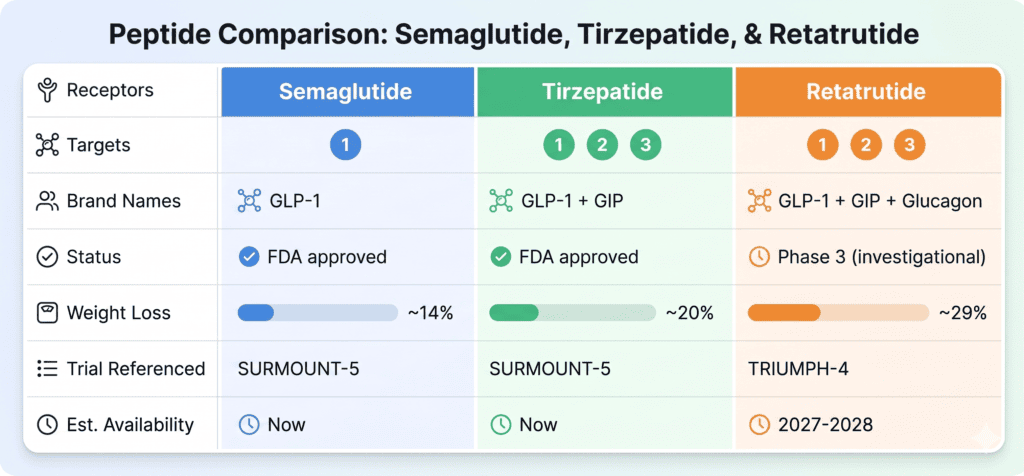
Head-to-Head Comparison — Semaglutide vs Tirzepatide vs Retatrutide
The following table summarises the key differences across all three compounds for quick reference in Semaglutide Tirzepatide Retatrutide research design:
Which Compound for Which Research Design?
Selecting the correct compound in Semaglutide Tirzepatide Retatrutide research depends entirely on the specific research question being investigated. Here is a practical guide for matching compound to research design:
Use Semaglutide when:
- Your research question is specifically about GLP-1R biology — binding kinetics, receptor pharmacology, downstream cAMP/PKA signalling
- You need a GLP-1R-only reference comparator to isolate the GLP-1R contribution in multi-receptor agonist studies
- Your protocol requires the longest-established, most characterised GLP-1R research tool
- You are studying GLP-1R-mediated central appetite and satiety pathways without GIP receptor confounders
Use Tirzepatide when:
- Your research question requires dual GIP receptor + GLP-1R co-activation — incretin synergy research, adipose GIPR biology, or bone metabolism research
- You are comparing dual GIP/GLP-1R agonism against GLP-1R-only agonism (Semaglutide) to isolate the GIP receptor contribution
- Your protocol requires the most established dual agonist with the most extensive published research foundation
- You are studying adipose tissue biology through GIPR pathways not accessible to Semaglutide
Use Retatrutide when:
- Your research requires simultaneous GLP-1R + GIP receptor + glucagon receptor co-activation — the most comprehensive metabolic receptor combination
- You are studying energy expenditure and thermogenesis through glucagon receptor pathways not engaged by Semaglutide or Tirzepatide
- You are comparing triple agonism against Tirzepatide to isolate the glucagon receptor contribution to metabolic outcomes
- Your protocol covers hepatic glucose and lipid metabolism through combined GLP-1R insulin stimulation and GcgR hepatic glucose output effects
Use all three together when:
- Your research program systematically dissects individual receptor pathway contributions — using Semaglutide as GLP-1R baseline, Tirzepatide to add GIP receptor, and Retatrutide to add glucagon receptor
- You are conducting comparative multi-receptor agonist research requiring the full panel for complete pathway isolation
- Your institution is building a comprehensive metabolic peptide research program covering the full incretin/glucagon receptor agonist landscape
Also Consider in Your Metabolic Research Program
- Mazdutide (IBI-362) — dual GLP-1R + glucagon receptor agonist — the GLP-1R/GcgR combination without GIP receptor, distinct from both Tirzepatide and Retatrutide
- Cagri+Sema Blend — amylin receptor + GLP-1R dual pathway — a completely different receptor class combination adding amylin/calcitonin receptor biology to GLP-1R research
- Cagrilitide — long-acting amylin analogue — for standalone amylin receptor biology research as a complement to GLP-1R agonist studies
Storage & Reconstitution for All Three Compounds
All three compounds share the same storage and reconstitution requirements — reflecting their common structural features as acylated GLP-1 class peptides:
Note on dissolution: All three compounds carry C18 fatty diacid acylation enabling albumin binding. This
acylation may cause slower initial dissolution compared to unacylated peptides — allow up to 10 minutes for complete dissolution, swirling gently throughout. Do not interpret slow dissolution as a quality issue. See our complete guide: How to Reconstitute Peptides in 9 Simple Steps.
Order Semaglutide, Tirzepatide & Retatrutide from PrimaLab Peptide
All three available with independent Janoshik COA documentation. 98–99.36% purity verified. Worldwide tracked shipping.
⚠️ Research Use Disclaimer: All products referenced in this article are intended exclusively for in-vitro laboratory research purposes only. They are not approved by any regulatory authority for human or veterinary use. Nothing in this article constitutes medical advice, diagnosis, or treatment recommendations. Researchers are solely responsible for compliance with all applicable local regulations governing the purchase, storage and use of research compounds.