
Buy Benzyl Alcohol 0.9% | Pure Bacteriostatic Preservative for Peptide Reconstitution | PrimaLab Peptide
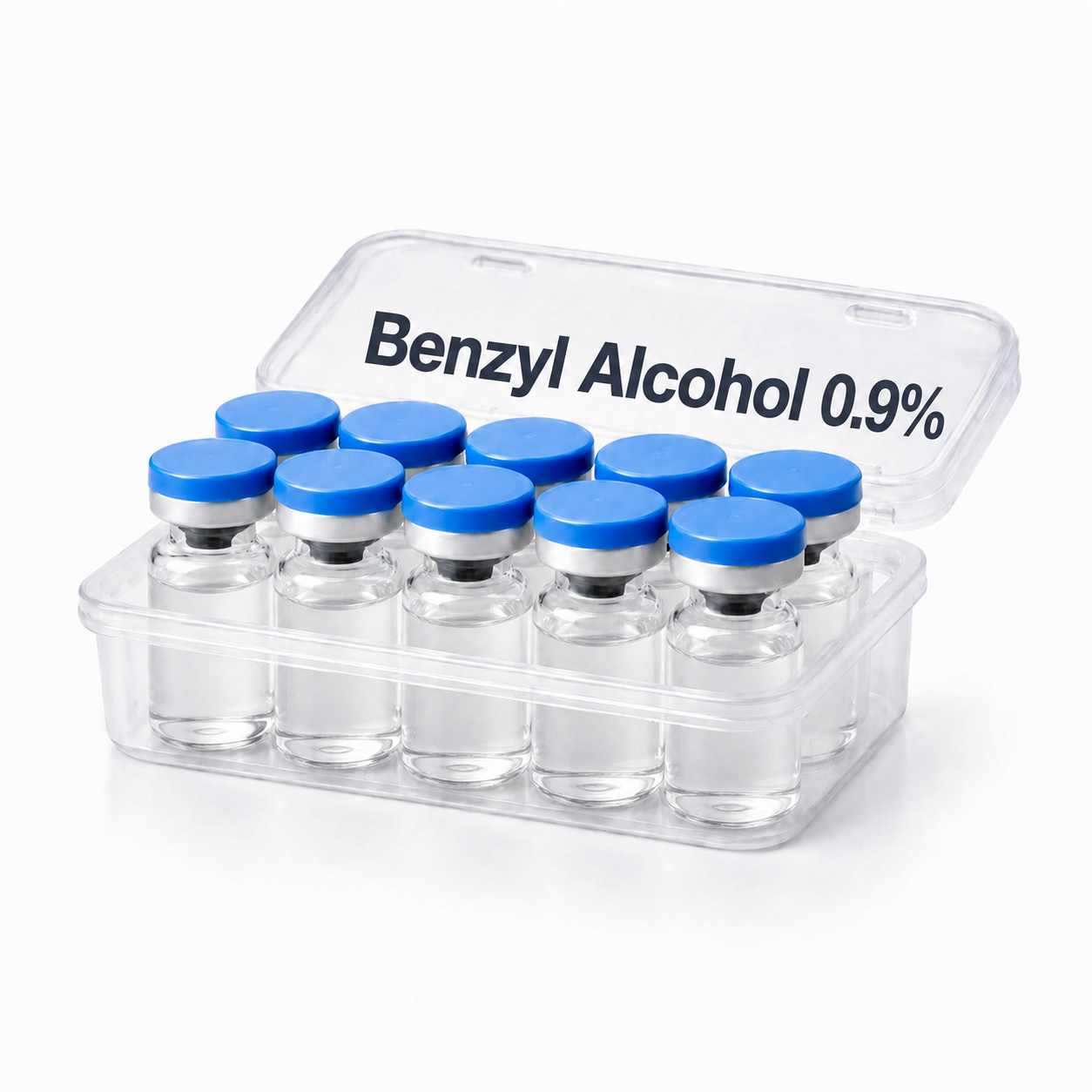
Benzyl Alcohol 0.9% is a research-grade bacteriostatic preservative solution used for peptide reconstitution and multi-dose research vial preparation. When researchers buy benzyl alcohol for peptide reconstitution, they are choosing the active preservative component that makes multi-use peptide vials viable — the same bacteriostatic mechanism at the core of standard BAC Water (Bacteriostatic Water), supplied here as a standalone sterile solution in a clean Water for Injection (WFI) base with no saline additives. PrimaLab Peptide supplies Benzyl Alcohol 0.9% at ≥99.2% purity, independently verified by Janoshik Analytical, with a full batch-specific Certificate of Analysis available with every order.
What Is Benzyl Alcohol 0.9% and How Does It Work?
Benzyl Alcohol (C₇H₈O / PhCH₂OH, CAS: 100-51-6) is an aromatic alcohol widely used as a bacteriostatic preservative in pharmaceutical and research applications. At a concentration of 0.9% (v/v) in sterile Water for Injection, it inhibits bacterial cell membrane function and disrupts microbial metabolic activity — effectively preventing bacterial proliferation in reconstituted peptide solutions without the aggressive antimicrobial action that would damage delicate peptide sequences.
This bacteriostatic mechanism is what enables researchers to draw from the same reconstituted peptide vial multiple times over days or weeks — a practical necessity in most laboratory research workflows involving lyophilized peptide powders. Without benzyl alcohol preservation, reconstituted peptide solutions must be treated as single-use to avoid microbial contamination of the research sample. A detailed review of benzyl alcohol’s pharmacological properties and preservative mechanism is available in the NIH PubChem compound record for Benzyl Alcohol.
Benzyl Alcohol 0.9% vs. Standard BAC Water — What Is the Difference?
Both products contain 0.9% benzyl alcohol as the bacteriostatic agent. However, there are meaningful differences relevant to research protocol design:
- Base solution: PrimaLab Peptide’s Benzyl Alcohol 0.9% uses Water for Injection (WFI) as the base — no saline, no sodium chloride additives. This produces a cleaner formulation suitable for a wider range of peptide reconstitution applications where ionic content must be minimised
- Standard BAC Water from pharmacy or hospital sources sometimes uses 0.9% NaCl saline as the base rather than WFI, introducing ionic content that can affect certain assay systems and peptide solubility profiles
- Concentration consistency: Commercial BAC water from non-research sources is often unlabelled by exact benzyl alcohol concentration. PrimaLab Peptide’s Benzyl Alcohol 0.9% is independently verified at precisely 0.9% (v/v) by Janoshik Analytical — every batch, every time
- Use case: Benzyl Alcohol 0.9% is particularly suited to custom reconstitution buffer preparation, multi-dose research vial formulation, and situations where researchers need direct control over the exact composition of their reconstitution vehicle
For standard peptide reconstitution where a pre-prepared all-in-one solvent is preferred, use BAC Water. For peptides requiring acidic reconstitution conditions such as IGF-1 LR3, use Acetic Acid Water 0.6%.
Research Peptide Reconstitution With Benzyl Alcohol 0.9%
Correct technique when using Benzyl Alcohol 0.9% for peptide reconstitution is identical in principle to standard BAC Water reconstitution protocol. Researchers buying benzyl alcohol for peptide reconstitution should follow these steps:
- Prepare a clean workspace: Use a laminar flow environment or sanitised workspace. Use sterile needles and syringes throughout. Aseptic technique is mandatory at every step to maintain both peptide and solvent sterility
- Equilibrate the peptide vial: Allow the sealed lyophilized peptide vial to reach room temperature before puncturing. Cold sealed vials can create internal pressure issues when the septum is pierced
- Draw the required volume: Using a clean sterile syringe, draw the required volume of Benzyl Alcohol 0.9% from the septum vial. Standard starting ratio is 1–2 mL per 5mg peptide vial — always verify against your specific protocol
- Inject along the vial wall: Insert the needle into the peptide vial and slowly inject the benzyl alcohol solution down the inside wall — never directly onto the lyophilized powder cake, which causes aggregation and incomplete dissolution
- Swirl gently — never shake: Gently swirl or invert the vial to dissolve the powder. Vigorous shaking introduces air bubbles, causes foaming, and risks peptide structural damage. Allow 2–5 minutes for full dissolution
- Inspect and label: The solution should be clear and colourless. Label the vial with reconstitution date, concentration, and compound identity. Store according to your specific peptide’s stability requirements
General guidance on peptide reconstitution best practices is available through the Sigma-Aldrich peptide solubilisation technical reference.
Purity & Third-Party Testing
Preservative concentration consistency matters in research. Benzyl alcohol at concentrations significantly above 0.9% can affect cell viability in sensitive in vitro assay systems. Below effective concentration, bacteriostatic protection is compromised. PrimaLab Peptide supplies Benzyl Alcohol 0.9% with independent concentration and purity verification through Janoshik Analytical:
- Purity: ≥99.2% confirmed by HPLC
- Concentration: 0.9% (v/v) — independently verified, not supplier-declared only
- Identity: Confirmed by mass spectrometry (CAS: 100-51-6, MW: 108.14 g/mol)
The Janoshik COA is batch-specific and available on request. Every batch we stock is independently tested before dispatch.
Product Specifications
| Product Name | Benzyl Alcohol 0.9% |
| Chemical Name | Benzyl Alcohol (Phenylmethanol) |
| Formula | C₇H₈O (PhCH₂OH) |
| CAS Number | 100-51-6 |
| Concentration | 0.9% (v/v) in Water for Injection (WFI) |
| Purity | ≥99.2% (Janoshik HPLC + Mass Spectrometry verified) |
| Form | Sterile aqueous solution |
| Appearance | Clear, colourless liquid |
| pH Range | 4.5–7.0 |
| Vial Type | Multi-dose sterile septum vial |
| Storage | 15°C–25°C, away from direct light |
| Testing Lab | Janoshik Analytical |
| COA | Available per batch — Janoshik verified |
| Intended Use | Laboratory research purposes only — not for human use |
Frequently Asked Questions — Benzyl Alcohol 0.9%
What is Benzyl Alcohol 0.9% used for in peptide research?
Researchers who buy benzyl alcohol for peptide reconstitution use it as a bacteriostatic preservative in custom reconstitution buffer preparation and multi-dose research vial formulation. The 0.9% benzyl alcohol concentration inhibits bacterial proliferation in reconstituted peptide solutions, enabling multiple draws from the same vial over days to weeks without microbial contamination — provided aseptic technique is maintained. It is also used when researchers need precise control over reconstitution buffer composition without saline additives present in some commercial BAC water products.
How is Benzyl Alcohol 0.9% different from standard BAC Water?
Both products use 0.9% benzyl alcohol as the bacteriostatic agent. The key differences are the base solution and concentration verification. PrimaLab Peptide’s Benzyl Alcohol 0.9% uses a clean Water for Injection (WFI) base with no saline or sodium chloride additives, making it suitable for a wider range of assay systems where ionic content matters. Commercial BAC water from some sources uses 0.9% NaCl saline as the base and may not specify exact benzyl alcohol concentration. Our product is independently verified at precisely 0.9% (v/v) by Janoshik Analytical every batch. For a pre-prepared all-in-one reconstitution solvent, see BAC Water.
Is PrimaLab Peptide’s Benzyl Alcohol 0.9% independently tested?
Yes. Every batch is verified by Janoshik Analytical at ≥99.2% purity via HPLC, with mass spectrometry identity confirmation and independent benzyl alcohol concentration verification at 0.9% (v/v). The batch-specific COA is available on request. Concentration consistency is particularly important in research — benzyl alcohol above effective concentrations can affect cell viability in sensitive in vitro systems.
Can Benzyl Alcohol 0.9% be used for all research peptides?
Benzyl Alcohol 0.9% in WFI is compatible with the majority of standard research peptide sequences. However, it is not appropriate for peptides requiring acidic reconstitution conditions — particularly IGF-1 LR3, for which Acetic Acid Water 0.6% is recommended. Always verify the recommended reconstitution solvent in your specific peptide’s protocol documentation before use.
How should Benzyl Alcohol 0.9% be stored?
Store at 15°C–25°C away from direct light. Unlike BAC Water, which is stored refrigerated at 2–8°C, Benzyl Alcohol 0.9% is stored at controlled room temperature. Do not freeze. Inspect for clarity and absence of particulates before each use — the solution should remain clear and colourless throughout its shelf life.
What is the standard reconstitution ratio when using Benzyl Alcohol 0.9%?
A commonly used starting ratio is 1–2 mL of Benzyl Alcohol 0.9% per 5mg peptide vial, producing a working concentration of 2.5–5 mg/mL. However, the correct volume depends entirely on the target concentration required for your specific research protocol and the mass of peptide in the vial. Always verify against your compound-specific reconstitution documentation and published literature for your particular peptide.
Related Reconstitution Supplies
PrimaLab Peptide supplies a complete range of reconstitution solvents for research peptide preparation:
- BAC Water (Bacteriostatic Water) — pre-prepared 0.9% benzyl alcohol in WFI, the standard all-in-one reconstitution solvent for most research peptides
- Acetic Acid Water 0.6% — recommended reconstitution solvent for IGF-1 LR3 and hydrophobic acid-soluble peptides
Browse our complete Accessories & Reconstitution Supplies category. Laboratory procurement teams and bulk researchers can apply for discounted rates through our Wholesale Portal.
⚠️ For laboratory research use only. Not intended for human or veterinary consumption. Handle in accordance with all applicable institutional safety protocols and regulatory guidelines.
Reviews
There are no reviews yet.